


Indonesia and East Timor yesterday held the first meeting of a truth commission as part of a joint attempt to leave behind the bloodshed and rancor of the 24 years they were bound together.
Indonesian troops invaded the former Portuguese colony of East Timor on Dec. 7, 1975 and then-president Suharto officially annexed it as the country's 27th province on July 17, 1976.
An estimated 100,000 to 200,000 East Timorese died in the early years of the Indonesian occupation, many from starvation or disease, as a guerrilla war raged against Jakarta.
Jakarta's harsh rule came under the international spotlight when troops fired randomly into a pro-democracy rally in Dili's Santa Cruz cemetery, killing at least 100 on Nov. 12, 1991. In the face of continuing international scrutiny, East Timor increasingly became a thorn in Indonesia's side and Jakarta's stance began to soften following the downfall of Suharto on May 21, 1998. The government of his successor B.J. Habibie on Jan. 27, 1999 made a surprise announcement that Jakarta was willing to let East Timor have independence if a broad autonomy offer it had made was rejected.
The UN accordingly began preparations for a self-determination ballot in East Timor which was finally held on Aug. 30.
The run-up to the vote was marked by violence from pro-Jakarta militias. The announcement of the result, with 78.5 percent choosing independence rather than autonomy, triggered an orgy of killing and destruction by the militias.
A UN report in 2000 said Indonesian army personnel had recruited and armed the militias with the intention of swaying the vote. It said troops in some cases were themselves directly involved in intimidation and terror attacks before and after the vote.
The UN says some 1,400 East Timorese were killed before and after the ballot and whole towns were razed. As world outrage grew in the face of Indonesia's failure to stop the killings, a UN-sanctioned peacekeeping force, composed mostly of Australians, arrived in Dili on Sept. 20 and began gradually to reestablish order. Indonesia's top legislature agreed in October 1999 to relinquish East Timor and the UN began to administer the territory until its independence on May 20, 2002.
Faced with international pressure to bring to justice those responsible for the violence, and to deflect demands for an international rights tribunal, president Megawati Sukarnoputri established a human rights court in August 2001.
The court began its first trial on March 14, 2002 and issued its last verdict in August of the following year. All but one of the 18 military and police officers and officials who appeared before it were acquitted, prompting an international outcry.

Republican US lawmakers on Friday criticized US President Joe Biden’s administration after sanctioned Chinese telecoms equipment giant Huawei unveiled a laptop this week powered by an Intel artificial intelligence (AI) chip. The US placed Huawei on a trade restriction list in 2019 for contravening Iran sanctions, part of a broader effort to hobble Beijing’s technological advances. Placement on the list means the company’s suppliers have to seek a special, difficult-to-obtain license before shipping to it. One such license, issued by then-US president Donald Trump’s administration, has allowed Intel to ship central processors to Huawei for use in laptops since 2020. China hardliners
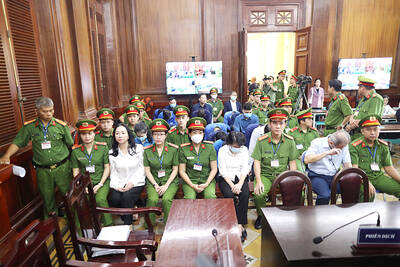
A top Vietnamese property tycoon was on Thursday sentenced to death in one of the biggest corruption cases in history, with an estimated US$27 billion in damages. A panel of three hand-picked jurors and two judges rejected all defense arguments by Truong My Lan, chair of major developer Van Thinh Phat, who was found guilty of swindling cash from Saigon Commercial Bank (SCB) over a decade. “The defendant’s actions ... eroded people’s trust in the leadership of the [Communist] Party and state,” read the verdict at the trial in Ho Chi Minh City. After the five-week trial, 85 others were also sentenced on

‘DELUSIONAL’: Targeting the families of Hamas’ leaders would not push the group to change its position or to give up its demands for Palestinians, Ismail Haniyeh said Israeli aircraft on Wednesday killed three sons of Hamas’ top political leader in the Gaza Strip, striking high-stakes targets at a time when Israel is holding delicate ceasefire negotiations with the militant group. Hamas said four of the leader’s grandchildren were also killed. Ismail Haniyeh’s sons are among the highest-profile figures to be killed in the war so far. Israel said they were Hamas operatives, and Haniyeh accused Israel of acting in “the spirit of revenge and murder.” The deaths threatened to strain the internationally mediated ceasefire talks, which appeared to gain steam in recent days even as the sides remain far
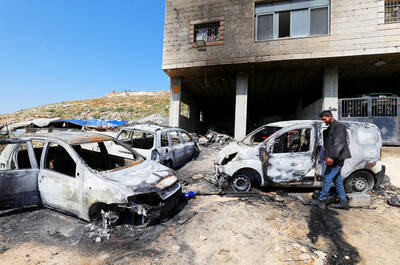
RAMPAGE: A Palestinian man was left dead after dozens of Israeli settlers searching for a missing 14-year-old boy stormed a village in the Israeli-occupied West Bank US President Joe Biden on Friday said he expected Iran to attack Israel “sooner, rather than later” and warned Tehran not to proceed. Asked by reporters about his message to Iran, Biden simply said: “Don’t,” underscoring Washington’s commitment to defend Israel. “We are devoted to the defense of Israel. We will support Israel. We will help defend Israel and Iran will not succeed,” he said. Biden said he would not divulge secure information, but said his expectation was that an attack could come “sooner, rather than later.” Israel braced on Friday for an attack by Iran or its proxies as warnings grew of


 RSS
RSS