


Lebanon's parliament approved a new government by a wide margin Saturday, giving its vote of confidence to the first Cabinet in years to be dominated by anti-Syrian politicians, tasked with tackling economic and security problems and repairing strained ties with Damascus.
Prime Minister Fuad Saniora put together the Cabinet after the anti-Syrian coalition seized a parliament majority in June elections, further crumbling Syria's once overwhelming domination of Lebanon. Syrian troops withdrew from the country in April.
The 128-member Parliament approved the government by a vote of 92-14, with two abstentions. Most of the "no" votes came from anti-Syrian Christian leader General Michel Aoun's parliament bloc. Aoun was left out of Saniora's government. The Cabinet lineup includes for the first time a member of the militant Hezbollah group, which Washington brands a terrorist organization.
Addressing Parliament Saturday before the vote, Saniora renewed his pledge to carry out political reforms and improve relations with Syria, strained after it was forced to end its 29-year military presence in Lebanon.
"We, as a homogenous and united government, are committed to follow the reform path and open up to the young," he said.
"We need reforms. We need security, political, economic and social stability," he said.
Lebanon has seen a string of bomb assassinations targeting mainly anti-Syrian politicians and other figures in recent months. Other bombings targeted shopping and commercial areas in Christian areas, killing three people and injuring more than 40.
One of the toughest challenges facing Saniora's government is how to deal with Syria. Saniora said he would visit Damascus on yesterday for talks with Syrian President Bashar Assad and other officials on improving relations.
After the vote, Saniora said he was "hopeful that we will have excellent discussions to the best of the two countries. Lebanon and Syria are brotherly countries, very friendly."
In past weeks, Syria has clamped what many Lebanese say amounts to a land blockade on its smaller neighbor, holding up hundreds of transit trucks on Lebanese-Syrian border crossings. Syria says the measures are aimed at catching saboteurs and militants but many Lebanese believe Syria is trying to exact revenge following the withdrawal of its troops.

Republican US lawmakers on Friday criticized US President Joe Biden’s administration after sanctioned Chinese telecoms equipment giant Huawei unveiled a laptop this week powered by an Intel artificial intelligence (AI) chip. The US placed Huawei on a trade restriction list in 2019 for contravening Iran sanctions, part of a broader effort to hobble Beijing’s technological advances. Placement on the list means the company’s suppliers have to seek a special, difficult-to-obtain license before shipping to it. One such license, issued by then-US president Donald Trump’s administration, has allowed Intel to ship central processors to Huawei for use in laptops since 2020. China hardliners

Conjoined twins Lori and George Schappell, who pursued separate careers, interests and relationships during lives that defied medical expectations, died this month in Pennsylvania, funeral home officials said. They were 62. The twins, listed by Guinness World Records as the oldest living conjoined twins, died on April 7 at the Hospital of the University of Pennsylvania, obituaries posted by Leibensperger Funeral Homes of Hamburg said. The cause of death was not detailed. “When we were born, the doctors didn’t think we’d make 30, but we proved them wrong,” Lori said in an interview when they turned 50, the Philadelphia Inquirer reported. The
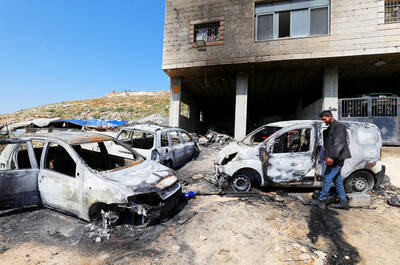
RAMPAGE: A Palestinian man was left dead after dozens of Israeli settlers searching for a missing 14-year-old boy stormed a village in the Israeli-occupied West Bank US President Joe Biden on Friday said he expected Iran to attack Israel “sooner, rather than later” and warned Tehran not to proceed. Asked by reporters about his message to Iran, Biden simply said: “Don’t,” underscoring Washington’s commitment to defend Israel. “We are devoted to the defense of Israel. We will support Israel. We will help defend Israel and Iran will not succeed,” he said. Biden said he would not divulge secure information, but said his expectation was that an attack could come “sooner, rather than later.” Israel braced on Friday for an attack by Iran or its proxies as warnings grew of

IN PURSUIT: Israel’s defense minister said the revenge attacks by Israeli settlers would make it difficult for security forces to find those responsible for the 14-year-old’s death Israeli Prime Minister Benjamin Netanyahu on Saturday condemned the “heinous murder” of an Israeli teenager in the occupied West Bank as attacks on Palestinian villages intensified following news of his death. After Benjamin Achimeir, 14, was reported missing near Ramallah on Friday, hundreds of Jewish settlers backed by Israeli forces raided nearby Palestinian villages, torching vehicles and homes, leaving at least one villager dead and dozens wounded. The attacks escalated in several villages on Saturday after Achimeir’s body was found near the Malachi Hashalom outpost. Agence France-Presse correspondents saw smoke rising from burned houses and fields. Mayor Amin Abu Alyah, of the


 RSS
RSS