


A Japanese high court yesterday upheld a decision to reject a lawsuit aimed at stopping Prime Minister Junichiro Koizumi from visiting a war memorial. The visits are opposed by China and other countries.
The decision upheld a lower court decision against the suit, an official at the Osaka High Court said, speaking on condition of anonymity. It was not immediately clear whether the plaintiffs would appeal to the Supreme Court.
The lawsuit was filed by 339 plaintiffs against the visits to Yasukuni shrine, which honors Japan's war dead, including executed World War II war criminals.
The plaintiffs argued that the visits violated the separation of religion and state. China, South Korea and other countries say the visits give official sanction to Japan's past imperialist ambitions.
The court official refused to offer details of the ruling. But Kyodo News reported that the court said "the rights and benefits the plaintiffs are contesting are vague in concept, and the court cannot find them something that should be protected by law."
The judge did not touch on the constitutionality of Koizumi's visits to Yasukuni, Kyodo said.
The lawsuit is one of several working their way through the justice system aimed at preventing Koizumi from making another visit to Yasukuni. He has visited the shrine four times since taking office in 2001. He has argued that he worships at Yasukuni because of personal beliefs, but he signs the guest book as prime minister.
The shrine honors some 2.5 million Japanese who died in wars starting in the 1860s, but also enshrines men executed for their role in Japan's aggressive policies, such as wartime prime minister Hideki Tojo.
In the earlier decision on the case in February last year, the Osaka District Court refused to rule on the constitutionality of the trip, saying the plaintiffs hadn't suffered any emotional turmoil.

Republican US lawmakers on Friday criticized US President Joe Biden’s administration after sanctioned Chinese telecoms equipment giant Huawei unveiled a laptop this week powered by an Intel artificial intelligence (AI) chip. The US placed Huawei on a trade restriction list in 2019 for contravening Iran sanctions, part of a broader effort to hobble Beijing’s technological advances. Placement on the list means the company’s suppliers have to seek a special, difficult-to-obtain license before shipping to it. One such license, issued by then-US president Donald Trump’s administration, has allowed Intel to ship central processors to Huawei for use in laptops since 2020. China hardliners
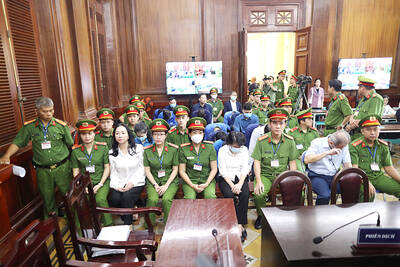
A top Vietnamese property tycoon was on Thursday sentenced to death in one of the biggest corruption cases in history, with an estimated US$27 billion in damages. A panel of three hand-picked jurors and two judges rejected all defense arguments by Truong My Lan, chair of major developer Van Thinh Phat, who was found guilty of swindling cash from Saigon Commercial Bank (SCB) over a decade. “The defendant’s actions ... eroded people’s trust in the leadership of the [Communist] Party and state,” read the verdict at the trial in Ho Chi Minh City. After the five-week trial, 85 others were also sentenced on

‘DELUSIONAL’: Targeting the families of Hamas’ leaders would not push the group to change its position or to give up its demands for Palestinians, Ismail Haniyeh said Israeli aircraft on Wednesday killed three sons of Hamas’ top political leader in the Gaza Strip, striking high-stakes targets at a time when Israel is holding delicate ceasefire negotiations with the militant group. Hamas said four of the leader’s grandchildren were also killed. Ismail Haniyeh’s sons are among the highest-profile figures to be killed in the war so far. Israel said they were Hamas operatives, and Haniyeh accused Israel of acting in “the spirit of revenge and murder.” The deaths threatened to strain the internationally mediated ceasefire talks, which appeared to gain steam in recent days even as the sides remain far

RAMPAGE: A Palestinian man was left dead after dozens of Israeli settlers searching for a missing 14-year-old boy stormed a village in the Israeli-occupied West Bank US President Joe Biden on Friday said he expected Iran to attack Israel “sooner, rather than later” and warned Tehran not to proceed. Asked by reporters about his message to Iran, Biden simply said: “Don’t,” underscoring Washington’s commitment to defend Israel. “We are devoted to the defense of Israel. We will support Israel. We will help defend Israel and Iran will not succeed,” he said. Biden said he would not divulge secure information, but said his expectation was that an attack could come “sooner, rather than later.” Israel braced on Friday for an attack by Iran or its proxies as warnings grew of


 RSS
RSS