


In the six years since NATO bombers forced Yugoslav troops out of this troubled province, progress toward resolving the entrenched enmity here between Serbs and ethnic Albanians has been slow. The UN, which has been administering Kosovo, now wants to broker a deal and step aside.
The negotiations are bound to be painful. Serbs are determined to keep Kosovo, their religious heartland, while ethnic Albanians, who make up 90 percent of the population, demand independence after suffering years of ethnic violence that culminated in the 1998-1999 war.
In one unusual peacemaking effort, a group backed by the British government has brought together eight politicians from two opposing camps -- former Albanian guerrilla leaders on one side, and minority Kosovar Serbs on the other -- for some exercises in getting along.
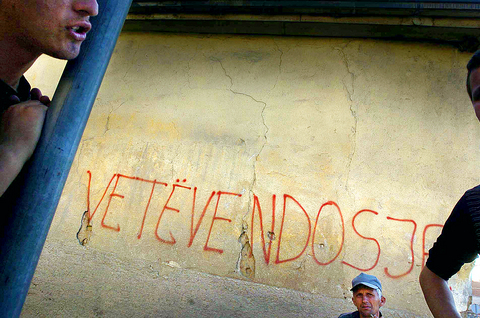
PHOTO: NY TIMES
The group was divided into pairs, an Albanian and a Serb in each. Every day began with 15 minutes of staring into each other's eyes. Then they performed exercises -- including climbing trees together and falling backward into each other's arms -- in which the former guerrilla commanders had to work hand in hand, literally, with their Serbian counterparts.
"We were trying to break their barriers down," said Scarlett MccGwire of the Westminster Foundation for Democracy, the group that organized the meeting.
They wanted to challenge the participants to see one another not as "terrorist" or "oppressor," but as human beings, MccGwire said.
To a surprising degree, the effort worked.
Xhavit Haliti, a founding member of the Kosovo Liberation Army, attended the encounter and found himself won over.
"I would recommend it for all the party leaders," he said.
By the end of week, he said, he and his Serbian counterparts were going out to restaurants together and even shared a sauna.
But as successful as these exercises were, they also point to the tough road ahead in Kosovo, where the majority of each community still barely acknowledges the existence of the other.
Serbs face the possibility of living in an independent Albanian-dominated state. Diplomats say that if Albanians want to achieve anything like independence they will have to give the Serbs basic rights, such as freedom of movement, as well as the right of those refugees who fled the region to return from Serbia.
The framework for the negotiations is still far from clear. The UN has commissioned a report to study if and when talks can start. Despite some Russian and Chinese opposition within the Security Council, most diplomats expect the negotiations to begin by early October. The talks would involve local Albanian and Serb leaders as well as the Serbian government and representatives of the world's leading industrial democracies.
While many Western officials privately acknowledge that independence is perhaps the only solution that the Albanian population will accept, the Serbian government is hoping Kosovo will remain within Serbia, but be granted substantial autonomy.
Talks on Kosovo's final status are seen as inevitable. But UN and NATO officials have concluded that the longer negotiations are put off, the higher the risk for more unrest.

Republican US lawmakers on Friday criticized US President Joe Biden’s administration after sanctioned Chinese telecoms equipment giant Huawei unveiled a laptop this week powered by an Intel artificial intelligence (AI) chip. The US placed Huawei on a trade restriction list in 2019 for contravening Iran sanctions, part of a broader effort to hobble Beijing’s technological advances. Placement on the list means the company’s suppliers have to seek a special, difficult-to-obtain license before shipping to it. One such license, issued by then-US president Donald Trump’s administration, has allowed Intel to ship central processors to Huawei for use in laptops since 2020. China hardliners
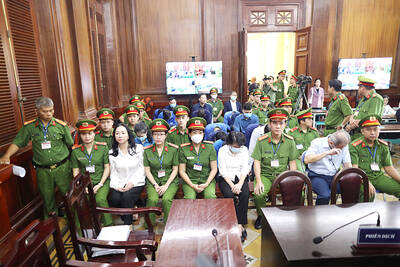
A top Vietnamese property tycoon was on Thursday sentenced to death in one of the biggest corruption cases in history, with an estimated US$27 billion in damages. A panel of three hand-picked jurors and two judges rejected all defense arguments by Truong My Lan, chair of major developer Van Thinh Phat, who was found guilty of swindling cash from Saigon Commercial Bank (SCB) over a decade. “The defendant’s actions ... eroded people’s trust in the leadership of the [Communist] Party and state,” read the verdict at the trial in Ho Chi Minh City. After the five-week trial, 85 others were also sentenced on

‘DELUSIONAL’: Targeting the families of Hamas’ leaders would not push the group to change its position or to give up its demands for Palestinians, Ismail Haniyeh said Israeli aircraft on Wednesday killed three sons of Hamas’ top political leader in the Gaza Strip, striking high-stakes targets at a time when Israel is holding delicate ceasefire negotiations with the militant group. Hamas said four of the leader’s grandchildren were also killed. Ismail Haniyeh’s sons are among the highest-profile figures to be killed in the war so far. Israel said they were Hamas operatives, and Haniyeh accused Israel of acting in “the spirit of revenge and murder.” The deaths threatened to strain the internationally mediated ceasefire talks, which appeared to gain steam in recent days even as the sides remain far
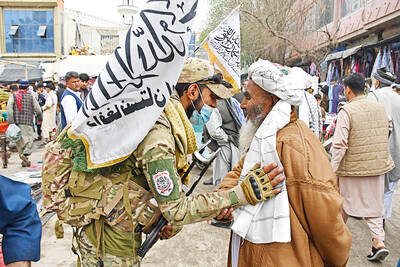
The Taliban’s reclusive supreme leader made a rare public appearance yesterday, an Afghan government spokesman said, leading thousands of worshipers in prayers marking Eid al-Fitr. Hibatullah Akhundzada has made only a handful of public appearances since inheriting the leadership of the Taliban in 2016 and leading the movement back to power with the withdrawal of US forces in 2021. Taliban government spokesman Zabihullah Mujahid said prayer in the largest mosque in Kandahar was “performed under the leadership of the supreme leader.” In a statement on X, he said the early-morning service “was attended by thousands of compatriots” in the southern province considered the


 RSS
RSS