


The British government hopes to quickly introduce new anti-terrorism legislation, the country's top legal officer said.
Charles Falconer, who is Lord Chancellor, said Sunday that the government hoped to agree on a timetable for new measures soon.
"We should not rush into things because these things need careful thought," Falconer told BBC radio's Westminster Hour program. "But if the opposition parties and the police can reach a consensus with us then we can do it very quickly."
At least 55 were killed and 700 injured when bombs ripped through three subway trains and a double-decker bus during rush hour in central London on July 7. Prime Minister Tony Blair's government has considerably tightened anti-terror laws in the past five years, but ministers want new powers to tackle those on the fringes of terrorism.
The new legislation is likely to outlaw "indirect incitement" of terrorism, including praising those who carry out attacks -- a new offense designed to counter extremist Islamist clerics blamed for radicalizing pockets of disaffected Muslim youth in Britain.
The legislation is also likely to make it an offense to receive training in terrorist techniques in Britain or abroad and to plan a terrorist act. Associating with members of a banned terrorist organization is also likely to be banned. The government also is reviewing its powers to exclude and deport people from Britain -- again with the hope of acting against radical clerics. Blair's government has struggled in the past to push anti-terrorism legislation through parliament due to opposition fears that new measures would erode civil rights.
Home Secretary Charles Clarke was scheduled to meet yesterday with his counterparts from the opposition Conservative Party and the Liberal Democrats. Blair will meet today with leaders from Britain's Muslim community and on Thursday with police, intelligence and security officials.
Further debate was called on allowing evidence from telephone taps to be used in court. The government is opposed to such a move, fearing it may compromise the work of intelligence agencies.
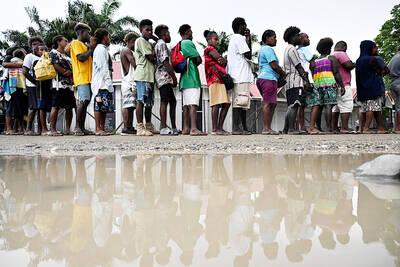
SEEKING CHANGE: A hospital worker said she did not vote in previous elections, but ‘now I can see that maybe my vote can change the system and the country’ Voting closed yesterday across the Solomon Islands in the south Pacific nation’s first general election since the government switched diplomatic allegiance from Taiwan to Beijing and struck a secret security pact that has raised fears of the Chinese navy gaining a foothold in the region. The Solomon Islands’ closer relationship with China and a troubled domestic economy weighed on voters’ minds as they cast their ballots. As many as 420,000 registered voters had their say across 50 national seats. For the first time, the national vote also coincided with elections for eight of the 10 local governments. Esther Maeluma cast her vote in the
Nearly half of China’s major cities are suffering “moderate to severe” levels of subsidence, putting millions of people at risk of flooding, especially as sea levels rise, according to a study of nationwide satellite data released yesterday. The authors of the paper, published by the journal Science, found that 45 percent of China’s urban land was sinking faster than 3mm per year, with 16 percent at more than 10mm per year, driven not only by declining water tables, but also the sheer weight of the built environment. With China’s urban population already in excess of 900 million people, “even a small portion

UNSETTLING IMAGES: The scene took place in front of TV crews covering the Trump trial, with a CNN anchor calling it an ‘emotional and unbelievably disturbing moment’ A man who doused himself in an accelerant and set himself on fire outside the courthouse where former US president Donald Trump is on trial has died, police said yesterday. The New York City Police Department (NYPD) said the man was declared dead by staff at an area hospital. The man was in Collect Pond Park at about 1:30pm on Friday when he took out pamphlets espousing conspiracy theories, tossed them around, then doused himself in an accelerant and set himself on fire, officials and witnesses said. A large number of police officers were nearby when it happened. Some officers and bystanders rushed

HYPOCRISY? The Chinese Ministry of Foreign Affairs yesterday asked whether Biden was talking about China or the US when he used the word ‘xenophobic’ US President Joe Biden on Wednesday called for a hike in steel tariffs on China, accusing Beijing of cheating as he spoke at a campaign event in Pennsylvania. Biden accused China of xenophobia, too, in a speech to union members in Pittsburgh. “They’re not competing, they’re cheating. They’re cheating and we’ve seen the damage here in America,” Biden said. Chinese steel companies “don’t need to worry about making a profit because the Chinese government is subsidizing them so heavily,” he said. Biden said he had called for the US Trade Representative to triple the tariff rates for Chinese steel and aluminum if Beijing was


 RSS
RSS