


George Orwell's novel 1984 provides a fictional warning of the dangers of a totalitarian society in which the hero, Winston Smith, struggles with the thought police.
It now appears that his vision of blanket surveillance in the service of Big Brother was more prescient than even he could have known: a secret Metropolitan police file newly released at the British National Archives shows that Orwell was himself the subject of repeated special branch reports for more than 12 years of his life.
The file, from the police department dealing with political security, shows that it was Orwell's journey north in 1936 to research the living and working conditions of the working class for The Road to Wigan Pier that aroused the suspicions of the security services. Wigan's chief constable, Thomas Pey, reported to Scotland Yard that Orwell, the nom de plume of Eric Blair, was staying in "an apartment house in a working-class district" arranged by the local Communist Party.
The file shows that as far as the intelligence services were concerned, Orwell was the Eton-educated son of a senior figure in the Indian civil service, who had left a job in the Burma (Myanmar) police for some unknown reason, drifted to Paris and London, and had written a few books on his experiences.
The Wigan police described him as "six foot, slim build with a long pale face."
In 1942, when he was working in the Indian section of the BBC in London, the special branch reported that he had been practically penniless when he found work with the corporation, and "dressed in a bohemian fashion both at his office and in his leisure hours."
Orwell's reputation as a hero of the British left took a knock 10 years ago when it was revealed that in 1948 he had supplied a list of 86 "Stalinist fellow travellers" to a Foreign Office anti-communist propaganda unit. But the special branch file shows that more than a decade earlier the intelligence services had Orwell himself down as "a man of advanced communist views."
According to his biographer, Professor Bernard Crick, Orwell saw himself as a Tribunite socialist whose experiences in the Spanish civil war had left him sharply disillusioned with Soviet communism.
His arrival in Wigan in February 1936 -- a year before he went to Spain -- to research the book commissioned by Victor Gollancz, the Left Book Club publisher, about the condition of the unemployed in the industrial north, was to lead to a series of special branch reports linking Orwell to known communists and leftwing organizations.
The Wigan police told Scotland Yard that on the day of his arrival in the town -- Feb. 10 -- he had attended a communist meeting addressed by Wal Hannington, the leader of the unemployed workers' movement, and that the local Communist Party had been instrumental in finding him accommodation.
"It would appear from his mode of living that he is an author, or has some connection with literary work as he devotes most of his time in writing. He has collected an amount of local data, eg. the number of churches, public houses, population, etc, and is in receipt of an unusual amount of correspondence. He had also been asking about local mines and factories."
They reported not only letters addressed to Eric Blair, South End Road, Hampstead, but also in the name of "George Orwell." He had also been sent letters from France, including a newspaper which was the "French counterpart of the Daily Worker."
The police in Wigan wanted to know from Scotland Yard who this man was and whether he was "associated with the Communist Party."
Special branch sent them an extensive background report on Orwell. It made much of the fact that he had given no official reason for resigning his job as an assistant superintendent of police in Burma "but he is reported to have told his intimate friends that he could not bring himself to arrest persons for committing acts which he did not think were wrong."
The special branch officers knew he had lived the life of a "down and out" in Paris and London to collect material for the book of the same party and spent a good deal of time studying L'Humanite (the communist daily).
Information is not available to shew whether he was an active supporter of the revolutionary movement in France, but it is known that whilst there, he offered his services to the Worker's Life, the forerunner of the Daily Worker, as Paris correspondent.

Republican US lawmakers on Friday criticized US President Joe Biden’s administration after sanctioned Chinese telecoms equipment giant Huawei unveiled a laptop this week powered by an Intel artificial intelligence (AI) chip. The US placed Huawei on a trade restriction list in 2019 for contravening Iran sanctions, part of a broader effort to hobble Beijing’s technological advances. Placement on the list means the company’s suppliers have to seek a special, difficult-to-obtain license before shipping to it. One such license, issued by then-US president Donald Trump’s administration, has allowed Intel to ship central processors to Huawei for use in laptops since 2020. China hardliners
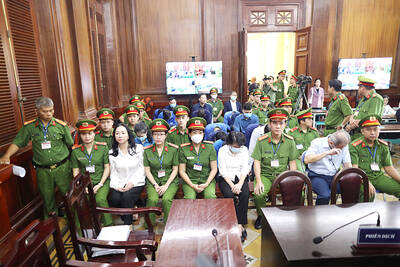
A top Vietnamese property tycoon was on Thursday sentenced to death in one of the biggest corruption cases in history, with an estimated US$27 billion in damages. A panel of three hand-picked jurors and two judges rejected all defense arguments by Truong My Lan, chair of major developer Van Thinh Phat, who was found guilty of swindling cash from Saigon Commercial Bank (SCB) over a decade. “The defendant’s actions ... eroded people’s trust in the leadership of the [Communist] Party and state,” read the verdict at the trial in Ho Chi Minh City. After the five-week trial, 85 others were also sentenced on

Conjoined twins Lori and George Schappell, who pursued separate careers, interests and relationships during lives that defied medical expectations, died this month in Pennsylvania, funeral home officials said. They were 62. The twins, listed by Guinness World Records as the oldest living conjoined twins, died on April 7 at the Hospital of the University of Pennsylvania, obituaries posted by Leibensperger Funeral Homes of Hamburg said. The cause of death was not detailed. “When we were born, the doctors didn’t think we’d make 30, but we proved them wrong,” Lori said in an interview when they turned 50, the Philadelphia Inquirer reported. The
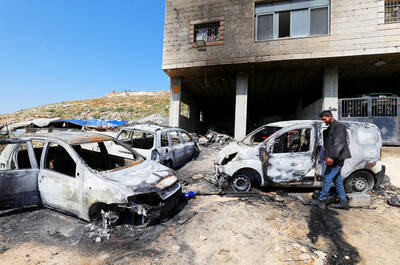
RAMPAGE: A Palestinian man was left dead after dozens of Israeli settlers searching for a missing 14-year-old boy stormed a village in the Israeli-occupied West Bank US President Joe Biden on Friday said he expected Iran to attack Israel “sooner, rather than later” and warned Tehran not to proceed. Asked by reporters about his message to Iran, Biden simply said: “Don’t,” underscoring Washington’s commitment to defend Israel. “We are devoted to the defense of Israel. We will support Israel. We will help defend Israel and Iran will not succeed,” he said. Biden said he would not divulge secure information, but said his expectation was that an attack could come “sooner, rather than later.” Israel braced on Friday for an attack by Iran or its proxies as warnings grew of


 RSS
RSS