


A Guantanamo detainee who once was Osama bin Laden's driver can be tried by military tribunal, a federal appeals court ruled, apparently clearing the way for the Pentagon to resume trials suspended when a lower court ruled the procedures unlawful.
A three-judge panel of the US Court of Appeals for the District of Columbia Circuit ruled unanimously Friday against Salim Ahmed Hamdan, a Yemeni.
More broadly it said that the 1949 Geneva Convention governing prisoners of war does not apply to al-Qaeda and its members. That supports a key assertion of the Bush administration, which has faced international criticism for holding hundreds of terror suspects at Guantanamo Bay without full POW protections.
"I think pretty much the entire opinion would be welcomed by the administration. I think there's nothing in there that is adverse to the administration's positions," Carl Tobias, a professor of law at the University of Richmond, said in a telephone interview. "It's a very pro-administration decision."
The Pentagon has argued that it is justified in using what it calls military commissions, or tribunals, to try terror suspects like Hamdan who were captured in the war in Afghanistan because they are "enemy combatants."
Hamdan, who was captured in Afghanistan in November 2001, denies conspiring to engage in acts of terrorism and denies he was a member of al-Qaeda. His lawyers say that by working as bin Laden's driver he simply wanted to earn enough money to return to Yemen, buy his own vehicle and support his family as a driver. Two lawyers representing Hamdan, Georgetown University law professor Neal Katyal and Navy Lieutenant Commander Charles Swift, said the appeals court ruling "is contrary to 200 years of constitutional law."
"Today's ruling places absolute trust in the president, unchecked by the Constitution, statutes of Congress and long-standing treaties ratified by the Senate of the US," the two defense lawyers said in a statement.
Katyal said in an interview that the detainee's legal team plans a further appeal. The Pentagon had no comment on the ruling, nor did it say whether or when it planned to resume the its commission proceedings against Hamdan and three other Guantanamo detainees.
Attorney General Alberto Gonzales praised the decision.
"The president's authority under the laws of our nation to try enemy combatants is a vital part of the global war on terror, and today's decision reaffirms this critical authority," Gonzales said.
Kenneth Roth, executive director of Human Rights Watch, a critic of the commissions, said the Pentagon would be better off using the normal courts-martial process under the Uniform Code of Military Justice.
"By permitting trials before military commissions, the court gave the administration enough rope to hang itself," Roth said. "That's because, as currently conceived, the military commissions are deeply flawed."
Hamdan's trial started last August but was halted when a district court ruled in November that Hamdan could not be tried by a US military commission unless a "competent tribunal" determined first that he was not a prisoner of war under the 1949 Geneva Convention. In Friday's ruling, the three judges said the commission itself is such a competent tribunal, and that Hamdan could assert his claim to prisoner of war status at the time of his trial before a military commission. Hamdan's lawyers said President George W. Bush violated the separation of powers in the Constitution when he established military commissions.
The appeals court disagreed, saying Bush relied on Congress's joint resolution authorizing the use of force after the Sept. 11, 2001, terrorist attacks, as well as two congressionally enacted laws.
"We think it no answer to say, as Hamdan does, that this case is different because Congress did not formally declare war," said the decision by Judge Randolph, who was appointed to the appeals court by the first President Bush. He was joined in the ruling by a Reagan appointee and a judge placed on the court by the current president.
A leading critic of the Pentagon's military commissions, the Center for Constitutional Rights, called Friday's ruling "misguided" and said it could have an impact beyond the status of Hamdan.
"The ramifications of the decision may be enormous in terms of the danger created for US soldiers stationed abroad," it said. "If the US does not use fair and just procedures that guarantee military detainees due process protections in the `war on terror,' no other country will feel the need to do so either."
Just 15 of the 520 detainees at Guantanamo Bay have been designated by Bush for such prosecution by military tribunals and only four, including Hamdan, have been charged. The Pentagon said it is developing charges against others, and maintains that those not charged could be held indefinitely at Guantanamo Bay.

Republican US lawmakers on Friday criticized US President Joe Biden’s administration after sanctioned Chinese telecoms equipment giant Huawei unveiled a laptop this week powered by an Intel artificial intelligence (AI) chip. The US placed Huawei on a trade restriction list in 2019 for contravening Iran sanctions, part of a broader effort to hobble Beijing’s technological advances. Placement on the list means the company’s suppliers have to seek a special, difficult-to-obtain license before shipping to it. One such license, issued by then-US president Donald Trump’s administration, has allowed Intel to ship central processors to Huawei for use in laptops since 2020. China hardliners
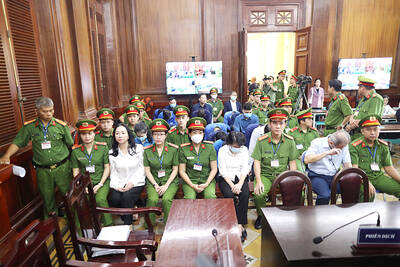
A top Vietnamese property tycoon was on Thursday sentenced to death in one of the biggest corruption cases in history, with an estimated US$27 billion in damages. A panel of three hand-picked jurors and two judges rejected all defense arguments by Truong My Lan, chair of major developer Van Thinh Phat, who was found guilty of swindling cash from Saigon Commercial Bank (SCB) over a decade. “The defendant’s actions ... eroded people’s trust in the leadership of the [Communist] Party and state,” read the verdict at the trial in Ho Chi Minh City. After the five-week trial, 85 others were also sentenced on

‘DELUSIONAL’: Targeting the families of Hamas’ leaders would not push the group to change its position or to give up its demands for Palestinians, Ismail Haniyeh said Israeli aircraft on Wednesday killed three sons of Hamas’ top political leader in the Gaza Strip, striking high-stakes targets at a time when Israel is holding delicate ceasefire negotiations with the militant group. Hamas said four of the leader’s grandchildren were also killed. Ismail Haniyeh’s sons are among the highest-profile figures to be killed in the war so far. Israel said they were Hamas operatives, and Haniyeh accused Israel of acting in “the spirit of revenge and murder.” The deaths threatened to strain the internationally mediated ceasefire talks, which appeared to gain steam in recent days even as the sides remain far
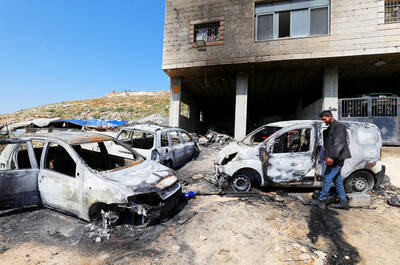
RAMPAGE: A Palestinian man was left dead after dozens of Israeli settlers searching for a missing 14-year-old boy stormed a village in the Israeli-occupied West Bank US President Joe Biden on Friday said he expected Iran to attack Israel “sooner, rather than later” and warned Tehran not to proceed. Asked by reporters about his message to Iran, Biden simply said: “Don’t,” underscoring Washington’s commitment to defend Israel. “We are devoted to the defense of Israel. We will support Israel. We will help defend Israel and Iran will not succeed,” he said. Biden said he would not divulge secure information, but said his expectation was that an attack could come “sooner, rather than later.” Israel braced on Friday for an attack by Iran or its proxies as warnings grew of


 RSS
RSS