


The US must overcome the distrust of the vast numbers of mainstream Muslims who are indispensable to ending terrorism, Singapore Prime Minister Lee Hsien Loong (
"Unfortunately, worldwide, right now many moderate Muslims are reluctant to condemn and disown the extremists, lest they be regarded as supporting the enemy," Lee said on Tuesday.
"The sources of Muslim anger and distrust of the US are historical and complex, but they have been accentuated in recent years by Muslim perceptions of American unilateralism and the feeling that the American policies in the Middle East are one-sided," Lee said. "It may or may not be so, but the perception is there."
Lee made his remarks to the US-ASEAN Business Council, a private trade group dedicated to building relations with the 10 countries of the Association of Southeast Asian Nations.
Lee spoke hours after signing a strategic agreement specifying closer cooperation in defense and security with the US. US President George W. Bush said the pact "will have long-term consequences for peace in the region."
The US and Singapore have had a free-trade agreement in effect since Jan. 1 last year.
In his speech, Lee said the fast, efficient US response to Indonesia's tsunami disaster in December "made a difference in attitudes, particularly ... in the world's largest Islamic country."
But, he said, "this has to be sustained over time in order gradually to win over a group which should be an important ally."
Lee, who holds a master's degree from the Kennedy School of Government at Harvard University, said the emergence of India and China as major powers makes a continued economic, strategic and political US presence even more vital in Asia, which "you defended ... not only with words but with action and blood."
"The US is not only a major economic player of Asia but also is a vital partner in Asia's overall security environment," Lee said. "In the new strategic landscape, the US remains the dominant military power, still exercising a decisive and benign influence in the region."
Still, Lee said, the terror threat remains not only on land but at sea, where every year 50,000 ships transit the Malacca Straits off Singapore carrying 30 percent of the world's trade and 50 percent of its oil. Immediate, far-reaching economic and strategic repercussions would follow any disruption, Lee said.
To avert such threats, "On land or at sea, our collective response to the terrorists must be resolute and implacable," he said. "But we can't defeat terrorism through military operations alone."
He said "this will be a test not of America's military hardware and equipment but of your other great strengths: openness, generosity and compassion, characteristics which have earned America admiration and respect all over the world.
"You must draw on them now to win over public opinion, correct misperceptions and build trust and credibility in the Muslim world."

Republican US lawmakers on Friday criticized US President Joe Biden’s administration after sanctioned Chinese telecoms equipment giant Huawei unveiled a laptop this week powered by an Intel artificial intelligence (AI) chip. The US placed Huawei on a trade restriction list in 2019 for contravening Iran sanctions, part of a broader effort to hobble Beijing’s technological advances. Placement on the list means the company’s suppliers have to seek a special, difficult-to-obtain license before shipping to it. One such license, issued by then-US president Donald Trump’s administration, has allowed Intel to ship central processors to Huawei for use in laptops since 2020. China hardliners
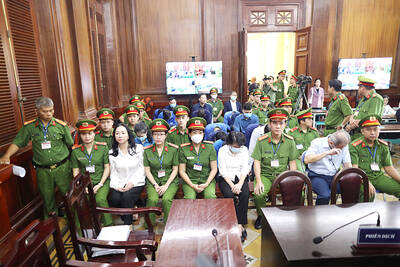
A top Vietnamese property tycoon was on Thursday sentenced to death in one of the biggest corruption cases in history, with an estimated US$27 billion in damages. A panel of three hand-picked jurors and two judges rejected all defense arguments by Truong My Lan, chair of major developer Van Thinh Phat, who was found guilty of swindling cash from Saigon Commercial Bank (SCB) over a decade. “The defendant’s actions ... eroded people’s trust in the leadership of the [Communist] Party and state,” read the verdict at the trial in Ho Chi Minh City. After the five-week trial, 85 others were also sentenced on

Conjoined twins Lori and George Schappell, who pursued separate careers, interests and relationships during lives that defied medical expectations, died this month in Pennsylvania, funeral home officials said. They were 62. The twins, listed by Guinness World Records as the oldest living conjoined twins, died on April 7 at the Hospital of the University of Pennsylvania, obituaries posted by Leibensperger Funeral Homes of Hamburg said. The cause of death was not detailed. “When we were born, the doctors didn’t think we’d make 30, but we proved them wrong,” Lori said in an interview when they turned 50, the Philadelphia Inquirer reported. The
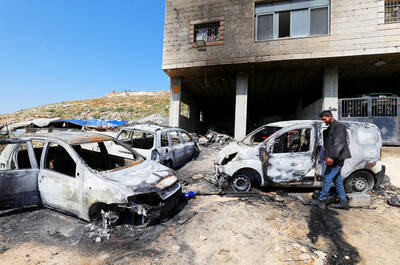
RAMPAGE: A Palestinian man was left dead after dozens of Israeli settlers searching for a missing 14-year-old boy stormed a village in the Israeli-occupied West Bank US President Joe Biden on Friday said he expected Iran to attack Israel “sooner, rather than later” and warned Tehran not to proceed. Asked by reporters about his message to Iran, Biden simply said: “Don’t,” underscoring Washington’s commitment to defend Israel. “We are devoted to the defense of Israel. We will support Israel. We will help defend Israel and Iran will not succeed,” he said. Biden said he would not divulge secure information, but said his expectation was that an attack could come “sooner, rather than later.” Israel braced on Friday for an attack by Iran or its proxies as warnings grew of


 RSS
RSS