


More than 6.2 million of South Africa's 47 million people may be HIV-positive, a dramatic increase from last year's estimate.
The department of health on Monday said that between 6.29 and 6.57 million South Africans are infected with the HIV virus.
The figures contradict a study by Statistics South Africa, a state agency, which estimated in May that about 4.5 million South Africans were infected with HIV. That figure put South Africa behind India as the country with the highest number of infections.

PHOTO: AFP
The latest statistics come from a study last year of women at prenatal clinics. According to blood tests on the women, 29.5 percent were HIV-positive, up from 27.9 percent in 2003.
The infection rate was as high as 40 percent among pregnant women in KwaZulu-Natal, the worst-affected province.
The health department acknowledged that its latest estimates assume that HIV prevalence among pregnant women visiting prenatal clinics was the same as for all women between the ages of 15 and 49.
Surveys of pregnant women visiting health clinics are the basis for most estimates of HIV prevalence in Africa, home to more than 25 million of the estimated 39 million people infected with HIV worldwide.
But the method has been criticized by some African countries for exaggerating the spread of HIV/Aids on the continent.
South African President Thabo Mbeki has questioned the severity of the HIV/Aids crisis in the country, saying that it is not as serious as some studies show.
This has infuriated South African health activists, who blame the government's slow response to the disease for increasing the number of Aids deaths in the country.
"Is it any wonder the public is confused when the same government offers estimates that differ by between 2 million and 2.5 million?" said Rob Dorrington, head of the center for actuarial science at the University of Cape Town.

Republican US lawmakers on Friday criticized US President Joe Biden’s administration after sanctioned Chinese telecoms equipment giant Huawei unveiled a laptop this week powered by an Intel artificial intelligence (AI) chip. The US placed Huawei on a trade restriction list in 2019 for contravening Iran sanctions, part of a broader effort to hobble Beijing’s technological advances. Placement on the list means the company’s suppliers have to seek a special, difficult-to-obtain license before shipping to it. One such license, issued by then-US president Donald Trump’s administration, has allowed Intel to ship central processors to Huawei for use in laptops since 2020. China hardliners
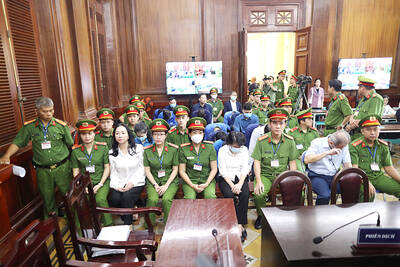
A top Vietnamese property tycoon was on Thursday sentenced to death in one of the biggest corruption cases in history, with an estimated US$27 billion in damages. A panel of three hand-picked jurors and two judges rejected all defense arguments by Truong My Lan, chair of major developer Van Thinh Phat, who was found guilty of swindling cash from Saigon Commercial Bank (SCB) over a decade. “The defendant’s actions ... eroded people’s trust in the leadership of the [Communist] Party and state,” read the verdict at the trial in Ho Chi Minh City. After the five-week trial, 85 others were also sentenced on

‘DELUSIONAL’: Targeting the families of Hamas’ leaders would not push the group to change its position or to give up its demands for Palestinians, Ismail Haniyeh said Israeli aircraft on Wednesday killed three sons of Hamas’ top political leader in the Gaza Strip, striking high-stakes targets at a time when Israel is holding delicate ceasefire negotiations with the militant group. Hamas said four of the leader’s grandchildren were also killed. Ismail Haniyeh’s sons are among the highest-profile figures to be killed in the war so far. Israel said they were Hamas operatives, and Haniyeh accused Israel of acting in “the spirit of revenge and murder.” The deaths threatened to strain the internationally mediated ceasefire talks, which appeared to gain steam in recent days even as the sides remain far
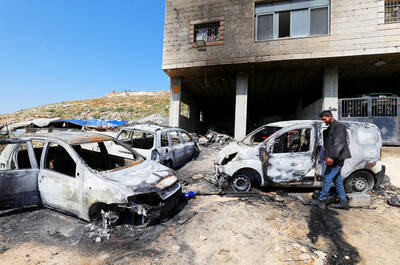
RAMPAGE: A Palestinian man was left dead after dozens of Israeli settlers searching for a missing 14-year-old boy stormed a village in the Israeli-occupied West Bank US President Joe Biden on Friday said he expected Iran to attack Israel “sooner, rather than later” and warned Tehran not to proceed. Asked by reporters about his message to Iran, Biden simply said: “Don’t,” underscoring Washington’s commitment to defend Israel. “We are devoted to the defense of Israel. We will support Israel. We will help defend Israel and Iran will not succeed,” he said. Biden said he would not divulge secure information, but said his expectation was that an attack could come “sooner, rather than later.” Israel braced on Friday for an attack by Iran or its proxies as warnings grew of


 RSS
RSS