


Hurricane Dennis roared quickly through Florida's northwestern Panhandle and Alabama coast with a 193kph bluster of blinding squalls and crashing waves, but shellshocked residents emerged to find far less damage than when Ivan took nearly the same path 10 months ago.
The tightly wound Dennis, which had been a Category 4, 233kph monster as it marched up the Gulf of Mexico, weakened just before it struck less than 80km east of where Ivan came ashore. And despite downed power lines and outages affecting more than half a million people, early reports indicated no deaths and relatively modest structural damage.
"We're really happy it was compact and that it lasted only so long," said Mike Decker, who lost only some shingles and a privacy fence at his home near where the storm came ashore.
"It was more of a show for the kids," he said.
The storm indeed put on a show as it blew ashore at 7:25pm on Sunday midway between the western Panhandle towns of Pensacola Beach and Navarre Beach.
White-capped waves spewed four-story geysers over sea walls. Sideways, blinding rain mixed with seawater blew in sheets, toppling roadside signs for hotels and gas stations. Waves offshore exceeded 99m, and in downtown Pensacola, the gulf spilled over sidewalks eight blocks inland. Boats broke loose and bobbed like toys in the roiling ocean.
But Dennis, which was responsible for at least 20 deaths in the Caribbean, spared those to the north because of its relatively small size and fast pace. Hurricane winds stretched only 65km from the center, compared with 170km for Ivan, and Dennis tore through at nearly 30kph, compared to Ivan's 21kph.
Rainfall was measured at 200mm, rather than the expected foot 300mm.
"With Ivan, the damage area was probably more spread out and wider than it was for Dennis," National Hurricane Center meteorologist Michelle Mainelli said.
Dennis caused an estimated US$1 billion to US$2.5 billion in insured damage in the US, according to AIR Worldwide Corp of Boston, an insurance risk modeling company.
Ivan, which also had top winds of 190kph, killed 29 people in the Panhandle and caused more than US$7 billion damage in the southeast. Mindful of that experience, more than 1.8 million coastal residents from Florida to Mississippi were urged to evacuate in advance of Dennis, leaving streets in most beach towns deserted.
Even Mark Sigler of Pensacola Beach, who owns a dome-shaped, steel-reinforced house built to withstand 320kph winds, decided to evacuate.
"The house is hurricane-resistant, not hurricane-proof," he said.
In Fort Lauderdale, a man was electrocuted when he stepped on a power line brought down by strong winds. He had been heading toward a house for shelter and apparently didn't see the streetlight cable on the ground, police spokesman Bill Schultz said.
But hours after Dennis' landfall, Florida emergency operations officials said they had no reports of storm-related deaths.
In Alabama, Gulf Shores and Orange Beach officials said they had no reports of major damage.
The biggest problem was power outages, which affected more than 236,700 homes and businesses in the Panhandle, some 280,000 in Alabama and at least 5,000 people in Mississippi. Gulf Power Co, the main power utility for the western Panhandle, said customers should be prepared to do without electricity for three weeks or more.
Another problem on Sunday was around the low-lying fishing village of St. Marks, about 30km south of Tallahassee. A tidal surge of 3m to 3.6m caused extensive flooding.
Dennis became the fifth hurricane to strike Florida in less than 11 months, and US President George W. Bush soon declared parts of the state a major federal disaster along with coastal Alabama and Mississippi.
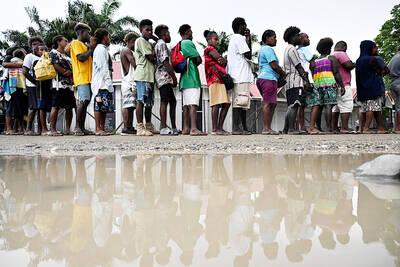
SEEKING CHANGE: A hospital worker said she did not vote in previous elections, but ‘now I can see that maybe my vote can change the system and the country’ Voting closed yesterday across the Solomon Islands in the south Pacific nation’s first general election since the government switched diplomatic allegiance from Taiwan to Beijing and struck a secret security pact that has raised fears of the Chinese navy gaining a foothold in the region. The Solomon Islands’ closer relationship with China and a troubled domestic economy weighed on voters’ minds as they cast their ballots. As many as 420,000 registered voters had their say across 50 national seats. For the first time, the national vote also coincided with elections for eight of the 10 local governments. Esther Maeluma cast her vote in the
Nearly half of China’s major cities are suffering “moderate to severe” levels of subsidence, putting millions of people at risk of flooding, especially as sea levels rise, according to a study of nationwide satellite data released yesterday. The authors of the paper, published by the journal Science, found that 45 percent of China’s urban land was sinking faster than 3mm per year, with 16 percent at more than 10mm per year, driven not only by declining water tables, but also the sheer weight of the built environment. With China’s urban population already in excess of 900 million people, “even a small portion

UNSETTLING IMAGES: The scene took place in front of TV crews covering the Trump trial, with a CNN anchor calling it an ‘emotional and unbelievably disturbing moment’ A man who doused himself in an accelerant and set himself on fire outside the courthouse where former US president Donald Trump is on trial has died, police said yesterday. The New York City Police Department (NYPD) said the man was declared dead by staff at an area hospital. The man was in Collect Pond Park at about 1:30pm on Friday when he took out pamphlets espousing conspiracy theories, tossed them around, then doused himself in an accelerant and set himself on fire, officials and witnesses said. A large number of police officers were nearby when it happened. Some officers and bystanders rushed

HYPOCRISY? The Chinese Ministry of Foreign Affairs yesterday asked whether Biden was talking about China or the US when he used the word ‘xenophobic’ US President Joe Biden on Wednesday called for a hike in steel tariffs on China, accusing Beijing of cheating as he spoke at a campaign event in Pennsylvania. Biden accused China of xenophobia, too, in a speech to union members in Pittsburgh. “They’re not competing, they’re cheating. They’re cheating and we’ve seen the damage here in America,” Biden said. Chinese steel companies “don’t need to worry about making a profit because the Chinese government is subsidizing them so heavily,” he said. Biden said he had called for the US Trade Representative to triple the tariff rates for Chinese steel and aluminum if Beijing was


 RSS
RSS