


Kurdish security officials said Sunday that they had arrested suspects from six different terrorist groups that they believe help form wide insurgent training and support networks inside Iraq and have links with international terrorist organizations.
The officials, including senior members of the Kurdish security police and the intelligence arm of the Kurdistan Democratic Party, say the groups, most of them previously unknown to the Kurdish authorities, appear to have ties to more established jihadist organizations like Ansar al-Sunna.
That group in turn can be traced to a collection of militants who fought US forces in the mountains near Halabja, on the Iranian border, in the weeks leading up to the 2003 invasion.
Abdulla Ali, the chief in Erbil of the security police, the Kurdish equivalent of the FBI, said Sunday that evidence also links the groups to intelligence services from neighboring countries. He declined to elaborate on that evidence, or say which countries he suspected of involvement.
The security officials said their conclusions had emerged from extensive questioning of the suspects, documentary evidence and forensic examinations of crime scenes. They would not say how many suspects had been arrested. Ali, who was himself severely wounded in a suicide car bombing last year, said the arrests indicated that for the first time, international elements appeared to be working together with local Islamic extremists and disaffected remnants of Saddam Hussein's Baath Party to push the boundaries of the violence wracking the country farther north, into the Kurdish region.
The groups are "putting their minds together," Ali said, and collaborating on "how to best achieve their goals."
What appears to be an alliance between Arab Islamic extremists and local Kurds is disheartening after the decades of oppression the Kurds suffered under Saddam's rule, said Nawzad Hadi Mawlood, the governor of Erbil Province.
"What's going on? It's very difficult to understand," Mawlood said.
The arrests, carried out in recent weeks, follow an uncharacteristic string of assassinations, bombings and rocket attacks in the northern provinces, including suicide car-bomb attacks in Erbil on May 4 and June 20 that together killed at least 75 Kurds and wounded nearly 300.
Ali said evidence suggested the June 20 attack was carried out by a Saudi suicide bomber aided by one of the local terrorist cells. Masrour Barzani, chief of the intelligence arm of the Kurdistan Democratic Party, which effectively rules the area, said that only an elaborate support system could have imported the bomber, identified a target -- a field crowded with police officers and recruits -- and supplied a car rigged with explosives.
"There is an interconnected network that is bringing these suicide bombers from their birthplace to Kurdistan," Barzani said.
Suspects from one of the six groups caught up in the recent sweep are believed to have orchestrated the June 20 attack, which killed 15 people, but because that investigation is continuing, officials declined to identify the suspects.

Republican US lawmakers on Friday criticized US President Joe Biden’s administration after sanctioned Chinese telecoms equipment giant Huawei unveiled a laptop this week powered by an Intel artificial intelligence (AI) chip. The US placed Huawei on a trade restriction list in 2019 for contravening Iran sanctions, part of a broader effort to hobble Beijing’s technological advances. Placement on the list means the company’s suppliers have to seek a special, difficult-to-obtain license before shipping to it. One such license, issued by then-US president Donald Trump’s administration, has allowed Intel to ship central processors to Huawei for use in laptops since 2020. China hardliners
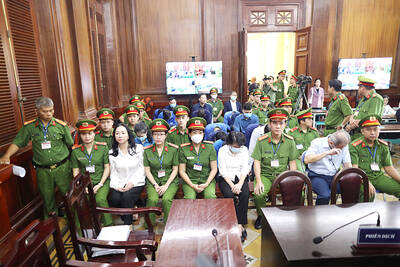
A top Vietnamese property tycoon was on Thursday sentenced to death in one of the biggest corruption cases in history, with an estimated US$27 billion in damages. A panel of three hand-picked jurors and two judges rejected all defense arguments by Truong My Lan, chair of major developer Van Thinh Phat, who was found guilty of swindling cash from Saigon Commercial Bank (SCB) over a decade. “The defendant’s actions ... eroded people’s trust in the leadership of the [Communist] Party and state,” read the verdict at the trial in Ho Chi Minh City. After the five-week trial, 85 others were also sentenced on

Conjoined twins Lori and George Schappell, who pursued separate careers, interests and relationships during lives that defied medical expectations, died this month in Pennsylvania, funeral home officials said. They were 62. The twins, listed by Guinness World Records as the oldest living conjoined twins, died on April 7 at the Hospital of the University of Pennsylvania, obituaries posted by Leibensperger Funeral Homes of Hamburg said. The cause of death was not detailed. “When we were born, the doctors didn’t think we’d make 30, but we proved them wrong,” Lori said in an interview when they turned 50, the Philadelphia Inquirer reported. The
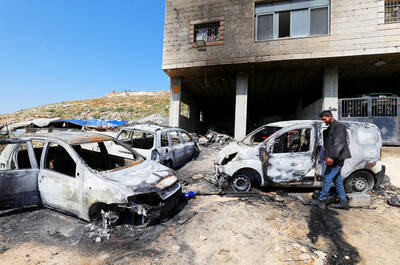
RAMPAGE: A Palestinian man was left dead after dozens of Israeli settlers searching for a missing 14-year-old boy stormed a village in the Israeli-occupied West Bank US President Joe Biden on Friday said he expected Iran to attack Israel “sooner, rather than later” and warned Tehran not to proceed. Asked by reporters about his message to Iran, Biden simply said: “Don’t,” underscoring Washington’s commitment to defend Israel. “We are devoted to the defense of Israel. We will support Israel. We will help defend Israel and Iran will not succeed,” he said. Biden said he would not divulge secure information, but said his expectation was that an attack could come “sooner, rather than later.” Israel braced on Friday for an attack by Iran or its proxies as warnings grew of


 RSS
RSS