


New Zealand Prime Minister Helen Clark said yesterday she was not surprised by reports that late French president Francois Mitterrand approved the sinking of the Greenpeace flagship the Rainbow Warrior 20 years ago.
Paris newspaper Le Monde reported at the weekend that the former head of France's external spy agency, Admiral Pierre Lacoste, had said the late president had personally approved the bombing of the Rainbow Warrior in Auckland harbor.
Greenpeace photographer Fernando Pereira was killed in the bombing after French agents attached two mines to the ship, which was involved in protests against French nuclear testing.
"We always felt deep down that an operation like that would have to have been approved at the very highest level of the French government," Clark said in a radio interview. "It is sad to have it confirmed that it went all the way to the president."
New Zealand Foreign Minister Phil Goff said Mitterrand's authorization changed nothing.
"It doesn't change the fact that the French state carried out the only act of terrorism on New Zealand soil. It makes no difference who authorized it," he was quoted as saying in the Dominion Post newspaper.
The document by Lacoste, who was sacked over the affair, represents the first official confirmation of Mitterrand's involvement in the June 10, 1985 bombing.
The Rainbow Warrior was in Auckland to head a flotilla of protest boats to Mururoa Atoll in French Polynesia in an attempt to disrupt French nuclear testing, a source of discord between France on one hand and New Zealand, Australia and other Pacific nations on the other.
In the document published by Le Monde, Lacoste described a meeting with Mitterrand at 6pm on May 15, 1985, just under two months before the attack.
"I asked the president if he would authorize me to conduct the project of neutralization that I had studied at the request of [defense minister Charles] Hernu. He gave me his consent while emphasizing the importance he placed on the nuclear tests," wrote Lacoste, then head of the General Directorate for External Security.
France was forced to admit its responsibility for the bombing by September 1985. Defense minister Charles Hernu resigned and Lacoste was sacked.
Two members of the 13-strong French secret service team which carried out the bombing, Dominique Prieur and Alain Mafart, pleaded pleaded guilty to manslaughter charges in a New Zealand court and were sentenced to 10 years in jail.

Republican US lawmakers on Friday criticized US President Joe Biden’s administration after sanctioned Chinese telecoms equipment giant Huawei unveiled a laptop this week powered by an Intel artificial intelligence (AI) chip. The US placed Huawei on a trade restriction list in 2019 for contravening Iran sanctions, part of a broader effort to hobble Beijing’s technological advances. Placement on the list means the company’s suppliers have to seek a special, difficult-to-obtain license before shipping to it. One such license, issued by then-US president Donald Trump’s administration, has allowed Intel to ship central processors to Huawei for use in laptops since 2020. China hardliners

Conjoined twins Lori and George Schappell, who pursued separate careers, interests and relationships during lives that defied medical expectations, died this month in Pennsylvania, funeral home officials said. They were 62. The twins, listed by Guinness World Records as the oldest living conjoined twins, died on April 7 at the Hospital of the University of Pennsylvania, obituaries posted by Leibensperger Funeral Homes of Hamburg said. The cause of death was not detailed. “When we were born, the doctors didn’t think we’d make 30, but we proved them wrong,” Lori said in an interview when they turned 50, the Philadelphia Inquirer reported. The
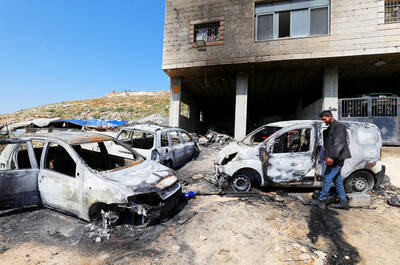
RAMPAGE: A Palestinian man was left dead after dozens of Israeli settlers searching for a missing 14-year-old boy stormed a village in the Israeli-occupied West Bank US President Joe Biden on Friday said he expected Iran to attack Israel “sooner, rather than later” and warned Tehran not to proceed. Asked by reporters about his message to Iran, Biden simply said: “Don’t,” underscoring Washington’s commitment to defend Israel. “We are devoted to the defense of Israel. We will support Israel. We will help defend Israel and Iran will not succeed,” he said. Biden said he would not divulge secure information, but said his expectation was that an attack could come “sooner, rather than later.” Israel braced on Friday for an attack by Iran or its proxies as warnings grew of
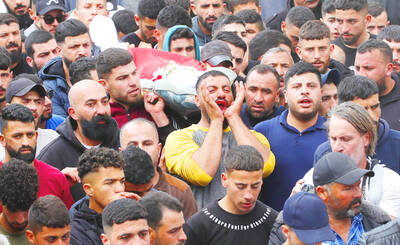
IN PURSUIT: Israel’s defense minister said the revenge attacks by Israeli settlers would make it difficult for security forces to find those responsible for the 14-year-old’s death Israeli Prime Minister Benjamin Netanyahu on Saturday condemned the “heinous murder” of an Israeli teenager in the occupied West Bank as attacks on Palestinian villages intensified following news of his death. After Benjamin Achimeir, 14, was reported missing near Ramallah on Friday, hundreds of Jewish settlers backed by Israeli forces raided nearby Palestinian villages, torching vehicles and homes, leaving at least one villager dead and dozens wounded. The attacks escalated in several villages on Saturday after Achimeir’s body was found near the Malachi Hashalom outpost. Agence France-Presse correspondents saw smoke rising from burned houses and fields. Mayor Amin Abu Alyah, of the


 RSS
RSS