


A bridge collapsed in southeast Haiti under a river swollen from fierce winds and rains, killing at least four people on Thursday as Hurricane Dennis lashed Caribbean coastlines.
Winds of up to 216kph are threatening to intensify as Dennis makes a beeline for Cuba before hitting the coastline of the Gulf of Mexico tomorrow or Monday, raising fears that oil supplies will be disrupted by the fourth storm in as many weeks.
At least four people were killed when the wooden and metal bridge collapsed in Haiti's southwest town of Grand Goave. Witnesses said floodwaters forced the river to rush over the bridge. At least three vehicles were swept away.
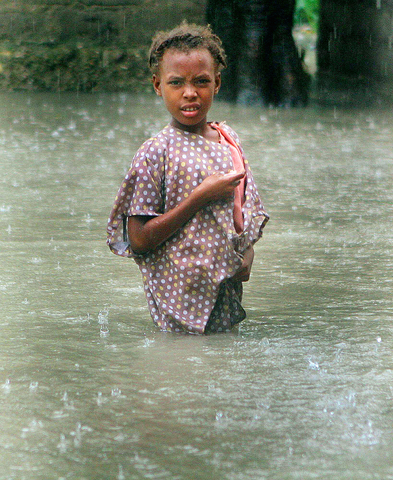
PHOTO: AP
Elsewhere in deforested Haiti, wind gusts uprooted a palm tree and flung it into a mud hut, killing one person and injuring three in southern Les Cayes town, the Red Cross said.
"Dangerous hurricane" Dennis should pass over central Cuba within 24 hours, the US National Hurricane Center in Miami said.
Several rivers burst their banks in eastern Jamaica, flooding roads and stranding many residents in their homes, Morant Bay Mayor Joan Spencer said. The main road linking the eastern part of the island with the capital of Kingston was flooded, preventing rescue workers from getting to the area, she told local radio.
"We are in a terrible situation right now," Spencer said.
About 10 percent of Jamaica's population was left without electricity, the Jamaica Power and Services Company told local radio.
In Cuba, where the military-style government has been praised by the UN for extensive hurricane preparedness, more than 100,000 people were evacuated from the island's southeast, civil defense officials said on state television.
Cuban President Fidel Castro appeared on the program to express concerns about the possible effects on an outdated electrical system. Blackouts have lasted up to 10 hours in some areas in recent weeks.
"The country is investing about US$500 million," in the project to renovate the system "and in the middle of that, here comes this barbarous" storm, Castro said.
The Cayman Islands and Cuba were under hurricane warnings, including the US detention camp holding some 520 terror suspects in Guantanamo Bay.
The southern Florida Keys went on hurricane warning on Thursday afternoon and ordered tourists to flee, while the southern Florida peninsula was on tropical storm watch, expecting stormy conditions within 36 hours.
Jamaican Prime Minister Percival Patterson urged people in low-lying areas of his country to evacuate.
"Let us all work together in unity so that we will be spared the worst," he said in a national radio broadcast.
But only about 1,000 of the 2.6 million people were in shelters late in the afternoon, when local forecasters said the eye of the storm was passing 80km north of Port Antonio on Jamaica's northeast coast.
Cuba was evacuating more than 2,500 tourists and workers from Cayo Largo del Sur, in the string of keys along the southeast, the National Information Agency reported. Most tourists were taken to other hotels in Havana and Varadero beach resort in the north.
There were no immediate plans to evacuate detainees or troops from the US detention center's Camp Delta at Guantanamo Bay, on Cuba's extreme southeast end, General Jay Hood said.
At the camp, about 135m from the ocean, troops put heavy steel shutters on sea-facing cell windows as heavy surf sent splashes of salt spray higher than the razor wire fence. Officials said Camp Delta was built to withstand winds up to 150kph.
Nearly half of China’s major cities are suffering “moderate to severe” levels of subsidence, putting millions of people at risk of flooding, especially as sea levels rise, according to a study of nationwide satellite data released yesterday. The authors of the paper, published by the journal Science, found that 45 percent of China’s urban land was sinking faster than 3mm per year, with 16 percent at more than 10mm per year, driven not only by declining water tables, but also the sheer weight of the built environment. With China’s urban population already in excess of 900 million people, “even a small portion

UNSETTLING IMAGES: The scene took place in front of TV crews covering the Trump trial, with a CNN anchor calling it an ‘emotional and unbelievably disturbing moment’ A man who doused himself in an accelerant and set himself on fire outside the courthouse where former US president Donald Trump is on trial has died, police said yesterday. The New York City Police Department (NYPD) said the man was declared dead by staff at an area hospital. The man was in Collect Pond Park at about 1:30pm on Friday when he took out pamphlets espousing conspiracy theories, tossed them around, then doused himself in an accelerant and set himself on fire, officials and witnesses said. A large number of police officers were nearby when it happened. Some officers and bystanders rushed

Beijing is continuing to commit genocide and crimes against humanity against Uyghurs and other Muslim minorities in its western Xinjiang province, U.S. Secretary of State Antony Blinken said in a report published on Monday, ahead of his planned visit to China this week. The State Department’s annual human rights report, which documents abuses recorded all over the world during the previous calendar year, repeated language from previous years on the treatment of Muslims in Xinjiang, but the publication raises the issue ahead of delicate talks, including on the war in Ukraine and global trade, between the top U.S. diplomat and Chinese

HYPOCRISY? The Chinese Ministry of Foreign Affairs yesterday asked whether Biden was talking about China or the US when he used the word ‘xenophobic’ US President Joe Biden on Wednesday called for a hike in steel tariffs on China, accusing Beijing of cheating as he spoke at a campaign event in Pennsylvania. Biden accused China of xenophobia, too, in a speech to union members in Pittsburgh. “They’re not competing, they’re cheating. They’re cheating and we’ve seen the damage here in America,” Biden said. Chinese steel companies “don’t need to worry about making a profit because the Chinese government is subsidizing them so heavily,” he said. Biden said he had called for the US Trade Representative to triple the tariff rates for Chinese steel and aluminum if Beijing was


 RSS
RSS