


Antonio Ferrer, his wife and their two children found themselves among thousands of other exiles, including former inmates of Cuba's prisons and insane asylums, when they arrived at this Florida military base on their search for freedom.
The criminals and mental patients, though, were less fearsome than stone-throwing mobs that had attacked Cuba's Peruvian embassy, where they had sought refuge before being allowed to sail from the communist island to Key West in 1980, Ferrer recalled.
"I thought one time that, after all the rocks that were thrown and the broken heads, soldiers were going to come in and start shooting," Ferrer said in a recent interview from Miami, where he lives. "After all that, Eglin was a walk in the park."

PHOTO: AP
Like Vietnamese refugees five years earlier, the Cubans got their first taste of the US -- from Southern fried chicken and cowboy movies to the July 4 US independence day celebrations -- at tent cities hastily put up at Eglin, which is located in northwestern Florida.
This year marks the 30th anniversary of the Vietnamese resettlement camp and the 25th for "Campo Libertad," or Camp Liberty, as the Cubans called their facility.
Both sets of refugees overcame strange food that made some sick, culture shock and long waits to be processed and assigned sponsors who would help them remake their lives. Most Vietnamese were passive and cooperative, but the Cuban camp was filled with tension that erupted into a minor riot.
Authorities blamed the clash partly on "agitators" planted by Cuban President Fidel Castro's government among the 10,025 exiles who went through Eglin's camp. Crowded conditions and impatience to be released also were factors, according to historical records on what the military called Operation Red, White and Blue, for the colors of the US flag. They were part of a "freedom flotilla" that took about 125,000 Cuban exiles to the US from April through October 1980.
Ferrer, 55, now an air conditioning designer in Miami, steered clear of one barracks he described as a "nightclub."
"It was a party for some of the criminals and cross-dressers until the military officers got serious and made the rule that 11pm was lights out," he said.
Five years earlier, in May through September 1975, 10,085 refugees, mostly Vietnamese, had gone through a similar camp during Operation New Arrivals. The Eglin refugees were among 130,000 Vietnamese, Cambodians and Laotians who came to the US in 1975 after the communist takeover of South Vietnam.
"We had a good time" at Eglin, said Truong Nguyen, then a teenager and now 48, but he added, "The only things we were allowed to do was study English and watch movies."
Nguyen said refugees were amazed by the quantity and variety of food although US cooking took some getting used to. The first meal at Eglin for most Cubans was a box lunch, said Captain Gerald Brown, a civilian Department of Defense police superintendent who pulled duty at both camps.
"Apparently at that time Cuba did not have apples or milk," he said. "You would have thought we were giving them a million dollars."
However, Nguyen's favorite -- beef stew -- and other US dishes such as ham and eggs for breakfast, did not go down well with the Cubans. Military cooks were brought in after many refused to eat food prepared by a contractor.
An Air Force spokesman then had told reporters some Cubans were getting sick from eating too much because US food was not as filling as beans and rice they were accustomed to. A 1975 Independence Day celebration included fried chicken, watermelon and aerobatics by two civilian stunt planes.

Republican US lawmakers on Friday criticized US President Joe Biden’s administration after sanctioned Chinese telecoms equipment giant Huawei unveiled a laptop this week powered by an Intel artificial intelligence (AI) chip. The US placed Huawei on a trade restriction list in 2019 for contravening Iran sanctions, part of a broader effort to hobble Beijing’s technological advances. Placement on the list means the company’s suppliers have to seek a special, difficult-to-obtain license before shipping to it. One such license, issued by then-US president Donald Trump’s administration, has allowed Intel to ship central processors to Huawei for use in laptops since 2020. China hardliners
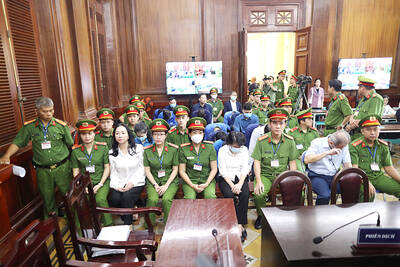
A top Vietnamese property tycoon was on Thursday sentenced to death in one of the biggest corruption cases in history, with an estimated US$27 billion in damages. A panel of three hand-picked jurors and two judges rejected all defense arguments by Truong My Lan, chair of major developer Van Thinh Phat, who was found guilty of swindling cash from Saigon Commercial Bank (SCB) over a decade. “The defendant’s actions ... eroded people’s trust in the leadership of the [Communist] Party and state,” read the verdict at the trial in Ho Chi Minh City. After the five-week trial, 85 others were also sentenced on

‘DELUSIONAL’: Targeting the families of Hamas’ leaders would not push the group to change its position or to give up its demands for Palestinians, Ismail Haniyeh said Israeli aircraft on Wednesday killed three sons of Hamas’ top political leader in the Gaza Strip, striking high-stakes targets at a time when Israel is holding delicate ceasefire negotiations with the militant group. Hamas said four of the leader’s grandchildren were also killed. Ismail Haniyeh’s sons are among the highest-profile figures to be killed in the war so far. Israel said they were Hamas operatives, and Haniyeh accused Israel of acting in “the spirit of revenge and murder.” The deaths threatened to strain the internationally mediated ceasefire talks, which appeared to gain steam in recent days even as the sides remain far
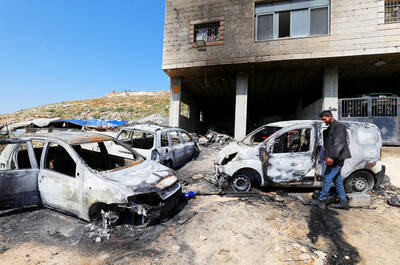
RAMPAGE: A Palestinian man was left dead after dozens of Israeli settlers searching for a missing 14-year-old boy stormed a village in the Israeli-occupied West Bank US President Joe Biden on Friday said he expected Iran to attack Israel “sooner, rather than later” and warned Tehran not to proceed. Asked by reporters about his message to Iran, Biden simply said: “Don’t,” underscoring Washington’s commitment to defend Israel. “We are devoted to the defense of Israel. We will support Israel. We will help defend Israel and Iran will not succeed,” he said. Biden said he would not divulge secure information, but said his expectation was that an attack could come “sooner, rather than later.” Israel braced on Friday for an attack by Iran or its proxies as warnings grew of


 RSS
RSS