


Angola has reported a case of polio -- its first in four years, the UN health agency said Saturday, a day after confirming a new case of the disease in Indonesia.
Angola's Ministry of Health contacted the WHO last month after a 17-year-old girl living in the capital of the African nation developed paralysis in both legs, said Oliver Rosenbauer, a WHO spokesman.
Rosenbauer said her case was unconnected to a West African polio strain that has spread to 16 countries in Africa and Asia, most recently Yemen and Indonesia.
genetically linked
"It's a polio case genetically linked to a virus circulating in India," he said.
On Friday, WHO confirmed a new case of polio in Indonesia's Lampung province, bringing the country's total known number of cases to 66. Yemen has had 284 cases since the virus was reintroduced earlier this year.
Yemen and Indonesia are the latest of 16 previously polio-free countries that have reported new cases of the crippling disease since 2003 after a vaccine boycott in Nigeria was blamed for causing an outbreak that spread the disease to other countries.
Last year, some 1,267 people were infected in the world -- 792 of them in Nigeria. The total new cases in 2005 stands at 618, according to WHO, with Yemen listed as the worst-affected country. When WHO launched its anti-polio campaign in 1988, the worldwide case count was more than 350,000 annually.
contact with feces
Polio is spread when people who are not vaccinated come into contact with the feces of those with the virus, often through water. It usually attacks the nervous system, causing paralysis, muscular atrophy, deformation and sometimes death, though only about one in 200 of those infected develop symptoms.
The disease is still endemic in six countries: Nigeria, India, Pakistan, Niger, Afghanistan and Egypt.
Rosenbauer said an investigation has begun to determine how the girl in Angola contracted the disease. There had not been a case of polio diagnosed in Angola since September 2001, he said.
A national immunization campaign has already being organized for the end of the month by Angolan officials who felt the country was at risk of importing the disease from its neighbors, Rosenbauer said. A second round now is being planned for August, he said.
It takes normally several doses spread out over a few months to fully protect children from polio.
Ideally, four doses should be given in the first year of life. However, in emergencies such as outbreaks, health authorities launch three rounds of vaccination for all children under 5. The doses are given once every four to six weeks.
Angola has been hit hard by health epidemics recently. An outbreak of the Ebola-like Marburg virus has been brought under control in Angola but only after killing more than 300 people.
The Marburg virus spreads through contact with bodily fluids and can kill rapidly, usually about nine days after the first symptoms.
WHO has warned that new cases might be still emerging and any one of them could spark a new crisis.

Republican US lawmakers on Friday criticized US President Joe Biden’s administration after sanctioned Chinese telecoms equipment giant Huawei unveiled a laptop this week powered by an Intel artificial intelligence (AI) chip. The US placed Huawei on a trade restriction list in 2019 for contravening Iran sanctions, part of a broader effort to hobble Beijing’s technological advances. Placement on the list means the company’s suppliers have to seek a special, difficult-to-obtain license before shipping to it. One such license, issued by then-US president Donald Trump’s administration, has allowed Intel to ship central processors to Huawei for use in laptops since 2020. China hardliners
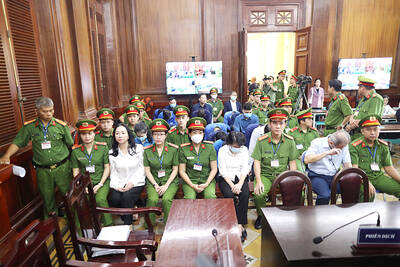
A top Vietnamese property tycoon was on Thursday sentenced to death in one of the biggest corruption cases in history, with an estimated US$27 billion in damages. A panel of three hand-picked jurors and two judges rejected all defense arguments by Truong My Lan, chair of major developer Van Thinh Phat, who was found guilty of swindling cash from Saigon Commercial Bank (SCB) over a decade. “The defendant’s actions ... eroded people’s trust in the leadership of the [Communist] Party and state,” read the verdict at the trial in Ho Chi Minh City. After the five-week trial, 85 others were also sentenced on

Conjoined twins Lori and George Schappell, who pursued separate careers, interests and relationships during lives that defied medical expectations, died this month in Pennsylvania, funeral home officials said. They were 62. The twins, listed by Guinness World Records as the oldest living conjoined twins, died on April 7 at the Hospital of the University of Pennsylvania, obituaries posted by Leibensperger Funeral Homes of Hamburg said. The cause of death was not detailed. “When we were born, the doctors didn’t think we’d make 30, but we proved them wrong,” Lori said in an interview when they turned 50, the Philadelphia Inquirer reported. The
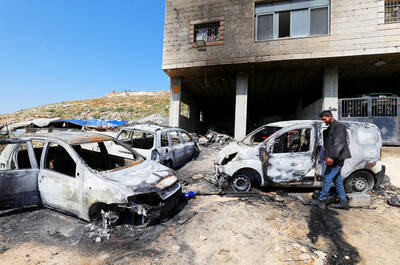
RAMPAGE: A Palestinian man was left dead after dozens of Israeli settlers searching for a missing 14-year-old boy stormed a village in the Israeli-occupied West Bank US President Joe Biden on Friday said he expected Iran to attack Israel “sooner, rather than later” and warned Tehran not to proceed. Asked by reporters about his message to Iran, Biden simply said: “Don’t,” underscoring Washington’s commitment to defend Israel. “We are devoted to the defense of Israel. We will support Israel. We will help defend Israel and Iran will not succeed,” he said. Biden said he would not divulge secure information, but said his expectation was that an attack could come “sooner, rather than later.” Israel braced on Friday for an attack by Iran or its proxies as warnings grew of


 RSS
RSS