


Nuek Ratchkaen wakes before 4:00am every morning to make an agonizing decision: does he need money badly enough to risk his life by venturing out to tap trees on the rubber plantation he sharecrops?
Each morning, in the relative safety of his wooden home shaded by neat rows of rubber trees, he makes an assessment of the all-too-real threat in this rural stretch of southern Thailand, where nearly 800 people have died since an Islamic insurgency erupted in January last year.
"Sometimes it's very scary. If I'm too afraid of getting attacked, I don't go out to cut the rubber trees. But this is my only income, so if I don't go out, I don't earn money," 40-year-old Nuek says.
The trees must be tapped in the coolness of the pre-dawn hours. After the sun rises, the tap becomes too sticky to collect.
But night time is also the most dangerous time to move about along these remote rural roads, which have become one of the main battlegrounds in a conflict that baffles residents as much as it terrifies them.
Nuek is Buddhist, like the vast majority of Thais, but in this predominantly Muslim region near the Malaysian border he is in the minority. In Kokpho district of Pattani province, Buddhists and Muslims live and work together without apparent animosity despite the violence.
His Muslim neighbor, Koseng Daman, is just as afraid as he is.
"We're scared, but this is our life. We have to work," Koseng says.
Thailand is the world's largest producer of natural rubber, an industry centered in the southern provinces, and has factories for major tire companies like Goodyear, Bridgestone and Michelin.
The rubber tapped here also feeds factories that make everything from condoms to rubber bands.
Industry forecasts don't expect much change in rubber production from last year's 2.86 million tonnes, and many plantations are located outside the provinces hit by the unrest.
But for those who live in the region along the Malaysian border, tapping trees to supply the industry is a daily test of nerves.
A Thai Buddhist couple was killed last week in a brutal attack in which their heads were almost hacked off while they were tapping rubber in nearby Narathiwat province. More frequently, rubber tappers are shot by attackers on motorcycles in gangland-style drive-bys.
Few people have been arrested in the 18 months of unrest, and no group has claimed responsibility for any of the attacks. Islamic separatists occasionally leave anonymous notes or graffiti, but experts say that smugglers, drug runners, mafia gangs, as well as corrupt politicians and police also have a hand in the violence.
Fung Sukphan, a 70-year-old chicken farmer who also lives in Kokpho, says he was attacked on June 17 while he was travelling before dawn to his favorite coffeeshop, as he has for years.
He then planned to visit 3 hectares of land he had planted with 1,000 rubber saplings two years ago.
Fung, a Buddhist, was attacked from behind, beaten on the back of his head with a blow strong enough to knock him out. His attackers then slashed his saplings, costing him years of work on the land.
He thinks he was attacked by someone who knew him, but not because of a personal grudge.
"I don't think it was a personal attack. I think they were trying to send a message to the government," he says in the shade of a workhouse near his chicken farm, as he swatted away flies.
What that message might be, he can't say, and he has started to wonder how much he can trust his neighbors in the village where he and his family have always lived.

Republican US lawmakers on Friday criticized US President Joe Biden’s administration after sanctioned Chinese telecoms equipment giant Huawei unveiled a laptop this week powered by an Intel artificial intelligence (AI) chip. The US placed Huawei on a trade restriction list in 2019 for contravening Iran sanctions, part of a broader effort to hobble Beijing’s technological advances. Placement on the list means the company’s suppliers have to seek a special, difficult-to-obtain license before shipping to it. One such license, issued by then-US president Donald Trump’s administration, has allowed Intel to ship central processors to Huawei for use in laptops since 2020. China hardliners

Conjoined twins Lori and George Schappell, who pursued separate careers, interests and relationships during lives that defied medical expectations, died this month in Pennsylvania, funeral home officials said. They were 62. The twins, listed by Guinness World Records as the oldest living conjoined twins, died on April 7 at the Hospital of the University of Pennsylvania, obituaries posted by Leibensperger Funeral Homes of Hamburg said. The cause of death was not detailed. “When we were born, the doctors didn’t think we’d make 30, but we proved them wrong,” Lori said in an interview when they turned 50, the Philadelphia Inquirer reported. The
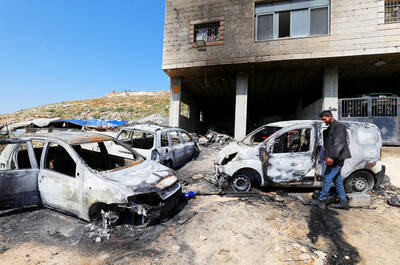
RAMPAGE: A Palestinian man was left dead after dozens of Israeli settlers searching for a missing 14-year-old boy stormed a village in the Israeli-occupied West Bank US President Joe Biden on Friday said he expected Iran to attack Israel “sooner, rather than later” and warned Tehran not to proceed. Asked by reporters about his message to Iran, Biden simply said: “Don’t,” underscoring Washington’s commitment to defend Israel. “We are devoted to the defense of Israel. We will support Israel. We will help defend Israel and Iran will not succeed,” he said. Biden said he would not divulge secure information, but said his expectation was that an attack could come “sooner, rather than later.” Israel braced on Friday for an attack by Iran or its proxies as warnings grew of

A prominent Christian leader has allegedly been stabbed at the altar during a Mass yesterday in southwest Sydney. Bishop Mar Mari Emmanuel was saying Mass at Christ The Good Shepherd Church in Wakeley just after 7pm when a man approached him at the altar and allegedly stabbed toward his head multiple times. A live stream of the Mass shows the congregation swarm forward toward Emmanuel before it was cut off. The church leader gained prominence during the COVID-19 pandemic, amassing a large online following, Officers attached to Fairfield City police area command attended a location on Welcome Street, Wakeley following reports a number


 RSS
RSS