


Defense ministers of the US and India signed a 10-year agreement on Tuesday paving the way for joint weapons production, cooperation on missile defense and possible lifting of US export controls for sensitive military technologies.
"The United States and India have entered a new era," a statement by US Defense Secretary Donald Rumsfeld and his Indian counterpart, Pranab Mukherjee, said after the signing. Mukherjee is on a visit to Washington.
"We are transforming our relationship to reflect our common principles and shared national interests," it said of the so-called "New Framework for the US-India Defense Relationship" signed at the Pentagon.

PHOTO: EPA
The ministers agreed to set up a "defense procurement and production group" to oversee defense trade, as well as prospects for "co-production and technology collaboration" and sign deals on military research, development, testing and evaluation as well as naval pilot training.
"Today, we agree on a new framework that builds on past successes, seizes new opportunities and charts a course for the US-India defense relationship for the next 10 years," the statement said.
The military pact came three months after the US unveiled plans to help India become a "major world power in the 21st century" and ahead of a visit by Indian Prime Minister Manmohan Singh at the invitation of US President George W. Bush from July 18 to 20.
Singh is scheduled to address a joint meeting of Congress.
US House of Representatives Speaker Dennis Hastert said on Tuesday that he looked forward to hearing from the visitor "how our two countries can help grow the global economy and make our world safe from those who seek to do us harm."
Washington's move to boost relations between the world's oldest and largest democracies which were on the opposite sides in the Cold War is seen by analysts as part of a strategy to counter the growing influence of China, India's immediate neighbor.
The US may back India's bid to become a permanent member in the UN Security Council, aside from its already pledged support for Japan, some analysts say.
Mukherjee said the US could also end its policy of restricting supply of dual-use nuclear and space technologies to India, sanctions imposed after India became an undeclared nuclear power.
"I feel there is a possibility of a change," he told reporters.
He said specific areas for cooperation under the new agreement would be subject to negotiations, but urged defense companies to study the different defense procurement procedures of the two countries to achieve quick results.
Rumsfeld did not speak to reporters but had said recently that US military ties with India would be strengthened and predicted that China's influence would decline unless it moved to a freer political system.
"It's pretty clear where India's going, and one would anticipate the relationship with India will continue to strengthen as we go through the period ahead," Rumsfeld had said.
Washington has given the green light to Lockheed Martin and Boeing to offer F-16 and F-18 warplanes as candidates for the Indian Air Force's multi-role fighter program, while also pledging support for Indian requests for other transformative systems in areas such as command and control, early warning, and missile defense.

Republican US lawmakers on Friday criticized US President Joe Biden’s administration after sanctioned Chinese telecoms equipment giant Huawei unveiled a laptop this week powered by an Intel artificial intelligence (AI) chip. The US placed Huawei on a trade restriction list in 2019 for contravening Iran sanctions, part of a broader effort to hobble Beijing’s technological advances. Placement on the list means the company’s suppliers have to seek a special, difficult-to-obtain license before shipping to it. One such license, issued by then-US president Donald Trump’s administration, has allowed Intel to ship central processors to Huawei for use in laptops since 2020. China hardliners

Conjoined twins Lori and George Schappell, who pursued separate careers, interests and relationships during lives that defied medical expectations, died this month in Pennsylvania, funeral home officials said. They were 62. The twins, listed by Guinness World Records as the oldest living conjoined twins, died on April 7 at the Hospital of the University of Pennsylvania, obituaries posted by Leibensperger Funeral Homes of Hamburg said. The cause of death was not detailed. “When we were born, the doctors didn’t think we’d make 30, but we proved them wrong,” Lori said in an interview when they turned 50, the Philadelphia Inquirer reported. The
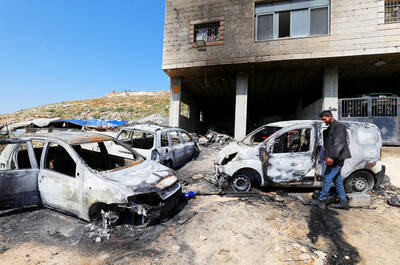
RAMPAGE: A Palestinian man was left dead after dozens of Israeli settlers searching for a missing 14-year-old boy stormed a village in the Israeli-occupied West Bank US President Joe Biden on Friday said he expected Iran to attack Israel “sooner, rather than later” and warned Tehran not to proceed. Asked by reporters about his message to Iran, Biden simply said: “Don’t,” underscoring Washington’s commitment to defend Israel. “We are devoted to the defense of Israel. We will support Israel. We will help defend Israel and Iran will not succeed,” he said. Biden said he would not divulge secure information, but said his expectation was that an attack could come “sooner, rather than later.” Israel braced on Friday for an attack by Iran or its proxies as warnings grew of

IN PURSUIT: Israel’s defense minister said the revenge attacks by Israeli settlers would make it difficult for security forces to find those responsible for the 14-year-old’s death Israeli Prime Minister Benjamin Netanyahu on Saturday condemned the “heinous murder” of an Israeli teenager in the occupied West Bank as attacks on Palestinian villages intensified following news of his death. After Benjamin Achimeir, 14, was reported missing near Ramallah on Friday, hundreds of Jewish settlers backed by Israeli forces raided nearby Palestinian villages, torching vehicles and homes, leaving at least one villager dead and dozens wounded. The attacks escalated in several villages on Saturday after Achimeir’s body was found near the Malachi Hashalom outpost. Agence France-Presse correspondents saw smoke rising from burned houses and fields. Mayor Amin Abu Alyah, of the


 RSS
RSS