


Russia said it intends to cancel US$2.2 billion owed by the poorest African countries in support of an initiative by the eight major industrialized nations to write off more than US$40 billion of debt.
Russia's UN Ambassador Andrey Denisov told a UN ministerial meeting focusing on ways to increase funding to fight poverty that Moscow wanted "to underline our general support" for the June 11 agreement by finance ministers of the Group of Eight to immediately cancel the debts of 18 poverty-burdened nations.
"This year Russia intends to announce the cancellation of US$2.2 billion for the poorest African states on a bilateral basis," Denisov said on Tuesday.
Russia is a member of the Group of Eight. Finance Minister Alexei Kudrin indicated after the G8 announcement that Moscow is ready to forgive African debt left over from the Soviet era. In a June 12 interview on state-run Rossiya television, he said Moscow hoped that eliminating some debt, which is unlikely to be paid back in the next decade or two anyway, "would help lift up the economies of these states."
But Denisov's speech was the first to give a figure and a timetable.
The Russian ambassador said that like the G8, Moscow will cancel debts under the Heavily Indebted Poor Countries Initiative (HIPC), a program launched by the World Bank and International Monetary Fund in 1996 to help nations, mainly in Africa, escape the poverty-trap.
The G8 deal will initially scrap US$40 billion owed by 18 nations eligible for debt relief under the initiative, including Benin, Bolivia, Burkina Faso, Ethiopia, Ghana, Guyana and Mali. A further nine countries owing US$11 billion are expected to complete the program's targets for good governance within 12 months to 18 months and would then qualify.
To meet the good governance standard, the G8 want recipient nations to cut corruption, tackle fraud, free up their economies and liberalize trade.
Denisov said "in absolute terms, Russia is among the leaders in the cancellation of debt of the poorest countries."
But he said Russia believes that debt cancellation alone will not lift countries out of poverty unless they reform financial and budgetary policies, adopt structural reforms, strengthen state institutions and improve the climate for investment.
Pakistan's UN envoy Munir Akram said world leaders attending a UN summit in September, which will focus partly on how to reduce extreme poverty by half by 2015, should also endorse significant debt cancellation for poor non-HIPC countries and more debt relief for heavily indebted middle-income countries.
The two-day ministerial meeting, which ended late on Tuesday, focused on commitments made by governments in 2002 at the UN summit on financing development in Monterrey, Mexico. Rich nations pledged to increase development aid, cancel debts to the poorest countries and open the global trading system, while developing countries promised to end corruption and promote good governance and democracy.
EU nations were lauded for setting timetables to increase aid to 0.7 percent of their national incomes by 2015. But the Group of 77, which includes 132 mainly developing countries, said that's not enough, and urged all donor countries to meet the target.
The G77 also criticized the failure to reach a breakthrough on trade since Monterrey and expressed hope that a ministerial meeting in Hong Kong in December would finally agree to give poor nations greater market access.
Peter Mandelson, the EU trade commissioner, told a news conference that "if aid is the fuel of economic growth, then trade is its engine," and he said "trade should be put at the service of development."
With next week's G8 summit in Scotland and the UN summit and global trade talks to follow, Mandelson said, "We can make 2005 the breakthrough year on poverty reduction."
Pakistan's Akram said developing countries also welcome efforts to find additional "innovative financing" to reduce poverty.
Luxembourg's Development Minister Jean-Louis Schiltz, whose country holds the rotating EU presidency, said the two most promising ideas are a tax on airline tickets and an International Finance Facility that would aim at raising an extra US$50 billion a year by selling bonds on the world's capital markets.

Republican US lawmakers on Friday criticized US President Joe Biden’s administration after sanctioned Chinese telecoms equipment giant Huawei unveiled a laptop this week powered by an Intel artificial intelligence (AI) chip. The US placed Huawei on a trade restriction list in 2019 for contravening Iran sanctions, part of a broader effort to hobble Beijing’s technological advances. Placement on the list means the company’s suppliers have to seek a special, difficult-to-obtain license before shipping to it. One such license, issued by then-US president Donald Trump’s administration, has allowed Intel to ship central processors to Huawei for use in laptops since 2020. China hardliners
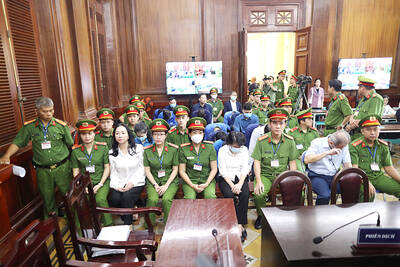
A top Vietnamese property tycoon was on Thursday sentenced to death in one of the biggest corruption cases in history, with an estimated US$27 billion in damages. A panel of three hand-picked jurors and two judges rejected all defense arguments by Truong My Lan, chair of major developer Van Thinh Phat, who was found guilty of swindling cash from Saigon Commercial Bank (SCB) over a decade. “The defendant’s actions ... eroded people’s trust in the leadership of the [Communist] Party and state,” read the verdict at the trial in Ho Chi Minh City. After the five-week trial, 85 others were also sentenced on

Conjoined twins Lori and George Schappell, who pursued separate careers, interests and relationships during lives that defied medical expectations, died this month in Pennsylvania, funeral home officials said. They were 62. The twins, listed by Guinness World Records as the oldest living conjoined twins, died on April 7 at the Hospital of the University of Pennsylvania, obituaries posted by Leibensperger Funeral Homes of Hamburg said. The cause of death was not detailed. “When we were born, the doctors didn’t think we’d make 30, but we proved them wrong,” Lori said in an interview when they turned 50, the Philadelphia Inquirer reported. The
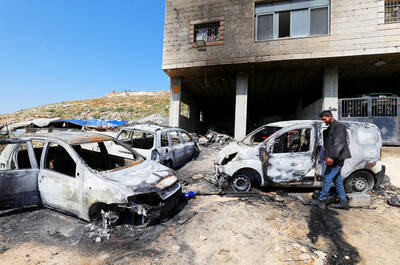
RAMPAGE: A Palestinian man was left dead after dozens of Israeli settlers searching for a missing 14-year-old boy stormed a village in the Israeli-occupied West Bank US President Joe Biden on Friday said he expected Iran to attack Israel “sooner, rather than later” and warned Tehran not to proceed. Asked by reporters about his message to Iran, Biden simply said: “Don’t,” underscoring Washington’s commitment to defend Israel. “We are devoted to the defense of Israel. We will support Israel. We will help defend Israel and Iran will not succeed,” he said. Biden said he would not divulge secure information, but said his expectation was that an attack could come “sooner, rather than later.” Israel braced on Friday for an attack by Iran or its proxies as warnings grew of


 RSS
RSS