


Seventeen historic tall ships from five countries held a mock sea battle off the coast of England to mark the 200th anniversary of the Battle of Trafalgar, during which Admiral Horatio Nelson defeated Napoleon Bonaparte's forces.
After nightfall Tuesday, bursts of orange flame meant to simulate cannon blasts illuminated the darkness. Smoke filled the sky and dozens of ships were silhouetted in front of bright flashes of light.
To avoid appearing to gloat over the famous victory by Britain's navy over Napoleon's warships from France and Spain, the organizers didn't have the tall ships carry out a precise re-enactment of the battle with a victor and a loser. Instead, they opted for a sea battle pitting an unidentified red navy against an unnamed blue one.
As tens of thousands of spectators watched from shore near Portsmouth harbor, the ships, including a replica 18th-century frigate portraying HMS Victory -- the flagship that Nelson commanded -- exploded gunpowder and used state-of-the-art pyrotechnics to simulate the battle.
The British victory in 1805 contributed to Napoleon's eventual downfall and gave Britain naval supremacy for more than 100 years.
Earlier Tuesday, nearly 170 ships, including two modern aircraft carriers, from many different countries crowded the waters off Portsmouth on the southern coast of England to commemorate Nelson's stunning victory.
Queen Elizabeth II, in her role as Lord High Admiral of the United Kingdom, reviewed the fleet from aboard the icebreaker HMS Endurance, along with her husband, the Duke of Edinburgh.
In a written message, the queen said the presence of such a large international fleet showed how highly other nations regarded Nelson, who is one of Britain's greatest military heroes.
"Admiral Lord Nelson's supreme qualities of seamanship, leadership with humanity and courage in the face of danger are shared among our maritime community today. He could wish for no greater legacy," the monarch said.
The fleet included 109 British vessels and 58 ships from 35 other countries, including Britain's Invincible and France's Charles de Gaulle aircraft carriers and America's amphibious assault ship the USS Saipan.
In a grand finale after the re-enactment, 10,000 fireworks were fired from 35 pontoons and six barges in the waterway, and all the ships in the fleet were illuminated with lights.
"I'm amazed to see that so many countries sent ships to help us celebrate the victory," said Dave Pullen, 30, a garbage collector from a nearby town who took the day off work to see the celebration with his wife and 11-month-old daughter.
"Given all the fighting going on in Iraq and Afghanistan, it's nice to see so many warships from so many countries that don't intend to destroy one another," he said. "It's a great sign of goodwill and peace."
During the famous battle, a bullet entered Nelson's shoulder, pierced his lung and came to rest at the base of his spine. But he didn't die until after the battle ended with a British victory, during which the Franco-Spanish alliance lost 22 ships and the British none.
France and Britain have long forged an alliance since then, but the British-French rivalry remains strong, as shown by their latest public feud over the EU budget.
The anniversary organizers worked hard to avoid touching it off by creating a display that had no victor.
"I thought in the summer, when it's good weather, we would have a large fleet review and get a lot of nations in, because that is the way we are employed around the world now, fighting terrorism, working with our close allies," First Sea Lord Admiral Sir Alan West told BBC radio.
"Nelson would have approved of that, to get the maritime back in the public eye," he said.
French Vice Admiral Jacques Mazars, who is in charge of five vessels that are taking part, said the point of such a ceremony isn't to put British forces on one side, and French and Spanish ones on the other, or to rekindle a rivalry, but to have the strong allies today celebrate a moment in history when both camps showed bravery.

‘IN A DIFFERENT PLACE’: The envoy first visited Shanghai, where he attended a Chinese basketball playoff match, and is to meet top officials in Beijing tomorrow US Secretary of State Antony Blinken yesterday arrived in China on his second visit in a year as the US ramps up pressure on its rival over its support for Russia while also seeking to manage tensions with Beijing. The US diplomat tomorrow is to meet China’s top brass in Beijing, where he is also expected to plead for restraint as Taiwan inaugurates president-elect William Lai (賴清德), and to raise US concerns on Chinese trade practices. However, Blinken is also seeking to stabilize ties, with tensions between the world’s two largest economies easing since his previous visit in June last year. At the
Nearly half of China’s major cities are suffering “moderate to severe” levels of subsidence, putting millions of people at risk of flooding, especially as sea levels rise, according to a study of nationwide satellite data released yesterday. The authors of the paper, published by the journal Science, found that 45 percent of China’s urban land was sinking faster than 3mm per year, with 16 percent at more than 10mm per year, driven not only by declining water tables, but also the sheer weight of the built environment. With China’s urban population already in excess of 900 million people, “even a small portion

UNSETTLING IMAGES: The scene took place in front of TV crews covering the Trump trial, with a CNN anchor calling it an ‘emotional and unbelievably disturbing moment’ A man who doused himself in an accelerant and set himself on fire outside the courthouse where former US president Donald Trump is on trial has died, police said yesterday. The New York City Police Department (NYPD) said the man was declared dead by staff at an area hospital. The man was in Collect Pond Park at about 1:30pm on Friday when he took out pamphlets espousing conspiracy theories, tossed them around, then doused himself in an accelerant and set himself on fire, officials and witnesses said. A large number of police officers were nearby when it happened. Some officers and bystanders rushed
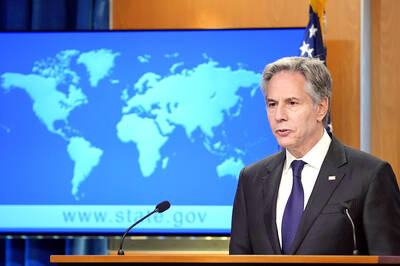
Beijing is continuing to commit genocide and crimes against humanity against Uyghurs and other Muslim minorities in its western Xinjiang province, U.S. Secretary of State Antony Blinken said in a report published on Monday, ahead of his planned visit to China this week. The State Department’s annual human rights report, which documents abuses recorded all over the world during the previous calendar year, repeated language from previous years on the treatment of Muslims in Xinjiang, but the publication raises the issue ahead of delicate talks, including on the war in Ukraine and global trade, between the top U.S. diplomat and Chinese


 RSS
RSS