


Four hundred years ago, Cervantes chose the torrid plains and dusty villages of southern central Spain as the setting of his novel Don Quixote of La Mancha.
Beneath the punishing sun, the romantic imagination of the mad hidalgo transformed windmills into giants, humble inns into castles and homely matrons into beautiful damsels.
To mark the 400th anniversary of the novel's publication, the provincial government of this poor, rural land is trying to transform its literary legacy into gold. In true quixotic spirit, officials of Castilla-La Mancha have invested US$44 million in a network of "ecological tourism routes" that trace the knight errant's misadventures in La Mancha.
The trails -- designed for hikers, bikers or those who prefer to gallop like Don Quixote on his scrawny Rocinante -- cover about 2,500km of rolling hills, woods and streams from Toledo to Cuenca.
They pass through 146 cities and towns, many of them mentioned in Cervantes' novel. El Toboso, for example, is the birthplace of Don Quixote's beloved Dulcinea. They also lead to dozens of ancient windmills at Campo de Criptana, reputedly the place where the brave knight tilted at the "giants."
The tourist trail is the latest symptom of the Don Quixote fever raging through the country on the 400th anniversary. It is difficult to find a play, concert or exhibition this summer that does not make reference to the deluded knight and his faithful squire, Sancho Panza.
For a sparsely populated region of 1.7 million people, US$44 million might seem a lot of money to spend on planting trees, building parking lots and refurbishing ancient trails blazed by shepherds and their sheep.
But like the chivalrous knight, the minister of economy, Maria Luisa Araujo, entertains lofty ambitions. She said the route was a magnet for investment by hotels, restaurants and other tourist services such as agencies specializing in adventure sports (which hopefully will not include drubbings by innkeepers and other Quixote-style activities).
Investment was needed, she said, to stimulate the mostly agrarian economy as it faced impending cuts in Spain's share of EU funding. EU money makes up roughly 4 percent of the region's budget.
"With time, we aspire to have the same importance as the Way of Saint James [the pilgrim route to Santiago de Compostela]," said Juan Camara, project director, who was leading a tour of traditional windmills in the village of Consuegra. In honor of the anniversary, the squat mills are once again grinding flour.
So far, the meagre income from tourism in the region has doubled from 4.6 percent to 10 percent of total revenue. But attracting tourists to this forgotten corner of Spain will be a tough battle worthy of that skinny, bearded hidalgo.
Some foreigners had not even heard of Don Quixote, let alone Castilla-La Mancha.
"I saw the musical in New York," said an American tourist, Kristin Froebel, 22, at a Madrid cafe. Her friends shot her quizzical looks. "The Man of La Mancha," she explained, but they still had not heard of it.
Nearly half of China’s major cities are suffering “moderate to severe” levels of subsidence, putting millions of people at risk of flooding, especially as sea levels rise, according to a study of nationwide satellite data released yesterday. The authors of the paper, published by the journal Science, found that 45 percent of China’s urban land was sinking faster than 3mm per year, with 16 percent at more than 10mm per year, driven not only by declining water tables, but also the sheer weight of the built environment. With China’s urban population already in excess of 900 million people, “even a small portion

UNSETTLING IMAGES: The scene took place in front of TV crews covering the Trump trial, with a CNN anchor calling it an ‘emotional and unbelievably disturbing moment’ A man who doused himself in an accelerant and set himself on fire outside the courthouse where former US president Donald Trump is on trial has died, police said yesterday. The New York City Police Department (NYPD) said the man was declared dead by staff at an area hospital. The man was in Collect Pond Park at about 1:30pm on Friday when he took out pamphlets espousing conspiracy theories, tossed them around, then doused himself in an accelerant and set himself on fire, officials and witnesses said. A large number of police officers were nearby when it happened. Some officers and bystanders rushed
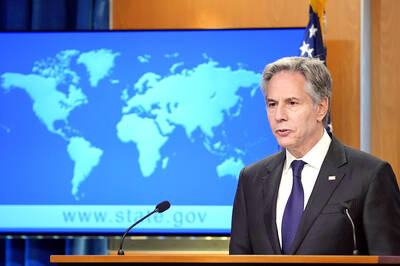
Beijing is continuing to commit genocide and crimes against humanity against Uyghurs and other Muslim minorities in its western Xinjiang province, U.S. Secretary of State Antony Blinken said in a report published on Monday, ahead of his planned visit to China this week. The State Department’s annual human rights report, which documents abuses recorded all over the world during the previous calendar year, repeated language from previous years on the treatment of Muslims in Xinjiang, but the publication raises the issue ahead of delicate talks, including on the war in Ukraine and global trade, between the top U.S. diplomat and Chinese

HYPOCRISY? The Chinese Ministry of Foreign Affairs yesterday asked whether Biden was talking about China or the US when he used the word ‘xenophobic’ US President Joe Biden on Wednesday called for a hike in steel tariffs on China, accusing Beijing of cheating as he spoke at a campaign event in Pennsylvania. Biden accused China of xenophobia, too, in a speech to union members in Pittsburgh. “They’re not competing, they’re cheating. They’re cheating and we’ve seen the damage here in America,” Biden said. Chinese steel companies “don’t need to worry about making a profit because the Chinese government is subsidizing them so heavily,” he said. Biden said he had called for the US Trade Representative to triple the tariff rates for Chinese steel and aluminum if Beijing was


 RSS
RSS