


British Prime Minister Tony Blair warned yesterday that the EU must modernize or risk failure as an economic bloc and as a social model.
Setting out an agenda for his country's six-month EU presidency at the European Parliament, which begins July 1, Blair also urged the 25-member bloc to continue expansion, warning that to shut its doors would give rise to new nationalism and xenophobia.
"If Europe defaulted to euroskepticism ... then we risk failure, and failure on a grand strategic scale. Only by change will Europe recover its strength, its relevance, its idealism and its support amongst people," he said.
A summit of EU leaders ended in acrimony a week ago, with no agreement on a budget for 2007-2013, and no guarantee that the bloc's first constitution will ever be ratified. Other EU nations have blamed Britain for the collapse of the summit, accusing it of unwillingness to accept a compromise that would permit a deal on future funding.
"The debate over Europe should not be conducted by trading insults or in terms of personality," Blair said. "It should be an open and frank exchange of ideas."
Some of Blair's critics heckled him when he described himself as a "passionate pro-European."
But he won applause when he addressed fears that Britain was interested in changing the EU to a mere free-trade zone, saying he believed in a Europe with a strong social dimension.
"I believe in Europe as a political project. I would never accept Europe that was simply an economic market," he said. "This is a union of values, of solidarity between nations and people, of not just a social market in which we trade but a common political space in which we live as citizens."
Blair said the 25-nation bloc needed a new blueprint with "urgent" reforms if Europe was to grow and meet the needs of its citizens and compete with other top economic powerhouses like the US, China and India. He said Europe's welfare system was outdated and needed to be overhauled.
"Tell me what type of social model is it that has 20 million unemployed in Europe, productivity rates falling behind those of the United States; that is allowing more science graduates to be produced by India than by Europe," said Blair. "Of the top 20 universities in the world today, only two are now in Europe."
"Investment in knowledge in skills in active labor policies ... in higher education, in urban regeneration in help for small businesses -- this is modern social policy, not regulation and job protection," said Blair. There was a disconnection, he said, between citizens and their political leaders about where the EU should be going and what it was doing.
"It is a crisis of political leadership," he said, pointing to the recent rejection of the EU's constitution in France and the Netherlands three weeks ago.
"As ever I'm afraid the people are ahead of the politicians," said Blair. "The issue is not about the idea of the EU, it is about modernization."
Nearly half of China’s major cities are suffering “moderate to severe” levels of subsidence, putting millions of people at risk of flooding, especially as sea levels rise, according to a study of nationwide satellite data released yesterday. The authors of the paper, published by the journal Science, found that 45 percent of China’s urban land was sinking faster than 3mm per year, with 16 percent at more than 10mm per year, driven not only by declining water tables, but also the sheer weight of the built environment. With China’s urban population already in excess of 900 million people, “even a small portion

UNSETTLING IMAGES: The scene took place in front of TV crews covering the Trump trial, with a CNN anchor calling it an ‘emotional and unbelievably disturbing moment’ A man who doused himself in an accelerant and set himself on fire outside the courthouse where former US president Donald Trump is on trial has died, police said yesterday. The New York City Police Department (NYPD) said the man was declared dead by staff at an area hospital. The man was in Collect Pond Park at about 1:30pm on Friday when he took out pamphlets espousing conspiracy theories, tossed them around, then doused himself in an accelerant and set himself on fire, officials and witnesses said. A large number of police officers were nearby when it happened. Some officers and bystanders rushed

HYPOCRISY? The Chinese Ministry of Foreign Affairs yesterday asked whether Biden was talking about China or the US when he used the word ‘xenophobic’ US President Joe Biden on Wednesday called for a hike in steel tariffs on China, accusing Beijing of cheating as he spoke at a campaign event in Pennsylvania. Biden accused China of xenophobia, too, in a speech to union members in Pittsburgh. “They’re not competing, they’re cheating. They’re cheating and we’ve seen the damage here in America,” Biden said. Chinese steel companies “don’t need to worry about making a profit because the Chinese government is subsidizing them so heavily,” he said. Biden said he had called for the US Trade Representative to triple the tariff rates for Chinese steel and aluminum if Beijing was
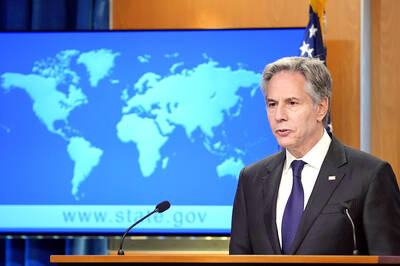
Beijing is continuing to commit genocide and crimes against humanity against Uyghurs and other Muslim minorities in its western Xinjiang province, U.S. Secretary of State Antony Blinken said in a report published on Monday, ahead of his planned visit to China this week. The State Department’s annual human rights report, which documents abuses recorded all over the world during the previous calendar year, repeated language from previous years on the treatment of Muslims in Xinjiang, but the publication raises the issue ahead of delicate talks, including on the war in Ukraine and global trade, between the top U.S. diplomat and Chinese


 RSS
RSS