


The US federal agency in charge of aviation security collected extensive personal information about airline passengers even though Congress forbade it and officials said they wouldn't do it, according to documents obtained Monday by reporters.
The Transportation Security Administration (TSA) is buying and storing detailed personal information about US citizens who flew on commercial airlines in June 2004 as part of a test of a terrorist screening program called Secure Flight, according to documents that will be published in the Federal Register this week.
"TSA is losing the public's trust," said Tim Sparapani, a privacy lawyer with the American Civil Liberties Union. "They have a repeated, consistent problem with doing one thing and then saying they did another."
Secure Flight and its predecessor, CAPPS II, have been criticized for secretly obtaining personal information about airline passengers and failing to do enough to protect it.
The TSA and several airlines were embarrassed last year when it was revealed that the personal information on 12 million passengers was given to the government without the permission or knowledge of the travelers. An inspector general's report found that the TSA misled the public about its role in acquiring data.
class-action lawsuits
Class-action lawsuits have been brought against airlines and government contractors for sharing their passengers' information. As a result, airlines agreed to turn over passenger data for testing only after they were ordered to do so by the government last November.
According to the documents, the TSA gave the data, known as passenger name records, to its contractor, Virginia-based EagleForce Associates. Passenger name records can include a variety of information, including name, address, phone number and credit card information.
EagleForce then compared the passenger name records with commercial data from three contractors that included first, last and middle names, home addresses and phone numbers, birth dates, name suffixes, second surnames, spouses' first names, genders, second addresses, third addresses, ZIP codes and latitude and longitude of addresses. The reason for the comparison was to check the accuracy of the passenger name record, according to the TSA.

Republican US lawmakers on Friday criticized US President Joe Biden’s administration after sanctioned Chinese telecoms equipment giant Huawei unveiled a laptop this week powered by an Intel artificial intelligence (AI) chip. The US placed Huawei on a trade restriction list in 2019 for contravening Iran sanctions, part of a broader effort to hobble Beijing’s technological advances. Placement on the list means the company’s suppliers have to seek a special, difficult-to-obtain license before shipping to it. One such license, issued by then-US president Donald Trump’s administration, has allowed Intel to ship central processors to Huawei for use in laptops since 2020. China hardliners
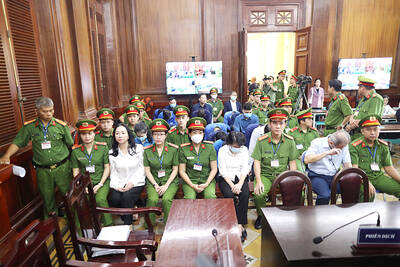
A top Vietnamese property tycoon was on Thursday sentenced to death in one of the biggest corruption cases in history, with an estimated US$27 billion in damages. A panel of three hand-picked jurors and two judges rejected all defense arguments by Truong My Lan, chair of major developer Van Thinh Phat, who was found guilty of swindling cash from Saigon Commercial Bank (SCB) over a decade. “The defendant’s actions ... eroded people’s trust in the leadership of the [Communist] Party and state,” read the verdict at the trial in Ho Chi Minh City. After the five-week trial, 85 others were also sentenced on

‘DELUSIONAL’: Targeting the families of Hamas’ leaders would not push the group to change its position or to give up its demands for Palestinians, Ismail Haniyeh said Israeli aircraft on Wednesday killed three sons of Hamas’ top political leader in the Gaza Strip, striking high-stakes targets at a time when Israel is holding delicate ceasefire negotiations with the militant group. Hamas said four of the leader’s grandchildren were also killed. Ismail Haniyeh’s sons are among the highest-profile figures to be killed in the war so far. Israel said they were Hamas operatives, and Haniyeh accused Israel of acting in “the spirit of revenge and murder.” The deaths threatened to strain the internationally mediated ceasefire talks, which appeared to gain steam in recent days even as the sides remain far
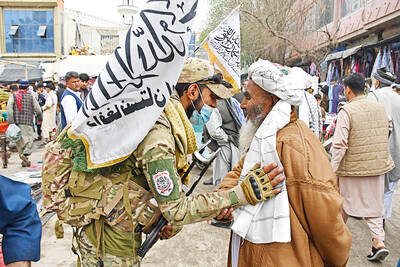
The Taliban’s reclusive supreme leader made a rare public appearance yesterday, an Afghan government spokesman said, leading thousands of worshipers in prayers marking Eid al-Fitr. Hibatullah Akhundzada has made only a handful of public appearances since inheriting the leadership of the Taliban in 2016 and leading the movement back to power with the withdrawal of US forces in 2021. Taliban government spokesman Zabihullah Mujahid said prayer in the largest mosque in Kandahar was “performed under the leadership of the supreme leader.” In a statement on X, he said the early-morning service “was attended by thousands of compatriots” in the southern province considered the


 RSS
RSS