


Jean Henold Buteau's wife listened frantically to the brusque voice on the other end of the phone: We've got your husband. Give us US$1 million or start planning his funeral.
Then she heard his screams as the kidnappers tortured her bound and hooded husband, crushing the tips of his fingers and earlobes with steel pliers and burning his feet with melted plastic juice bottles.
Buteau's 20-hour abduction in April was part of a rash of kidnappings adding to the misery in violence-torn Haiti.
An average of four people are kidnapped each day by politically aligned street gangs, drug traffickers, crooked police and criminal deportees from the US, officials say.
"I was thinking, `Thank God my mother is dead because she couldn't take this,'" said Buteau, a physician and leader of a center-left political party who was released after his family paid a ransom well below the amount demanded. "They were very, very brutal."
The kidnappings are the latest trend in relentless violence that one UN official called "an urban war" to destabilize Haiti ahead of fall elections to fill a power vacuum after a revolt toppled President Jean-Bertrand Aristide last year.
At least 130 people were kidnapped in the capital of Port-au-Prince in April, a big jump over previous months, UN officials have said. Precise statistics were not available for the previous months, or for last month or this month.
The victims range from wealthy business owners pulled out of luxury vehicles on busy streets to working-class Haitians snatched from poor neighborhoods and held for a few hundred dollars.
Foreigners are also targets.
On Friday, an Italian woman, Gigliola Martino, was kidnapped in the capital and released unharmed later overnight, the Italian Foreign Ministry said. Italian news agency ANSA reported that Martino, 65, has been living in Haiti for about 30 years with her husband and two children.
The incident came days after a Canadian woman was kidnapped from her home and reportedly held for US$300,000. She was freed Wednesday, but it was unclear if a ransom was paid. At least six foreigners have been kidnapped in recent months.
"We are facing a kind of terrorism," said Ann-Marie Issa, a member of a US-backed council of business leaders, academics and others who helped choose Haiti's interim government and still monitor it. "When we go out in the morning we don't know if we'll come home."
Many wealthier Haitians, who had been relatively insulated from violence, are leaving the nation or fleeing to the countryside, Issa said. Several business owners have been forced to close up shop, laying off workers and perpetuating Haiti's cycle of poverty, she said.
Increased violence prompted the US Peace Corps to pull its 16 volunteers out of Haiti this week, three weeks after the US State Department warned US citizens against traveling here and ordered nonessential US personnel to leave.
Haitian officials blame much of the kidnappings on well-armed pro-Aristide street gangs, but say drug traffickers, corrupt police and an influx of criminal deportees from the US are also involved.
"Some of these guys were not even born in Haiti, but their parents were Haitians," interim Prime Minister Gerard Latortue said recently, urging U.S. authorities to stop sending back criminals of Haitian descent.
A 7,400-strong UN peacekeeping force is patrolling volatile slums of the capital and parts of the countryside but says it can do little to combat kidnappings.
"The kidnapping [problem] is not the job of peacekeepers," UN military spokesman Lieutenant Colonel Elouafi Boulbars said. "It's the job of the population, civil society and law enforcement."
Haiti's ill-equipped police force is forming a new anti-kidnapping squad, but families of victims are often reluctant to involve police, who are sometimes behind the crimes themselves. Two police officers were detained this week for alleged kidnappings, police spokeswoman Gessy Coicou said.
UN Civilian Police Commissioner David Beer called the violence "an urban war" aimed at "destabilizing the government" ahead of elections scheduled for October and November.

Republican US lawmakers on Friday criticized US President Joe Biden’s administration after sanctioned Chinese telecoms equipment giant Huawei unveiled a laptop this week powered by an Intel artificial intelligence (AI) chip. The US placed Huawei on a trade restriction list in 2019 for contravening Iran sanctions, part of a broader effort to hobble Beijing’s technological advances. Placement on the list means the company’s suppliers have to seek a special, difficult-to-obtain license before shipping to it. One such license, issued by then-US president Donald Trump’s administration, has allowed Intel to ship central processors to Huawei for use in laptops since 2020. China hardliners

Conjoined twins Lori and George Schappell, who pursued separate careers, interests and relationships during lives that defied medical expectations, died this month in Pennsylvania, funeral home officials said. They were 62. The twins, listed by Guinness World Records as the oldest living conjoined twins, died on April 7 at the Hospital of the University of Pennsylvania, obituaries posted by Leibensperger Funeral Homes of Hamburg said. The cause of death was not detailed. “When we were born, the doctors didn’t think we’d make 30, but we proved them wrong,” Lori said in an interview when they turned 50, the Philadelphia Inquirer reported. The
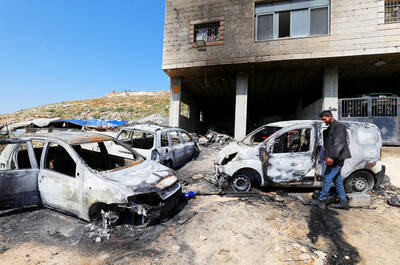
RAMPAGE: A Palestinian man was left dead after dozens of Israeli settlers searching for a missing 14-year-old boy stormed a village in the Israeli-occupied West Bank US President Joe Biden on Friday said he expected Iran to attack Israel “sooner, rather than later” and warned Tehran not to proceed. Asked by reporters about his message to Iran, Biden simply said: “Don’t,” underscoring Washington’s commitment to defend Israel. “We are devoted to the defense of Israel. We will support Israel. We will help defend Israel and Iran will not succeed,” he said. Biden said he would not divulge secure information, but said his expectation was that an attack could come “sooner, rather than later.” Israel braced on Friday for an attack by Iran or its proxies as warnings grew of

A prominent Christian leader has allegedly been stabbed at the altar during a Mass yesterday in southwest Sydney. Bishop Mar Mari Emmanuel was saying Mass at Christ The Good Shepherd Church in Wakeley just after 7pm when a man approached him at the altar and allegedly stabbed toward his head multiple times. A live stream of the Mass shows the congregation swarm forward toward Emmanuel before it was cut off. The church leader gained prominence during the COVID-19 pandemic, amassing a large online following, Officers attached to Fairfield City police area command attended a location on Welcome Street, Wakeley following reports a number


 RSS
RSS