


The West African nation of Guinea-Bissau held its first presidential elections yesterday since a 2003 coup, with 13 contenders vying for the country's top post -- including the man the military ousted two years ago.
Many hope fresh leadership can shunt one of the world's poorest countries toward democracy and development after decades of internal conflict. The victor faces a near-Herculean task: jump-starting a woeful economy based largely on cashew-nut production while enticing foreign investors to a coup-prone, war-ravaged country of 1.4 million, roughly two-thirds of whom can't read.
"We're just looking for a president who can bring stability," bank employee Jaime Cabral said Saturday, standing outside the crumbling presidential palace, which was gutted by bazooka-fire on the final day of the country's ruinous 1998-1999 civil war.

PHOTO: EPA
"Without peace and stability, foreigners with money will never come to our poor country. Tranquility is everything," the 44-year-old said.
The poll marks the nation's first since the military ousted democratically ex-President Kumba Yala in bloodless coup in September 2003.
Yala, a one-time philosophy professor, is running amid a field of 13 candidates. Another top contender is former military ruler Joao Bernardo "Nino" Vieira, who seized power in 1980 and held it until his 1999 ouster.
Also running is Malam Bacai Sanha, who heads a main political party born from a guerrilla movement that led the successful battle for 1973 independence from Portugal. Sanha briefly headed an interim administration that replaced Vieira.
Decades of instability have made Guinea Bissau one the world's ten least-developed countries, according the UN, with 80 percent of the population living on less than US$2 per day. Unemployment runs high at 60 percent in an economy which gains almost all income from exports of raw cashews and sales of fishing rights to European-flagged ships. Eighty percent of the government's budget comes from foreign aid, even as lenders shy away from the country.
Yala was elected in 2000 after the end of the one-time Portuguese colony's civil war, sparked by fighting among rival army factions. Three years later, he was ousted amid growing unpopularity stemming from months of unpaid salaries to civil servants and his increasingly erratic leadership -- like issuing over 150 presidential proclamations, including some scribbled on cocktail napkins, residents say.
Last month, Yala said he still considers himself the rightful leader, sparking riots and leading supporters in a brief nighttime occupation of the presidential palace.
But the military that ousted him remains the most powerful force in the country. While president, Yala stocked the officer class with members of his ethnic Balantas. Of the 25 top officers, 18 are Balanta.
But Vieira, an independence-era guerrilla commander, is also believed to have large sway in the military. Sanha is seen as the military-rejectionist option.
On Saturday, residents sported shirts and hats emblazoned with candidates' faces, including ladies cleaning fish in sprawling markets. Campaign posters dotted fading colonial-era buildings sweltering in the tropical heat.

Republican US lawmakers on Friday criticized US President Joe Biden’s administration after sanctioned Chinese telecoms equipment giant Huawei unveiled a laptop this week powered by an Intel artificial intelligence (AI) chip. The US placed Huawei on a trade restriction list in 2019 for contravening Iran sanctions, part of a broader effort to hobble Beijing’s technological advances. Placement on the list means the company’s suppliers have to seek a special, difficult-to-obtain license before shipping to it. One such license, issued by then-US president Donald Trump’s administration, has allowed Intel to ship central processors to Huawei for use in laptops since 2020. China hardliners
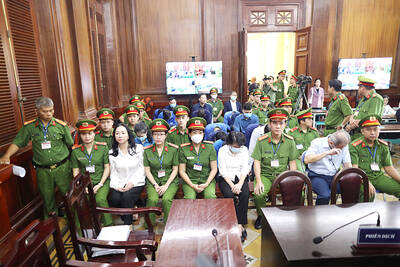
A top Vietnamese property tycoon was on Thursday sentenced to death in one of the biggest corruption cases in history, with an estimated US$27 billion in damages. A panel of three hand-picked jurors and two judges rejected all defense arguments by Truong My Lan, chair of major developer Van Thinh Phat, who was found guilty of swindling cash from Saigon Commercial Bank (SCB) over a decade. “The defendant’s actions ... eroded people’s trust in the leadership of the [Communist] Party and state,” read the verdict at the trial in Ho Chi Minh City. After the five-week trial, 85 others were also sentenced on

‘DELUSIONAL’: Targeting the families of Hamas’ leaders would not push the group to change its position or to give up its demands for Palestinians, Ismail Haniyeh said Israeli aircraft on Wednesday killed three sons of Hamas’ top political leader in the Gaza Strip, striking high-stakes targets at a time when Israel is holding delicate ceasefire negotiations with the militant group. Hamas said four of the leader’s grandchildren were also killed. Ismail Haniyeh’s sons are among the highest-profile figures to be killed in the war so far. Israel said they were Hamas operatives, and Haniyeh accused Israel of acting in “the spirit of revenge and murder.” The deaths threatened to strain the internationally mediated ceasefire talks, which appeared to gain steam in recent days even as the sides remain far
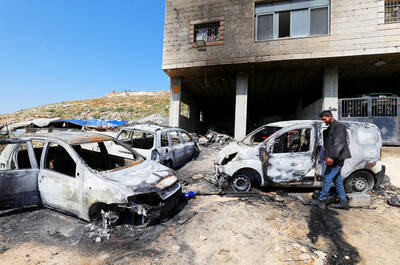
RAMPAGE: A Palestinian man was left dead after dozens of Israeli settlers searching for a missing 14-year-old boy stormed a village in the Israeli-occupied West Bank US President Joe Biden on Friday said he expected Iran to attack Israel “sooner, rather than later” and warned Tehran not to proceed. Asked by reporters about his message to Iran, Biden simply said: “Don’t,” underscoring Washington’s commitment to defend Israel. “We are devoted to the defense of Israel. We will support Israel. We will help defend Israel and Iran will not succeed,” he said. Biden said he would not divulge secure information, but said his expectation was that an attack could come “sooner, rather than later.” Israel braced on Friday for an attack by Iran or its proxies as warnings grew of


 RSS
RSS