


Osama bin Laden's al-Qaeda network is regrouping and intends to bring Iraq-style bloodshed to Afghanistan, the nation's defense minister said, warning that the country could be in for several months of intense violence ahead of key legislative elections.
Defense Minister Rahim Wardak said Friday he had received intelligence that the terror organization has slipped about half a dozen Arab agents into Afghanistan in the past three weeks, two of whom killed themselves in suicide bombings in the south against a packed mosque and a convoy of US troops.
"We have gotten reports here and there that they have entered -- at least half a dozen of them," Wardak told reporters. "The last report is that they came in just close to the time of the mosque attack."
The blast at the mosque on June 1 killed 20 mourners at the funeral of a moderate cleric who had been assassinated days earlier. The same day, a shoulder-launched, surface-to-air missile was fired at an American aircraft, but missed. Then on Monday, another suicide bomber drove up to a US military vehicle in Kandahar and detonated himself, wounding four American soldiers.
"It looks like there has been a regrouping of al-Qaeda and they may have changed their tactics not only to concentrate on Iraq but also on Afghanistan," Wardak said at his wood-paneled office next to the heavily guarded presidential compound.
Authorities recovered the head of the mosque attacker and said he appeared to be of Middle Eastern descent. Wardak said initial indications are that the second suicide attacker was also Arab.
US military spokesman Lieutenant Colonel Jerry O'Hara said Friday it would not be appropriate to comment on the attacks, which were still under investigation.
Wardak would not say where the al-Qaeda fighters entered from, but other Afghan intelligence sources told reporters the men are believed to have crossed the border from Pakistan's southwestern Baluchistan province, and that more were on the way. Pakistan vehemently denies it is a sanctuary for al-Qaeda or the Taliban.
The bombings in Kandahar represented a sea change in the tactics of the insurgency, now in its fourth year. Afghan Taliban fighters have rarely resorted to suicide attacks, a practice that is considered more common among Arab militants.
The defense minister said al-Qaeda and the Taliban were receiving support from "regional powers" who were rattled by Afghanistan's request for a long-term US and NATO presence, but he declined to single out any country in particular.
"There is no doubt that there are countries in this region that have their own designs, and have had from long ago, and they are always trying to exploit the vacuums that have been created here," he said.
Afghan officials often point the finger at Pakistan, where many Taliban and al-Qaeda forces are still believed to take refuge, but Wardak said more than one country was involved, including some that did not border Afghanistan directly.
The defense minister said he did not know whether bin Laden was personally directing the shift in tactics on the ground, but he said he doubted the terror mastermind was capable of day-to-day control of his forces.
"al-Qaeda, at the moment, based on our intelligence, has a more decentralized command and control," Wardak said. "There might have been a general instruction [from bin Laden], but I really doubt he is in daily command and control of events."
Bin Laden is believed to be hiding in the mountains between Pakistan and Afghanistan, though there has been no definitive report on his whereabouts in more than three years.
Wardak acknowledged that recent months have represented a setback for Afghan and coalition forces in their efforts to end the insurgency.
At least 29 US troops have died here since March -- about half of them in a helicopter crash whose cause has not yet been determined -- a significant upsurge in what was once a relatively painless conflict for Washington. About 240 suspected rebels and three dozen Afghan soldiers and police have been killed in that same period -- undercutting US and Afghan claims that the insurgency is all but finished.
"Logically, the [security] situation ought to be better than it is," Wardak said, adding that it may get even worse as the Sept. 18 parliamentary vote nears.

Republican US lawmakers on Friday criticized US President Joe Biden’s administration after sanctioned Chinese telecoms equipment giant Huawei unveiled a laptop this week powered by an Intel artificial intelligence (AI) chip. The US placed Huawei on a trade restriction list in 2019 for contravening Iran sanctions, part of a broader effort to hobble Beijing’s technological advances. Placement on the list means the company’s suppliers have to seek a special, difficult-to-obtain license before shipping to it. One such license, issued by then-US president Donald Trump’s administration, has allowed Intel to ship central processors to Huawei for use in laptops since 2020. China hardliners
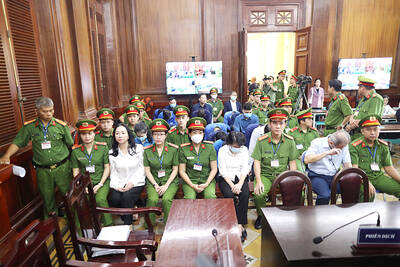
A top Vietnamese property tycoon was on Thursday sentenced to death in one of the biggest corruption cases in history, with an estimated US$27 billion in damages. A panel of three hand-picked jurors and two judges rejected all defense arguments by Truong My Lan, chair of major developer Van Thinh Phat, who was found guilty of swindling cash from Saigon Commercial Bank (SCB) over a decade. “The defendant’s actions ... eroded people’s trust in the leadership of the [Communist] Party and state,” read the verdict at the trial in Ho Chi Minh City. After the five-week trial, 85 others were also sentenced on

Conjoined twins Lori and George Schappell, who pursued separate careers, interests and relationships during lives that defied medical expectations, died this month in Pennsylvania, funeral home officials said. They were 62. The twins, listed by Guinness World Records as the oldest living conjoined twins, died on April 7 at the Hospital of the University of Pennsylvania, obituaries posted by Leibensperger Funeral Homes of Hamburg said. The cause of death was not detailed. “When we were born, the doctors didn’t think we’d make 30, but we proved them wrong,” Lori said in an interview when they turned 50, the Philadelphia Inquirer reported. The
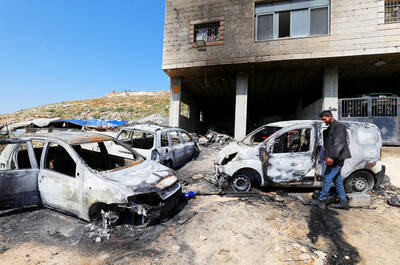
RAMPAGE: A Palestinian man was left dead after dozens of Israeli settlers searching for a missing 14-year-old boy stormed a village in the Israeli-occupied West Bank US President Joe Biden on Friday said he expected Iran to attack Israel “sooner, rather than later” and warned Tehran not to proceed. Asked by reporters about his message to Iran, Biden simply said: “Don’t,” underscoring Washington’s commitment to defend Israel. “We are devoted to the defense of Israel. We will support Israel. We will help defend Israel and Iran will not succeed,” he said. Biden said he would not divulge secure information, but said his expectation was that an attack could come “sooner, rather than later.” Israel braced on Friday for an attack by Iran or its proxies as warnings grew of


 RSS
RSS