


Stemming the flow of illicit drugs from Afghanistan and curbing international terrorism and child pornography will top the agenda at a meeting of G8 interior ministers yesterday, officials say.
Britain's top law enforcement official, Home Secretary Charles Clarke, said 87 percent of heroin and other narcotics came from Afghanistan, despite international efforts led by Britain to stem opium poppy cultivation there.
"The progress we would have liked to see has not happened," said Clarke, briefing reporters in advance of the summit. "It is a big concern. That is why we have put it on the agenda."
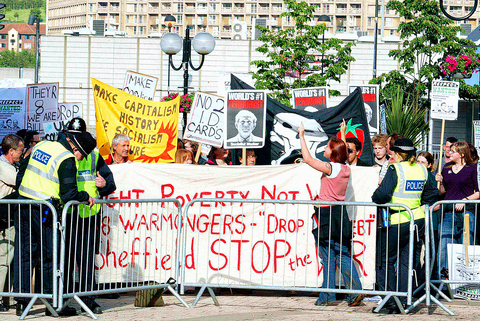
PHOTO: EPA
Afghanistan last year supplied more than 90 percent of the world's opium, the raw material for heroin, sparking warnings that the country was turning into a narco-state just three years after the fall of the Taliban.
Britain is working closely with Afghan President Hamid Karzai's government to tackle the problem. A five-point plan developed in the latter half of last year includes promotion of alternative crops for poppy farmers, ground eradication and interdiction of heroin labs and storage facilities.
The plan appears to be failing, however. Earlier this year a US report said the area in Afghanistan devoted to poppy cultivation last year set a record of more than 206,000 hectares, more than triple the figure for 2003.
"There are a whole string of issues here which are both about the economy of the country, about the systems of controls, about the political issues and it is all that we will be reviewing," Clarke told reporters Wednesday, on the condition that he was not quoted until the opening day of the two day summit in Sheffield, northern England.
Britain is chairing the G8 this year and has already hosted a summit of finance ministers from Japan, the US, Canada, Russia, France, Germany and Italy. The country's leaders will meet in Gleneagles, Scotland, on July 6 to July 8.
The interior ministers will also discuss counter terrorism and will be briefed by the director-general of Britain's MI5 security service, Eliza Manningham-Buller.
"We are working to prevent a new generation of terrorists by analyzing why individuals choose a path of violence and how, for example, they use the Internet to promote radicalization and recruitment," Clarke said.
In related news, German Chancellor Gerhard Schroeder said before a crucial EU summit starting yesterday that Britain's EU budget rebate was no longer justified.
"There is absolutely no justification any longer for the British rebate," Schroeder told the German parliament in a debate on EU policy ahead of the two-day summit.
"Britain is the sixth biggest per capita beneficiary of the EU budget but ranks far below that as a contributor."
He said if the British annual rebate were maintained as it is, it would soon reach more than 7 billion euros (US$8.5 billion) versus 4.5 billion euros currently.
Schroeder described the controversy over the rebate as the "key point" in the debate over the EU's 2007-2013 budget. Germany is the biggest EU contributor nation.
Under a compromise plan unveiled Wednesday, the EU presidency maintained plans to freeze the long-cherished rebate but would drop a reference to then cutting the refund.
The bid to avoid deadlock at the summit also suggested linking the rebate's evolution to agricultural aid after 2013.
Under the previous draft of the EU proposals on the British rebate -- secured by Margaret Thatcher in 1984 -- the rebate would be "fixed" in 2007 and "set on a downward path from the following year."
That formula was rejected as "unacceptable" by the British government, which has called for a new look at the EU farm subsidies program -- of which France is the biggest beneficiary -- if its rebate is called into question.
Nearly half of China’s major cities are suffering “moderate to severe” levels of subsidence, putting millions of people at risk of flooding, especially as sea levels rise, according to a study of nationwide satellite data released yesterday. The authors of the paper, published by the journal Science, found that 45 percent of China’s urban land was sinking faster than 3mm per year, with 16 percent at more than 10mm per year, driven not only by declining water tables, but also the sheer weight of the built environment. With China’s urban population already in excess of 900 million people, “even a small portion

UNSETTLING IMAGES: The scene took place in front of TV crews covering the Trump trial, with a CNN anchor calling it an ‘emotional and unbelievably disturbing moment’ A man who doused himself in an accelerant and set himself on fire outside the courthouse where former US president Donald Trump is on trial has died, police said yesterday. The New York City Police Department (NYPD) said the man was declared dead by staff at an area hospital. The man was in Collect Pond Park at about 1:30pm on Friday when he took out pamphlets espousing conspiracy theories, tossed them around, then doused himself in an accelerant and set himself on fire, officials and witnesses said. A large number of police officers were nearby when it happened. Some officers and bystanders rushed
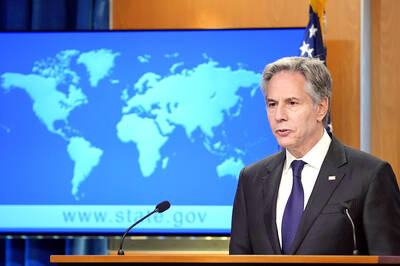
Beijing is continuing to commit genocide and crimes against humanity against Uyghurs and other Muslim minorities in its western Xinjiang province, U.S. Secretary of State Antony Blinken said in a report published on Monday, ahead of his planned visit to China this week. The State Department’s annual human rights report, which documents abuses recorded all over the world during the previous calendar year, repeated language from previous years on the treatment of Muslims in Xinjiang, but the publication raises the issue ahead of delicate talks, including on the war in Ukraine and global trade, between the top U.S. diplomat and Chinese

HYPOCRISY? The Chinese Ministry of Foreign Affairs yesterday asked whether Biden was talking about China or the US when he used the word ‘xenophobic’ US President Joe Biden on Wednesday called for a hike in steel tariffs on China, accusing Beijing of cheating as he spoke at a campaign event in Pennsylvania. Biden accused China of xenophobia, too, in a speech to union members in Pittsburgh. “They’re not competing, they’re cheating. They’re cheating and we’ve seen the damage here in America,” Biden said. Chinese steel companies “don’t need to worry about making a profit because the Chinese government is subsidizing them so heavily,” he said. Biden said he had called for the US Trade Representative to triple the tariff rates for Chinese steel and aluminum if Beijing was


 RSS
RSS