


Human rights activists yesterday brushed aside an admission by Maoists that a bus bombing which killed 36 people was a "grave mistake," saying the rebels had long targeted civilians and urging that those behind the killings be punished.
The Office of the UN High Commissioner for Human Rights (OHCHR) and the government's National Human Rights Commission (NHRC) said separately they would send teams to investigate Monday's bombing.
The rebels have announced their own probe into the attack in Chitwan district, about 180km southwest of Kathmandu, which also wounded more than 70 people packed into and on the roof of the civilian bus.
On Monday the rebels blew apart a passenger bus killing at least 38 people and injuring 71 more. The bus was crossing a wooden bridge in Nepal's rural south when the explosion threw the vehicle into the air.
"A group of People's Liberation Army personnel were involved in the attack and the direct leadership supervising the action have been immediately suspended," said Maoist leader Pushpa Kamal Dahal, also known as Prachanda.
"The ambush was targeted at security personnel and the loss of civilian lives in it was a grave mistake," he said in a statement.
"It is not our party policy to target innocent civilians, and there has been no change in the policy," the statement said, adding that he believed there was "a strong possibility of enemy infiltration in the incident."
Subodh Raj Pyakurel president of independent rights group Informal Sector Service Centre (INSEC) expressed scepticism of the Maoist statement.
"Why should we trust the Maoists who say it was not their policy to attack civilians?" he asked. "They make a mistake and then say it was a grave error and [engage in] self-criticism for the actions, but they continue to make mistakes.
"They have continued to attack and abduct opposition party leaders and activists, continued with extortion and have been targetting civilians," he said.
"The Maoist leader said it was a grave mistake to attack the bus and that those involved have been suspended but he did not say if those involved would be punished," Pyakurel said.
"The practice of impunity has to stop. How could they say it was a mistake when they could very well see the bus was filled with civilians?"
The OHCHR in Nepal condemned the attack.
"This terrible incident constitutes a grave breach of international humanitarian law, for which the perpetrators should be brought to justice," it said in a statement.
Newspapers also joined in the chorus of condemnation.
The Kathmandu Post, demanded "retribution against the culprits for their inhuman act."
"If we let the criminals go scot-free, Nepal's internal war will enter a stage of genocide. It will not become a safe place anymore for humanity," it said.
HUNT FOR GUERILLAS
Soldiers combed jungles of western Nepal yesterday to hunt for communist guerrillas who fled after ambushing an army patrol earlier this week in violence that killed at least 21 combatants, officials said.
Hundreds of soldiers were searching the area around Kailali district, about 550km west of Katmandu on foot, in trucks and in helicopters, a senior army official said.
Troops went to the area after receiving information that hundreds of Maoist rebels were camping there.
The insurgents had ambushed an army patrol on Monday near Shankarpur village, killing at least 13 soldiers and a policeman.
Several rebels also were killed in the ensuing battle, but soldiers recovered only eight rebel bodies, the army said. More rebels were believed killed but their bodies were carried away by surviving guerrillas, and villagers reported seeing dozens of injured rebels being carried away, the army said.
The rebels were believed to have been planning a major attack in the area for months. They were chased away during an army operation in April, but appear to be returning to the area, the senior army official said.
The guerrillas have stepped up violence since Feb. 1, when King Gyanendra took control of the government and imposed a three-month state of emergency.
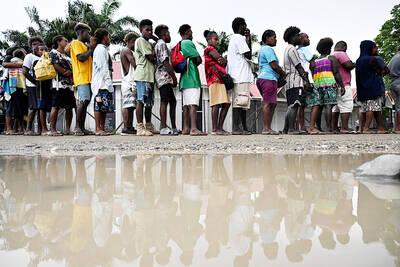
SEEKING CHANGE: A hospital worker said she did not vote in previous elections, but ‘now I can see that maybe my vote can change the system and the country’ Voting closed yesterday across the Solomon Islands in the south Pacific nation’s first general election since the government switched diplomatic allegiance from Taiwan to Beijing and struck a secret security pact that has raised fears of the Chinese navy gaining a foothold in the region. The Solomon Islands’ closer relationship with China and a troubled domestic economy weighed on voters’ minds as they cast their ballots. As many as 420,000 registered voters had their say across 50 national seats. For the first time, the national vote also coincided with elections for eight of the 10 local governments. Esther Maeluma cast her vote in the
Nearly half of China’s major cities are suffering “moderate to severe” levels of subsidence, putting millions of people at risk of flooding, especially as sea levels rise, according to a study of nationwide satellite data released yesterday. The authors of the paper, published by the journal Science, found that 45 percent of China’s urban land was sinking faster than 3mm per year, with 16 percent at more than 10mm per year, driven not only by declining water tables, but also the sheer weight of the built environment. With China’s urban population already in excess of 900 million people, “even a small portion

UNSETTLING IMAGES: The scene took place in front of TV crews covering the Trump trial, with a CNN anchor calling it an ‘emotional and unbelievably disturbing moment’ A man who doused himself in an accelerant and set himself on fire outside the courthouse where former US president Donald Trump is on trial has died, police said yesterday. The New York City Police Department (NYPD) said the man was declared dead by staff at an area hospital. The man was in Collect Pond Park at about 1:30pm on Friday when he took out pamphlets espousing conspiracy theories, tossed them around, then doused himself in an accelerant and set himself on fire, officials and witnesses said. A large number of police officers were nearby when it happened. Some officers and bystanders rushed

HYPOCRISY? The Chinese Ministry of Foreign Affairs yesterday asked whether Biden was talking about China or the US when he used the word ‘xenophobic’ US President Joe Biden on Wednesday called for a hike in steel tariffs on China, accusing Beijing of cheating as he spoke at a campaign event in Pennsylvania. Biden accused China of xenophobia, too, in a speech to union members in Pittsburgh. “They’re not competing, they’re cheating. They’re cheating and we’ve seen the damage here in America,” Biden said. Chinese steel companies “don’t need to worry about making a profit because the Chinese government is subsidizing them so heavily,” he said. Biden said he had called for the US Trade Representative to triple the tariff rates for Chinese steel and aluminum if Beijing was


 RSS
RSS