


Bolivia may hold early presidential and congressional elections as part of a political agreement to end almost three weeks of protests that have paralyzed La Paz and blocked scores of roads across the nation.
An early election, probably in December, is a possibility "that is gaining force in the country," Senate President Hormando Vaca Diez said after meeting Cardinal Julio Terraza and other Roman Catholic Church leaders who are attempting to mediate in the crisis.
"This should have to be done within the constitutional framework," Vaca Diez added after the meeting Saturday in the eastern city of Santa Cruz.
President Carlos Mesa, whose constitutional term ends in August 2007, asked the Catholic Church to mediate in the crisis and on Sunday joined lengthy meetings with the prelates and political leaders.
At the end of the discussions, the Bolivian Bishops Conference said, "There are reasons for hope, because all parties involved have expressed their firm decision to find concrete solutions to the problems faced by the country within the framework of the constitution."
In a communique, the bishops asked for an end to the protests and said the prelates will meet Monday with the leaders of the demonstrations.
The La Paz daily La Razon, quoting unidentified government officials, reported Sunday that the embattled president has indicated he is prepared to allow an "early transition" to a new government.
La Paz was calm Sunday, but marches and protests were expected to resume yesterday. And at least 55 roads remained blocked by protesters throughout the country, isolating major cities and cutting land access to neighboring countries.
At the same time, officials said that the protests were beginning to cause shortages of fuels, food and other essentials, and pushing many prices up.
Government officials have estimated that the protests, which started May 16, are costing the economy around US$20 million.
Protests have been held daily by peasants, miners, students and workers.
They first demanded the nationalization of the oil industry, but soon added a call for a constitutional assembly to write a new constitution to give stronger representation in the society to the indigenous population, which accounts for about 50 percent of Bolivia's 8.3 million population.
Other groups in the eastern and southern provinces were pressing for a referendum to decide on greater autonomy for their regions.
After political parties failed to reach an agreement on the demands, Mesa on Friday called for both the constitutional assembly and the provincial autonomy referendum to be held on Oct. 16. But the leaders of the protests and the political parties did not accept the procedure, saying the initiatives should approved by Congress, not the president.
Faced with stalemate, Mesa turned to the church which is highly influential in a country where 87 percent of the population say they are Catholic.
On Sunday, Pope Benedict XVI said he was particularly concerned about the "worrisome" situation in Bolivia.
"While I invite you to pray for this dear people, I entrust to the Madonna my hope and my call that the search for the common good, the sense of responsibility and the willingness to have an open and faithful dialogue prevails," Benedict said.

Republican US lawmakers on Friday criticized US President Joe Biden’s administration after sanctioned Chinese telecoms equipment giant Huawei unveiled a laptop this week powered by an Intel artificial intelligence (AI) chip. The US placed Huawei on a trade restriction list in 2019 for contravening Iran sanctions, part of a broader effort to hobble Beijing’s technological advances. Placement on the list means the company’s suppliers have to seek a special, difficult-to-obtain license before shipping to it. One such license, issued by then-US president Donald Trump’s administration, has allowed Intel to ship central processors to Huawei for use in laptops since 2020. China hardliners
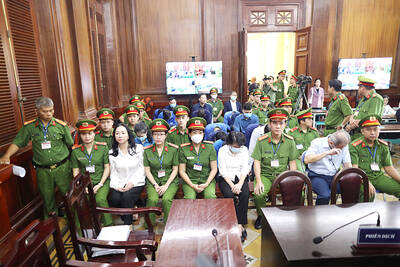
A top Vietnamese property tycoon was on Thursday sentenced to death in one of the biggest corruption cases in history, with an estimated US$27 billion in damages. A panel of three hand-picked jurors and two judges rejected all defense arguments by Truong My Lan, chair of major developer Van Thinh Phat, who was found guilty of swindling cash from Saigon Commercial Bank (SCB) over a decade. “The defendant’s actions ... eroded people’s trust in the leadership of the [Communist] Party and state,” read the verdict at the trial in Ho Chi Minh City. After the five-week trial, 85 others were also sentenced on

Conjoined twins Lori and George Schappell, who pursued separate careers, interests and relationships during lives that defied medical expectations, died this month in Pennsylvania, funeral home officials said. They were 62. The twins, listed by Guinness World Records as the oldest living conjoined twins, died on April 7 at the Hospital of the University of Pennsylvania, obituaries posted by Leibensperger Funeral Homes of Hamburg said. The cause of death was not detailed. “When we were born, the doctors didn’t think we’d make 30, but we proved them wrong,” Lori said in an interview when they turned 50, the Philadelphia Inquirer reported. The
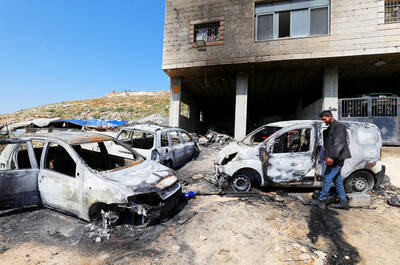
RAMPAGE: A Palestinian man was left dead after dozens of Israeli settlers searching for a missing 14-year-old boy stormed a village in the Israeli-occupied West Bank US President Joe Biden on Friday said he expected Iran to attack Israel “sooner, rather than later” and warned Tehran not to proceed. Asked by reporters about his message to Iran, Biden simply said: “Don’t,” underscoring Washington’s commitment to defend Israel. “We are devoted to the defense of Israel. We will support Israel. We will help defend Israel and Iran will not succeed,” he said. Biden said he would not divulge secure information, but said his expectation was that an attack could come “sooner, rather than later.” Israel braced on Friday for an attack by Iran or its proxies as warnings grew of


 RSS
RSS