


Palestinian President Mahmoud Abbas on Saturday postponed parliamentary elections indefinitely, giving his embattled Fatah party time to halt political infighting and shore up support against a growing challenge from Hamas.
The decision angered Hamas, which accused Abbas of stonewalling to protect his political interests. But the group signaled it would continue to honor a ceasefire with Israel, despite previous threats to abandon the truce if the election date was pushed back.
The election was to have been held July 17. Abbas said Saturday that more time was needed to resolve differences over a new election law. He wants all candidates chosen on national lists, while some Fatah members in parliament prefer voting by district.
"This is to allow for more consultation and for legal measures to take place," Abbas said. "Time is short. Postponement was necessary to allow us to finalize the legal measures and consultations between factions."
Abbas did not give a new date, saying it would be set after discussions with the legislature and rival political parties.
"This decision was taken unilaterally ... and it came as a response to the conditions and the atmosphere of the Fatah movement and not because of any national consideration," said Sami Abu Zuhri, a Hamas spokesman.
While accusing Abbas of violating understandings of the ceasefire agreement, Abu Zuhri indicated that Hamas would continue to honor the truce. He said only that Abbas' decision "might harm the credibility of relations" with Hamas.
Tapping into voter dissatisfaction over years of Fatah corruption, the militant group has captured a number of key races in recent local elections and appears poised for strong gains in the legislative vote as well. It is the first time it will participate in legislative elections.
Abbas reached the ceasefire agreement with Israeli Prime Minister Ariel Sharon on Feb. 8 in an effort to end four years of fighting.
Hamas and other groups agreed to honor the truce in return for pledges from Abbas to give them a formal role in Palestinian decision-making. Violence has dropped sharply since then.
The delay could give Abbas time to hold Fatah primaries, which he believes will yield stronger candidates, and allow him to capitalize on Israel's planned withdrawal from Gaza in August. The withdrawal could also bolster Hamas, whose stronghold is Gaza.
"This plays into the hands of everybody," said Hanan Ashrawi, an independent Palestinian lawmaker. "I believe the period of calm will continue as an act of will and political commitment by the different factions."
Still, the delay further heightened tensions. Hamas is already angry over Fatah's attempts to overturn its victories in three recent local elections in Gaza. A court has ordered a new vote, but election officials postponed a revote last week after Hamas refused to participate.
Nearly half of China’s major cities are suffering “moderate to severe” levels of subsidence, putting millions of people at risk of flooding, especially as sea levels rise, according to a study of nationwide satellite data released yesterday. The authors of the paper, published by the journal Science, found that 45 percent of China’s urban land was sinking faster than 3mm per year, with 16 percent at more than 10mm per year, driven not only by declining water tables, but also the sheer weight of the built environment. With China’s urban population already in excess of 900 million people, “even a small portion
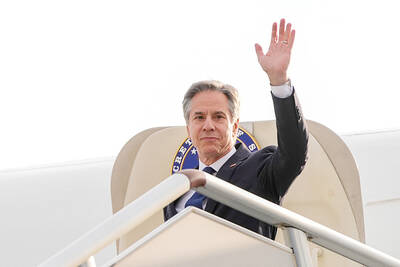
‘IN A DIFFERENT PLACE’: The envoy first visited Shanghai, where he attended a Chinese basketball playoff match, and is to meet top officials in Beijing tomorrow US Secretary of State Antony Blinken yesterday arrived in China on his second visit in a year as the US ramps up pressure on its rival over its support for Russia while also seeking to manage tensions with Beijing. The US diplomat tomorrow is to meet China’s top brass in Beijing, where he is also expected to plead for restraint as Taiwan inaugurates president-elect William Lai (賴清德), and to raise US concerns on Chinese trade practices. However, Blinken is also seeking to stabilize ties, with tensions between the world’s two largest economies easing since his previous visit in June last year. At the

UNSETTLING IMAGES: The scene took place in front of TV crews covering the Trump trial, with a CNN anchor calling it an ‘emotional and unbelievably disturbing moment’ A man who doused himself in an accelerant and set himself on fire outside the courthouse where former US president Donald Trump is on trial has died, police said yesterday. The New York City Police Department (NYPD) said the man was declared dead by staff at an area hospital. The man was in Collect Pond Park at about 1:30pm on Friday when he took out pamphlets espousing conspiracy theories, tossed them around, then doused himself in an accelerant and set himself on fire, officials and witnesses said. A large number of police officers were nearby when it happened. Some officers and bystanders rushed

Beijing is continuing to commit genocide and crimes against humanity against Uyghurs and other Muslim minorities in its western Xinjiang province, U.S. Secretary of State Antony Blinken said in a report published on Monday, ahead of his planned visit to China this week. The State Department’s annual human rights report, which documents abuses recorded all over the world during the previous calendar year, repeated language from previous years on the treatment of Muslims in Xinjiang, but the publication raises the issue ahead of delicate talks, including on the war in Ukraine and global trade, between the top U.S. diplomat and Chinese


 RSS
RSS