


Saad Hariri, the son of slain former prime minister Rafik Hariri, swept parliamentary elections in Lebanon's capital, according to official results announced yesterday for the country's first elections held largely free of Syrian domination.
Riding a sympathy vote, candidates led by Hariri won all 19 seats in the Beirut polls. The election is seen as a tribute to the leader whose February assassination triggered international anger and street protests that ultimately drove the Syrian army out of Lebanon.
Interior Minister Hassan Sabei, announcing the official results at a news conference, said all 10 contested seats were won by Hariri and allies. The remaining nine seats already had been won by candidates on Hariri's ticket before the election because there were no challengers.
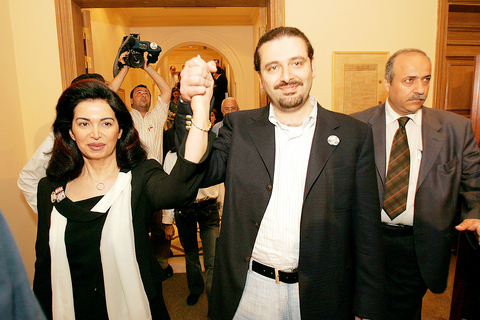
PHOTO: AFP
Hariri was the biggest vote-getter, collecting 39,499 votes -- five times the distant loser in one constituency. But turnout was low, at about 27 percent of the 473,652 eligible voters, compared with 35 percent in the 2000 parliamentary elections.
The weak turnout reflected public dissatisfaction amid calls for a boycott, complaints that the ticket of Saad Hariri, a Sunni Muslim, lacked representation of political factions, and the lack of challengers in some constituencies. Television stations reported the boycott was strong in Christian areas.
Hariri and his allies had begun celebrating even before the official results were announced, after incomplete results indicated victory.
Hundreds of Hariri supporters danced and cheered outside the family's palatial residence in Beirut's Koreitem neighborhood on Sunday night as returns tallied by his campaign showed the Hariri slate winning Beirut's 10 contested seats. Fireworks lit the night sky as the Hariri family went to the grave of the slain leader late on Sunday to pray.
Sunday's vote, which Sabei called "trouble-free," was the first stage of a four-part election. Other regions of Lebanon vote on the next three Sundays.
But there was one minor incident, when fistfights broke out late Sunday between supporters of opposition leader Walid Jumblatt, a Hariri ally, and Najah Wakim, who lost on Sunday. The two sides threw bottles and rocks at each other before police intervened and restored calm, witnesses said.
Many observers expect the polls, the first free of Syrian meddling in 29 years, to sweep the anti-Syrian opposition to power and install a new parliament, removing the last vestiges of Damascus' control.
The vote was watched closely by the US and other outside governments that pushed for a Syrian troop withdrawal and on-time elections, despite an election law widely described as unfair.
Syrian forces withdrew last month after mass demonstrations in Lebanon and relentless international pressure sparked by the February assassination of the former premier. The bombing also killed 20 others. Stephane Dujarric, a spokesman for UN Secretary-General Kofi Annan, said the UN chief was encouraged by the democratic conduct of the first round of Lebanese parliamentary elections and hoped the remaining rounds would take place in the same peaceful atmosphere.
"These elections constitute a major opportunity for the Lebanese people to shape their own future, to strengthen their political institutions and to restore their full sovereignty," Annan said in a statement.
More than 100 observers watched the vote for irregularities, the first time Lebanon has permitted foreign scrutiny.
"I see it as a potential for a new start," said US Senator Joseph Biden, who came to watch the balloting.
The Democrat acknowledged that the new parliament may not be fundamentally different from the previous one, but said the atmosphere had improved because "there's an occupying force that's gone."
Nearly half of China’s major cities are suffering “moderate to severe” levels of subsidence, putting millions of people at risk of flooding, especially as sea levels rise, according to a study of nationwide satellite data released yesterday. The authors of the paper, published by the journal Science, found that 45 percent of China’s urban land was sinking faster than 3mm per year, with 16 percent at more than 10mm per year, driven not only by declining water tables, but also the sheer weight of the built environment. With China’s urban population already in excess of 900 million people, “even a small portion

UNSETTLING IMAGES: The scene took place in front of TV crews covering the Trump trial, with a CNN anchor calling it an ‘emotional and unbelievably disturbing moment’ A man who doused himself in an accelerant and set himself on fire outside the courthouse where former US president Donald Trump is on trial has died, police said yesterday. The New York City Police Department (NYPD) said the man was declared dead by staff at an area hospital. The man was in Collect Pond Park at about 1:30pm on Friday when he took out pamphlets espousing conspiracy theories, tossed them around, then doused himself in an accelerant and set himself on fire, officials and witnesses said. A large number of police officers were nearby when it happened. Some officers and bystanders rushed

HYPOCRISY? The Chinese Ministry of Foreign Affairs yesterday asked whether Biden was talking about China or the US when he used the word ‘xenophobic’ US President Joe Biden on Wednesday called for a hike in steel tariffs on China, accusing Beijing of cheating as he spoke at a campaign event in Pennsylvania. Biden accused China of xenophobia, too, in a speech to union members in Pittsburgh. “They’re not competing, they’re cheating. They’re cheating and we’ve seen the damage here in America,” Biden said. Chinese steel companies “don’t need to worry about making a profit because the Chinese government is subsidizing them so heavily,” he said. Biden said he had called for the US Trade Representative to triple the tariff rates for Chinese steel and aluminum if Beijing was
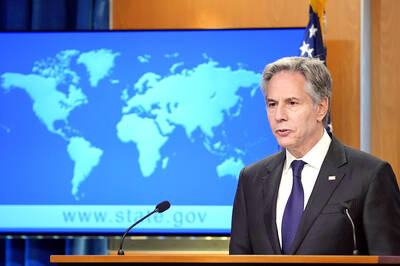
Beijing is continuing to commit genocide and crimes against humanity against Uyghurs and other Muslim minorities in its western Xinjiang province, U.S. Secretary of State Antony Blinken said in a report published on Monday, ahead of his planned visit to China this week. The State Department’s annual human rights report, which documents abuses recorded all over the world during the previous calendar year, repeated language from previous years on the treatment of Muslims in Xinjiang, but the publication raises the issue ahead of delicate talks, including on the war in Ukraine and global trade, between the top U.S. diplomat and Chinese


 RSS
RSS