


South Africa's leading investigative newspaper has been banned by the courts from publishing a report detailing how a state oil company secretly paid public funds to the ruling party, the African National Congress (ANC).
Police surrounded the presses of the Mail & Guardian (M&G) on Thursday night to prevent publication of new allegations of what has become known as the "oilgate" corruption story.
"We have been gagged," the newspaper's editor, Ferial Haffajee, said. "Our biggest concern is press freedom. We believe the public has a right to know what happens with public funds, but we will respect the court's hearing."
The paper scrapped its front page and instead ran a banner stating: "Gagged."
`dangerous precedent'
The court interdict on the story was denounced yesterday as "an extraordinarily dangerous precedent" to South Africa's press freedom, by the press watchdog, the Media Institute for Southern Africa.
The banned story was a follow-up to last week's expose alleging that the state-owned oil company, PetroSA, channelled 11 million rand to the ANC just months before last year's parliamentary elections.
It described how PetroSA paid the money to Imvume, a firm with close ties to the ANC, ostensibly to purchase oil. Imvume, however, gave the money to the ANC election campaign fund in December 2003, according to the report. PetroSA then paid again for the order of oil products, according to the story.
The ANC has denied any wrongdoing. ANC spokesman Smuts Ngonyama said the party was not aware of, or concerned by, the origins of the funds donated by Imvume.
Ngonyama cited a recent court ruling that political parties did not have to make public the donations they receive.
`deep concern'
The Media Institute for Southern Africa yesterday expressed "deep concern that this judgment may open the way for others seeking to prevent newspapers from publishing articles about their questionable or irregular conduct." The institute's deputy chairman, Raymond Louw, said the court order could lead to "legal censorship of the media."
He said: "One of the fundamental services that media in a democratic society fulfill is that of a public watchdog. It would seem that not only has the ruling muzzled this essential function, but it has set an extraordinarily dangerous precedent."
"This is a setback to media freedom," said Haffajee from the M&G's offices Friday.
"But judged by the public outcry and the support we have received from colleagues far and wide, we believe it will be only a temporary one."
She said South Africa's political environment is "relatively transparent, but unfortunately that does not apply to the area of party-political funding."
"It seems that much corruption stems from this legal and policy lacuna," she said. "We are determined to keep highlighting the urgent need for reform."
distinguished record
The M&G is South Africa's leading investigative newspaper.
In the apartheid years it carried numerous accounts of human rights abuses and corruption by the regime. It defied censorship rules designed to suppress news of the ANC's struggle against white rule and the brutality used by the apartheid government to hold on to power.
The new gagging order is the first time the paper has been muzzled since the apartheid state banned the M&G under emergency regulations in the late 1980s, according to the paper.
Since South Africa reached majority rule, the paper has also held the new ANC government accountable for its actions.

Republican US lawmakers on Friday criticized US President Joe Biden’s administration after sanctioned Chinese telecoms equipment giant Huawei unveiled a laptop this week powered by an Intel artificial intelligence (AI) chip. The US placed Huawei on a trade restriction list in 2019 for contravening Iran sanctions, part of a broader effort to hobble Beijing’s technological advances. Placement on the list means the company’s suppliers have to seek a special, difficult-to-obtain license before shipping to it. One such license, issued by then-US president Donald Trump’s administration, has allowed Intel to ship central processors to Huawei for use in laptops since 2020. China hardliners

Conjoined twins Lori and George Schappell, who pursued separate careers, interests and relationships during lives that defied medical expectations, died this month in Pennsylvania, funeral home officials said. They were 62. The twins, listed by Guinness World Records as the oldest living conjoined twins, died on April 7 at the Hospital of the University of Pennsylvania, obituaries posted by Leibensperger Funeral Homes of Hamburg said. The cause of death was not detailed. “When we were born, the doctors didn’t think we’d make 30, but we proved them wrong,” Lori said in an interview when they turned 50, the Philadelphia Inquirer reported. The
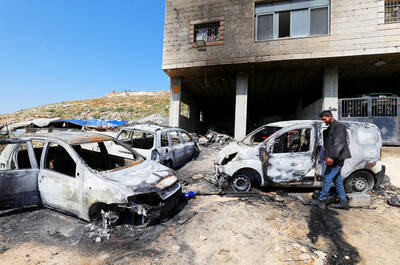
RAMPAGE: A Palestinian man was left dead after dozens of Israeli settlers searching for a missing 14-year-old boy stormed a village in the Israeli-occupied West Bank US President Joe Biden on Friday said he expected Iran to attack Israel “sooner, rather than later” and warned Tehran not to proceed. Asked by reporters about his message to Iran, Biden simply said: “Don’t,” underscoring Washington’s commitment to defend Israel. “We are devoted to the defense of Israel. We will support Israel. We will help defend Israel and Iran will not succeed,” he said. Biden said he would not divulge secure information, but said his expectation was that an attack could come “sooner, rather than later.” Israel braced on Friday for an attack by Iran or its proxies as warnings grew of
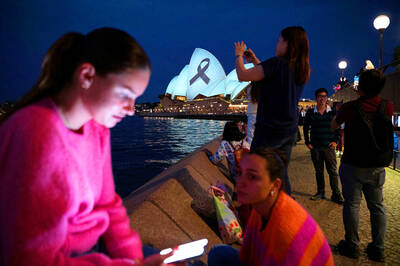
A prominent Christian leader has allegedly been stabbed at the altar during a Mass yesterday in southwest Sydney. Bishop Mar Mari Emmanuel was saying Mass at Christ The Good Shepherd Church in Wakeley just after 7pm when a man approached him at the altar and allegedly stabbed toward his head multiple times. A live stream of the Mass shows the congregation swarm forward toward Emmanuel before it was cut off. The church leader gained prominence during the COVID-19 pandemic, amassing a large online following, Officers attached to Fairfield City police area command attended a location on Welcome Street, Wakeley following reports a number


 RSS
RSS