


Protests over lack of housing and other basic services broke out in several cities across South Africa on Wednesday, underlining the slow pace of change for millions of poor blacks a decade after apartheid's end.
Police fired tear gas and rubber bullets against hundreds of protesters who erected barricades of burning tires in Happy Valley, an inaptly named slum settlement outside Cape Town.
Some 2,000 residents of the poor township of Segunda in the northern Cape marched to the town hall demanding the mayor's resignation for his failure to improve abysmal living conditions.
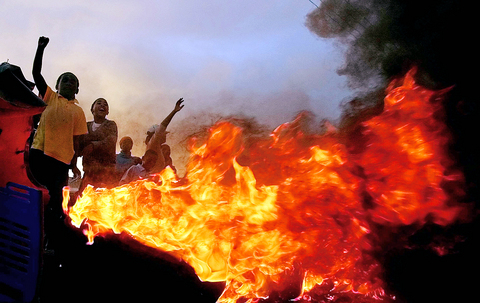
PHOTO: AP
Elsewhere in the northern Cape province, demonstrators blocked a key highway near the diamond center of Kimberly for several hours. In the southern coastal city of Port Elizabeth, tensions were still high following days of protests there.
And in the capital, Pretoria, hundreds of destitute and disabled protesters with banners bearing slogans like "welfare is bleeding, the nation is dying" took to the streets to call for higher benefits.
In a speech to parliament on Wednesday, President Thabo Mbeki said the demonstrations were driven by "feelings among some of the poor that, so far, the democratic order has failed them."
Bantu Holomisa, leader of the small opposition United Democratic Movement, warned of the "danger that these protests could easily spiral out of control."
"A ripple here and a ripple there could easily become a wave of national uprising if valid frustrations are not addressed," Holomisa said.
Eleven years after South Africa's multiracial elections, the government is struggling to overturn the legacy of years of racial segregation and systematic neglect of social and economic rights of the black majority.
The scale of the challenge is overwhelming on the Cape Flats -- a grim, wind-swept collection of crime-infested townships used in the apartheid era to house blacks and mixed-race communities straddling the N2 highway between the graceful center of Cape Town and the airport.
Housing Minister Lindiwe Sisulu has launched the N2 Gateway Project to try to replace the tin and cardboard shacks along the highway by 2010 in a bid to improve the quality of life for hundreds of thousands of locals -- and get rid of an embarrassing eyesore before the anticipated influx of millions of tourists into the "Mother City" for the World Cup soccer finals.
The aim is to build modest family homes and subsidized apartment blocks, and build roads and sewage systems as well as more facilities like schools and clinics. Authorities also want to build housing near the city center, thus reversing apartheid-era policies which forced people to live in the townships far away from their places of work. With only 27 percent of residents having access to electricity and only 3 percent access to flush or chemical toilets in the worst-hit suburbs, tempers have reached breaking point.
"We are not going anywhere until officials tell us what they are going to do," said Nkosinathi Mzayiya, a spokesman for Happy Valley's Backyard Dwellers, so named because they have flimsy shacks in the back yard of someone else's shack.
"There are no services and no schools for the children. Our children have to get up as early as 5 o'clock in the morning to wait for buses to take them to school," he told South African television.
He said unrest was likely to spread to the nearby suburbs of Guguletu and Khayelitsha, where protesters erected barricades and emptied buckets of human waste on a busy thoroughfare earlier this week to protest the total lack of facilities.
At a meeting late Tuesday, Mcebisi Skwaya of the ruling African National Congress pleaded with locals to give authorities more time.
"We can't promise houses in three months because of pressure that there will be violence," he said. "Progress is there but it's going to take time. We are asking people to be patient," said Skwaya.
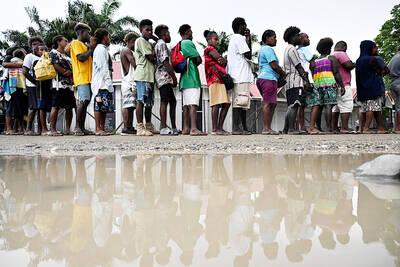
SEEKING CHANGE: A hospital worker said she did not vote in previous elections, but ‘now I can see that maybe my vote can change the system and the country’ Voting closed yesterday across the Solomon Islands in the south Pacific nation’s first general election since the government switched diplomatic allegiance from Taiwan to Beijing and struck a secret security pact that has raised fears of the Chinese navy gaining a foothold in the region. The Solomon Islands’ closer relationship with China and a troubled domestic economy weighed on voters’ minds as they cast their ballots. As many as 420,000 registered voters had their say across 50 national seats. For the first time, the national vote also coincided with elections for eight of the 10 local governments. Esther Maeluma cast her vote in the
Nearly half of China’s major cities are suffering “moderate to severe” levels of subsidence, putting millions of people at risk of flooding, especially as sea levels rise, according to a study of nationwide satellite data released yesterday. The authors of the paper, published by the journal Science, found that 45 percent of China’s urban land was sinking faster than 3mm per year, with 16 percent at more than 10mm per year, driven not only by declining water tables, but also the sheer weight of the built environment. With China’s urban population already in excess of 900 million people, “even a small portion

UNSETTLING IMAGES: The scene took place in front of TV crews covering the Trump trial, with a CNN anchor calling it an ‘emotional and unbelievably disturbing moment’ A man who doused himself in an accelerant and set himself on fire outside the courthouse where former US president Donald Trump is on trial has died, police said yesterday. The New York City Police Department (NYPD) said the man was declared dead by staff at an area hospital. The man was in Collect Pond Park at about 1:30pm on Friday when he took out pamphlets espousing conspiracy theories, tossed them around, then doused himself in an accelerant and set himself on fire, officials and witnesses said. A large number of police officers were nearby when it happened. Some officers and bystanders rushed

HYPOCRISY? The Chinese Ministry of Foreign Affairs yesterday asked whether Biden was talking about China or the US when he used the word ‘xenophobic’ US President Joe Biden on Wednesday called for a hike in steel tariffs on China, accusing Beijing of cheating as he spoke at a campaign event in Pennsylvania. Biden accused China of xenophobia, too, in a speech to union members in Pittsburgh. “They’re not competing, they’re cheating. They’re cheating and we’ve seen the damage here in America,” Biden said. Chinese steel companies “don’t need to worry about making a profit because the Chinese government is subsidizing them so heavily,” he said. Biden said he had called for the US Trade Representative to triple the tariff rates for Chinese steel and aluminum if Beijing was


 RSS
RSS