


After a campaign dominated by promises to end widespread poverty, Mongolians were voting for a new president yesterday, with polls showing the candidate of the former communist ruling party leading three rivals.
If none of the four candidates wins more than 50 percent, a run-off would be held June 5 between the top two.
Voters began lining up even before polls opened at 7am, many wearing traditional Mongolian costumes just for the occasion. Voter turnout is typically very high in Mongolia -- in the last presidential vote it was 83 percent -- a legacy of communist rule before 1990 when voting was compulsory.
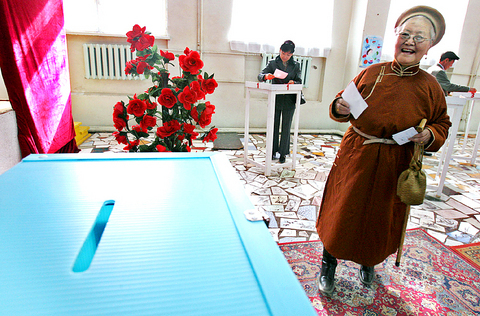
PHOTO: AP
But unlike under communism, "now we can choose," said Janchiv Tserev, 82, who wore his World War II medals pinned to his knee-length maroon tunic.
"Before we could vote for only one person. Now there are four candidates," he said.
For elderly nomads too frail to make it to their voting site, poll workers took ballot boxes to them -- driving out in sport-utility vehicles to the round white tents that dot Mongolia's grasslands.
"It's good to be old, because people come out and take our vote," said Batsukh Tseveenchimed, 62, as she offered bread and tea to the six poll workers -- including opposition party monitors -- who descended on her tent.
"All the candidates sounded the same to me, so I just voted for my old party," she said later of Mongolian People's Revolutionary Party, which governed the country under communism.
"We know that party. That's the party that used to rule Mongolia," she said.
Older voters' loyalty to the ex-communist MPRP has helped put its candidate Nambariin Enkhbayar ahead in opinion polls. The MPRP gave up its monopoly on power in 1990 and has since been voted out and back into power.
Mongolia's economy collapsed after Soviet subsidies ended, and MPRP supporters say they hope the party's experience in government will bring greater stability.
Opposition parties complain that MPRP members still dominate the local election commissions that register voters and staff the polls. Activists demonstrated in the capital earlier this month against the election bodies and said they would be on guard against voter intimidation.
International observers were visiting polling sites yesterday to investigate any complaints.
The Democratic Party's Mendsaikhanin Enkhsaikhan draws his support from anti-communists, who defied police to take the streets in 1990 and bring down one-party rule.
He advocates direct subsidies to poor families, lower taxes for private businesses, and keeping a larger share of profits from foreign mining operations.
The Democrats are hurt by division within their ranks and the memory of their term in power in 1996-2000, when a coalition of anti-communist parties splintered and collapsed.
The other two candidates say Mongolia needs an alternative to the larger parties.
The Republican Party's Bazarsadyn Jargalsaikhan is one of the country's richest men. His Buyan Co processes cashmere, and he says his success as a businessman shows he can bring prosperity.
The Motherland Party's Badarchyn Erdenebat supports a national referendum to give more power to the presidency, in a country where parliament is splintered among many parties and the prime minister changes frequently.
The current president, Natsagiin Bagabandi, is from the MPRP.
The final results are expected today.
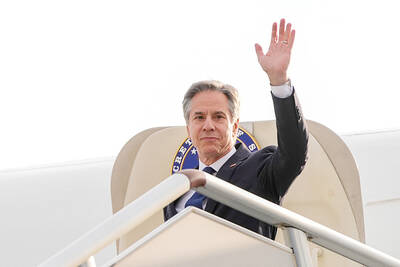
‘IN A DIFFERENT PLACE’: The envoy first visited Shanghai, where he attended a Chinese basketball playoff match, and is to meet top officials in Beijing tomorrow US Secretary of State Antony Blinken yesterday arrived in China on his second visit in a year as the US ramps up pressure on its rival over its support for Russia while also seeking to manage tensions with Beijing. The US diplomat tomorrow is to meet China’s top brass in Beijing, where he is also expected to plead for restraint as Taiwan inaugurates president-elect William Lai (賴清德), and to raise US concerns on Chinese trade practices. However, Blinken is also seeking to stabilize ties, with tensions between the world’s two largest economies easing since his previous visit in June last year. At the
Nearly half of China’s major cities are suffering “moderate to severe” levels of subsidence, putting millions of people at risk of flooding, especially as sea levels rise, according to a study of nationwide satellite data released yesterday. The authors of the paper, published by the journal Science, found that 45 percent of China’s urban land was sinking faster than 3mm per year, with 16 percent at more than 10mm per year, driven not only by declining water tables, but also the sheer weight of the built environment. With China’s urban population already in excess of 900 million people, “even a small portion

UNSETTLING IMAGES: The scene took place in front of TV crews covering the Trump trial, with a CNN anchor calling it an ‘emotional and unbelievably disturbing moment’ A man who doused himself in an accelerant and set himself on fire outside the courthouse where former US president Donald Trump is on trial has died, police said yesterday. The New York City Police Department (NYPD) said the man was declared dead by staff at an area hospital. The man was in Collect Pond Park at about 1:30pm on Friday when he took out pamphlets espousing conspiracy theories, tossed them around, then doused himself in an accelerant and set himself on fire, officials and witnesses said. A large number of police officers were nearby when it happened. Some officers and bystanders rushed
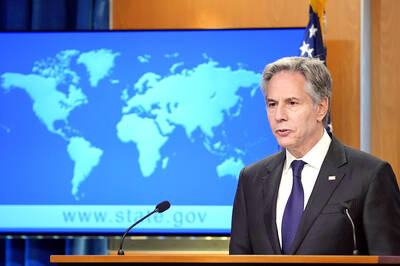
Beijing is continuing to commit genocide and crimes against humanity against Uyghurs and other Muslim minorities in its western Xinjiang province, U.S. Secretary of State Antony Blinken said in a report published on Monday, ahead of his planned visit to China this week. The State Department’s annual human rights report, which documents abuses recorded all over the world during the previous calendar year, repeated language from previous years on the treatment of Muslims in Xinjiang, but the publication raises the issue ahead of delicate talks, including on the war in Ukraine and global trade, between the top U.S. diplomat and Chinese


 RSS
RSS