


Iraq and Iran have issued a joint statement blaming former Iraqi president Saddam Hussein and his henchmen for being the military aggressors in the 1980 to 1988 war between both countries and Iraq's 1990 invasion of Kuwait.
The statement, issued on Thursday during Iranian Foreign Minister Kamal Kharrazi's historic trip to Iraq, comes as the Shiite Muslim-dominated governments of both countries try to forge better ties following Saddam's ouster two years ago.
The former Iraqi dictator, who was captured in December 2003, is facing charges including killing rival politicians during his 30-year rule, gassing Kurds, invading Kuwait in 1990 and suppressing Kurdish and Shiite uprisings in 1991. He is in US military custody with several of his former top aides awaiting trial. No trial dates have been set.
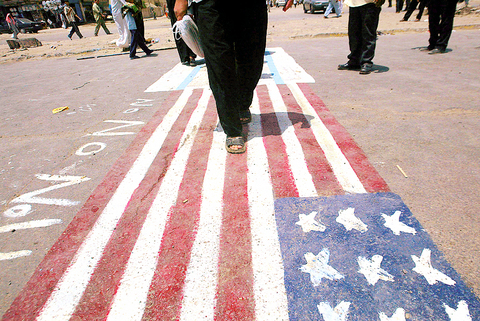
PHOTO: AP
Iraqi officials inside the country's new government and Iran's Shiite-led theocracy have previously blamed the former Iraqi dictator for starting the bloody eight-year war against Iran, in which 1 million people died. But the latest statement, issued by the Iraqi Foreign Ministry, marks the first time Iraq has jointly accused with Iran the former Iraqi president for being the aggressor in the war.
"The two sides confirm the necessity of trying the leaders of the former regime in Iraq in a fair trial because they committed war crimes and crimes against humanity and their military aggression against the Iraqi people, Iran and Kuwait," the statement said.
Shiite lawmaker Jalaleddine al-Saghir said yesterday that Iranian officials have made it clear previously that "they are not after financial compensation, but seeking rehabilitation." He described the statement as a "positive step to solve all problems between the two countries."
Asked if such a statement would anger this country's Sunni Arab community, of which Saddam belonged, al-Saghir said it was not only Iraqi Shiites who accuse the former dictator of being the aggressor in the war with Iran, "but all Iraqis as a state, and the proof is that the foreign minister is a Sunni," referring to Hoshyar Zebari, an Iraqi Kurd.
Iran has said previously it is considering filing a suit against Saddam for invading Iran, which says it is owed billions in war damages. Iraq also owes billions to Kuwait for damage to oil facilities and the environment caused during Iraq's seven-month occupation of Kuwait that began August 1990 and ended with the February liberation by a US-led coalition during the Gulf War. Ties between Kuwait and Iraq have resumed since the fall of Saddam.
During that seven-month Gulf crisis, Iraq flew 120 military and civilian planes to Iran for safekeeping during the war in Kuwait. Tehran since has said it would keep the planes as compensation for war damages it sought from Iraq.
Iraq had started to pay billions of dollars to Kuwaitis who lost possessions and relatives during the Iraqi occupation and the Gulf War. Views among Iraqi Shiites toward Iran range from hate to devotion. Despite 60 percent of Iraq's 26 million people being Shiite, many harbor resentment toward Iran over the war.
In related news, supporters of radical Shiite cleric Muqtada al-Sadr clashed with guards of a provincial governor's office in the southern city of Nasiriyah yesterday. More than 10 people were reported injured. The fighting occurred during an organized parade of about 2,000 members of al-Sadr's al-Mahdi Army followers. A reporter on the scene said the al-Sadr supporters, many holding Islam's holy book, the Koran, above their heads, were marching toward the anti-US cleric's office.
Armed men guarding the headquarters opened fire toward the crowd in an apparent bid to disperse it, prompting retaliatory shooting from al-Sadr supporters. An official said four policemen and four civilians were wounded in the fighting and are being treated. Before the clashes, some of the crowd had stepped on US and Israeli flags.
Al-Sadr launched two uprisings against US forces last year. After the last uprising he went into hiding until surfacing Monday demanding an end to the US-led coalition occupation of Iraq.
In other news, two people were killed in Baghdad in a remote-detonated bomb attack apparently targeting a Shiite mosque in the city, witnesses said yesterday. The US Army in Iraq yesterday admitted firing on a house in Mosul owned by a member of the Iraqi parliament on Thursday. An official statement said troops were targeting "terrorists" who had fired on a US helicopter from the roof of a neighboring building. Eight people are believed to have died in the clash.

Republican US lawmakers on Friday criticized US President Joe Biden’s administration after sanctioned Chinese telecoms equipment giant Huawei unveiled a laptop this week powered by an Intel artificial intelligence (AI) chip. The US placed Huawei on a trade restriction list in 2019 for contravening Iran sanctions, part of a broader effort to hobble Beijing’s technological advances. Placement on the list means the company’s suppliers have to seek a special, difficult-to-obtain license before shipping to it. One such license, issued by then-US president Donald Trump’s administration, has allowed Intel to ship central processors to Huawei for use in laptops since 2020. China hardliners
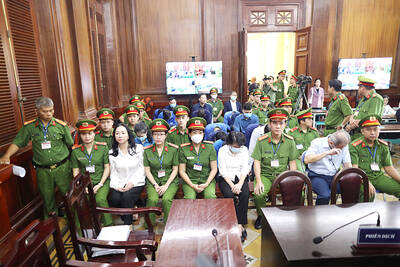
A top Vietnamese property tycoon was on Thursday sentenced to death in one of the biggest corruption cases in history, with an estimated US$27 billion in damages. A panel of three hand-picked jurors and two judges rejected all defense arguments by Truong My Lan, chair of major developer Van Thinh Phat, who was found guilty of swindling cash from Saigon Commercial Bank (SCB) over a decade. “The defendant’s actions ... eroded people’s trust in the leadership of the [Communist] Party and state,” read the verdict at the trial in Ho Chi Minh City. After the five-week trial, 85 others were also sentenced on

Conjoined twins Lori and George Schappell, who pursued separate careers, interests and relationships during lives that defied medical expectations, died this month in Pennsylvania, funeral home officials said. They were 62. The twins, listed by Guinness World Records as the oldest living conjoined twins, died on April 7 at the Hospital of the University of Pennsylvania, obituaries posted by Leibensperger Funeral Homes of Hamburg said. The cause of death was not detailed. “When we were born, the doctors didn’t think we’d make 30, but we proved them wrong,” Lori said in an interview when they turned 50, the Philadelphia Inquirer reported. The
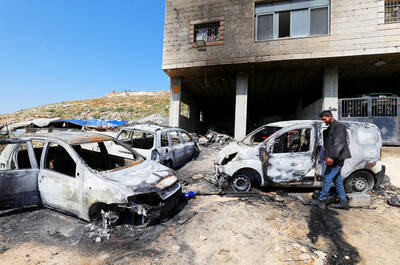
RAMPAGE: A Palestinian man was left dead after dozens of Israeli settlers searching for a missing 14-year-old boy stormed a village in the Israeli-occupied West Bank US President Joe Biden on Friday said he expected Iran to attack Israel “sooner, rather than later” and warned Tehran not to proceed. Asked by reporters about his message to Iran, Biden simply said: “Don’t,” underscoring Washington’s commitment to defend Israel. “We are devoted to the defense of Israel. We will support Israel. We will help defend Israel and Iran will not succeed,” he said. Biden said he would not divulge secure information, but said his expectation was that an attack could come “sooner, rather than later.” Israel braced on Friday for an attack by Iran or its proxies as warnings grew of


 RSS
RSS