


Ethiopia's opposition yesterday backed off a threat to reject nationwide results from hotly contested weekend elections it says were marred by fraud, saying their complaints were limited to key areas.
Instead, opposition leaders said they would protest irregularities and ask national election authorities to conduct new votes in specific places where they believe problems were particularly egregious.
The boycott threat, prompted by angry claims of widespread vote rigging, mass arrests of activists and other abuses, led Prime Minister Meles Zenawi late Sunday to ban all post-election demonstrations for one month.
But as preliminary results began to be posted outside some of the country's more than 30,000 polling stations after massive voter turnout, estimated at 90 percent, opposition leaders toned down their rhetoric.
"I think the decision will come to a compromise to complain around certain areas around Ethiopia," said Hailu Shawl, head of the Coalition for Unity and Democracy (CUD), who had urged his group to consider a blanket boycott.
"It is not a right out rejection of all the election results around the whole country, it is in specific areas where we will complain," he told reporters. "I think we should focus more on the areas where we had problems."
"We have specific areas where the elections have to be redone," Hailu said, citing the eastern region of Afar as being one such place.
The leader of the other main opposition coalition, the United Ethiopian Democratic Forces (UEDF), said his group, which had also threatened to reject the election results, was still considering its options.
The first unofficial compilation of local polling station results is not expected to be released until today, as election authorities wade through millions of ballots to consider challenges and protests.
However, with international observers refusing to endorse their complaints in preliminary assessments and vehement denials from the government and national election board, the opposition appeared to be cornered.
By most accounts, Meles' Ethiopian People's Revolutionary Democratic Front (EPRDF) was likely to have won majority backing from the estimated 90 percent of the country's 26 million voters who cast ballots in the election.
Election officials estimated turnout to be about 95 percent in the capital and at between 80 and 90 percent in the rest of the country, where the EPRDF is particularly strong.
The prime minister appeared confident when he announced the banning of all demonstrations in greater Addis Ababa for the next month and his assumption of direct control of the capital's security forces as the last polls were closing on Sunday night.
Meles praised the election as a success, noting the positive comments from observers from the European Union and US-based Carter Center, but said the moves were necessary to counter "havoc" and "fear" created by the opposition charges.
"This action is just simply a precaution to see that no one is endangered," he said.
Meles, 50, who has run the country since the 1991 ouster of a Soviet-backed dictatorship, believes that the vote will affirm the policies of his west-leaning center-left policies and showcase Ethiopia's burgeoning democracy.

Republican US lawmakers on Friday criticized US President Joe Biden’s administration after sanctioned Chinese telecoms equipment giant Huawei unveiled a laptop this week powered by an Intel artificial intelligence (AI) chip. The US placed Huawei on a trade restriction list in 2019 for contravening Iran sanctions, part of a broader effort to hobble Beijing’s technological advances. Placement on the list means the company’s suppliers have to seek a special, difficult-to-obtain license before shipping to it. One such license, issued by then-US president Donald Trump’s administration, has allowed Intel to ship central processors to Huawei for use in laptops since 2020. China hardliners
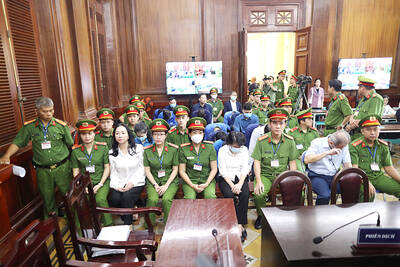
A top Vietnamese property tycoon was on Thursday sentenced to death in one of the biggest corruption cases in history, with an estimated US$27 billion in damages. A panel of three hand-picked jurors and two judges rejected all defense arguments by Truong My Lan, chair of major developer Van Thinh Phat, who was found guilty of swindling cash from Saigon Commercial Bank (SCB) over a decade. “The defendant’s actions ... eroded people’s trust in the leadership of the [Communist] Party and state,” read the verdict at the trial in Ho Chi Minh City. After the five-week trial, 85 others were also sentenced on

Conjoined twins Lori and George Schappell, who pursued separate careers, interests and relationships during lives that defied medical expectations, died this month in Pennsylvania, funeral home officials said. They were 62. The twins, listed by Guinness World Records as the oldest living conjoined twins, died on April 7 at the Hospital of the University of Pennsylvania, obituaries posted by Leibensperger Funeral Homes of Hamburg said. The cause of death was not detailed. “When we were born, the doctors didn’t think we’d make 30, but we proved them wrong,” Lori said in an interview when they turned 50, the Philadelphia Inquirer reported. The
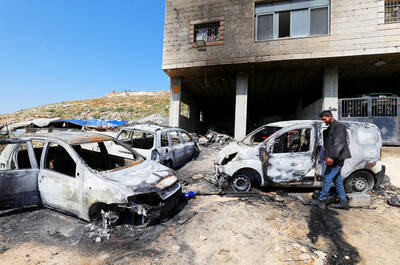
RAMPAGE: A Palestinian man was left dead after dozens of Israeli settlers searching for a missing 14-year-old boy stormed a village in the Israeli-occupied West Bank US President Joe Biden on Friday said he expected Iran to attack Israel “sooner, rather than later” and warned Tehran not to proceed. Asked by reporters about his message to Iran, Biden simply said: “Don’t,” underscoring Washington’s commitment to defend Israel. “We are devoted to the defense of Israel. We will support Israel. We will help defend Israel and Iran will not succeed,” he said. Biden said he would not divulge secure information, but said his expectation was that an attack could come “sooner, rather than later.” Israel braced on Friday for an attack by Iran or its proxies as warnings grew of


 RSS
RSS