


North Korea held senior level negotiations with South Korea yesterday, the first in nearly a year, igniting hopes for a resumption of six-party talks to end the nuclear standoff.
North Korea called for the inter-Korean dialogue over the weekend, breaking a 10-month freeze in relations, while at the same time ratcheting up its propaganda offensive on the US.
US and South Korea officials were encouraged by the move, but cautioned North Korea has a history of trying to strengthen its bargaining position by driving a wedge between Seoul and Washington.
Washington's envoy on North Korea, Christopher Hill, said he was looking for something concrete to emerge after months of deadlock in the nuclear standoff.
"I am tired of looking at signals and reading tea leaves," he was quoted as saying by Yonhap news agency.
Traditionally North Korea refuses to discuss the nuclear standoff at inter-Korean talks, saying the matter is between Pyongyang and Washington.
However, South Korea's top delegate to the talks, Vice Unification Minister Rhee Bong-jo said Pyongyang simply gave Seoul's statement on the nuclear standoff a hearing.
"Urging the North to return to six-way talks, we expressed our wish to prepare an `important offer' to make substantial progress in resolving the nuclear issue if the North comes back," he was quoted as saying after the first day of talks ended.
"They were listening to our position," he added.
North Korea has asked for 500,000 tonnes of urgently needed fertilizer from South Korea and Seoul promised to deliver an undisclosed quantity, according to pool reports from Kaesong, the town just over the border in North Korea where two days of talks began earlier Monday.
The South Korean side denounced North Korea's Feb. 10 announcement in which it claimed it had nuclear weapons, pointing out that it violated a 1992 inter-Korean accord to keep the peninsula free of nuclear weapons.
Hill, the US assistant secretary of state for East Asian and Pacific Affairs, was cautious about the inter-Korean talks.
"Of course, if it can help the six-party process, it will be very good. But we just don't know," Hill said at the foreign ministry where he held separate talks with South Korean Foreign Minister Ban Ki-moon and Deputy Foreign Minister Song Min-soon.
Hill, who was to leave yesterday after a day of official talks, also met with Chang Dong-young, South Korea's Unification Minister who is in charge of handling ties with North Korea.
North Korea has raised the stakes in the nuclear standoff in recent weeks amid speculation it was planning a nuclear test after announcing in February that it possessed nuclear weapons.
US National Security Adviser Stephen Hadley on Sunday said an atomic test would trigger unspecified action by the US and its allies.
Hill also said Washington was looking at other options to deal with the standoff.
"We're doing everything we can do to get this six party process going," he said.
"And we really want to, but that doesn't mean we're not going to look eventually at other options, because we have to."
China, Japan, Russia, South Korea and the US have been seeking to entice North Korea to return to six-party talks since last June, when the last of three inconclusive rounds was held.
As concern grew about a possible test, North Korea triggered alarm by announcing last Wednesday it had completed the unloading of spent nuclear fuel rods form its nuclear reactor at Yongbyon.
North Korea can dramatically increase its arsenal if it reprocesses the rods into plutonium.
At the same time, North Korea has been sending mixed messages about its willingness to attend talks.
Japan's Asahi Shimbun said a senior state department official had contacted North Korea's New York-based deputy UN ambassador Han Song-ryol last week in a move that could indicate progress in behind-the-scenes negotiations.
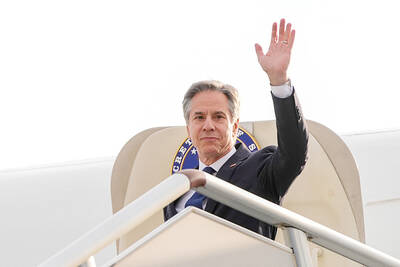
‘IN A DIFFERENT PLACE’: The envoy first visited Shanghai, where he attended a Chinese basketball playoff match, and is to meet top officials in Beijing tomorrow US Secretary of State Antony Blinken yesterday arrived in China on his second visit in a year as the US ramps up pressure on its rival over its support for Russia while also seeking to manage tensions with Beijing. The US diplomat tomorrow is to meet China’s top brass in Beijing, where he is also expected to plead for restraint as Taiwan inaugurates president-elect William Lai (賴清德), and to raise US concerns on Chinese trade practices. However, Blinken is also seeking to stabilize ties, with tensions between the world’s two largest economies easing since his previous visit in June last year. At the
Nearly half of China’s major cities are suffering “moderate to severe” levels of subsidence, putting millions of people at risk of flooding, especially as sea levels rise, according to a study of nationwide satellite data released yesterday. The authors of the paper, published by the journal Science, found that 45 percent of China’s urban land was sinking faster than 3mm per year, with 16 percent at more than 10mm per year, driven not only by declining water tables, but also the sheer weight of the built environment. With China’s urban population already in excess of 900 million people, “even a small portion

UNSETTLING IMAGES: The scene took place in front of TV crews covering the Trump trial, with a CNN anchor calling it an ‘emotional and unbelievably disturbing moment’ A man who doused himself in an accelerant and set himself on fire outside the courthouse where former US president Donald Trump is on trial has died, police said yesterday. The New York City Police Department (NYPD) said the man was declared dead by staff at an area hospital. The man was in Collect Pond Park at about 1:30pm on Friday when he took out pamphlets espousing conspiracy theories, tossed them around, then doused himself in an accelerant and set himself on fire, officials and witnesses said. A large number of police officers were nearby when it happened. Some officers and bystanders rushed

Beijing is continuing to commit genocide and crimes against humanity against Uyghurs and other Muslim minorities in its western Xinjiang province, U.S. Secretary of State Antony Blinken said in a report published on Monday, ahead of his planned visit to China this week. The State Department’s annual human rights report, which documents abuses recorded all over the world during the previous calendar year, repeated language from previous years on the treatment of Muslims in Xinjiang, but the publication raises the issue ahead of delicate talks, including on the war in Ukraine and global trade, between the top U.S. diplomat and Chinese


 RSS
RSS