


Dressed in flowing brown robe and turban, Abu Jibril raised his fist and promised worshippers in a packed suburban mosque that every coin they donate to overthrow Indonesia's secular government will be repaid hundreds of times over in heaven.
"The government no longer looks to Allah, but to America," said the soft-spoken preacher, who argues that only jihad, or holy war, can establish an Islamic state in the 210 million-strong country, home to more Muslims than any other. "Prepare your forces and banish the enemy."
Two years after Washington blocked Jibril's assets and declared him a terrorist -- the alleged "primary recruiter and second in command" of Southeast Asia's deadliest al-Qaeda-linked group, Jemaah Islamiyah -- he's back delivering extremist sermons.
Indonesian authorities keep Jibril under surveillance, but say they have no evidence he has committed a crime in the country, where he was deported after his release a year ago from prison in Malaysia. Now, he travels, preaches and meets other known extremists and followers.
His case presents a dilemma for Indonesia as it tries to balance US demands to further crack down on Islamic terrorists with the need to preserve democratic freedoms ushered in after the 1998 downfall of the dictator Suharto.
It also illustrates the difficulties authorities in Southeast Asia and elsewhere face in bringing to court terrorist suspects who have operated outside their countries. In cases against alleged militants, getting admissible evidence across borders has proved difficult.
Jibril, who is also known by a host of aliases including Mohammed Iqbal bin Abdul Rahman, denies having terrorist links and insists the US allegations against him are false.
"They are no surprise because they come from a government of unbelievers," he told reporters, sitting cross-legged on the floor of the Ar-Rahma Mosque on the grounds of a hospital in south Jakarta. "If they have proof, why don't they present it?"
But Jibril, 47, won't talk about his past, saying with a smile, "It is a long story."
In January 2003, the US Treasury Department blocked Jibril's assets and accused him of being the "primary recruiter and second in command" of Jemaah Islamiyah, whose operations span 10 years and a half-dozen Southeast Asian countries.
The group, which officials say got funding from al-Qaeda, is blamed for the 2002 bombings that killed 202 people on the resort island of Bali, a 2003 suicide bombing at a US-owned hotel in Jakarta and a string of other attacks and plots against Western targets.
In Washington, Treasury Department spokeswoman Molly Millerwise said Jibril's designation was based on domestic and foreign intelligence. She declined to give details -- including how much money was frozen -- or say if the information was shared with Indonesian authorities.
In his sermon last month, Jibril said Muslims were obliged to join a jihad to topple Indonesia's government and replace it with one based on Islamic law or Shariah.
"Those who say a jihad is not necessary are speaking nonsense," he said, without explicitly stating what form this holy war should take. Mainstream Islamic thinking argues violent jihad is only permissible in self-defense.
Two policemen assigned to monitor the meeting sat in one corner, struggling to stay awake.

Republican US lawmakers on Friday criticized US President Joe Biden’s administration after sanctioned Chinese telecoms equipment giant Huawei unveiled a laptop this week powered by an Intel artificial intelligence (AI) chip. The US placed Huawei on a trade restriction list in 2019 for contravening Iran sanctions, part of a broader effort to hobble Beijing’s technological advances. Placement on the list means the company’s suppliers have to seek a special, difficult-to-obtain license before shipping to it. One such license, issued by then-US president Donald Trump’s administration, has allowed Intel to ship central processors to Huawei for use in laptops since 2020. China hardliners

Conjoined twins Lori and George Schappell, who pursued separate careers, interests and relationships during lives that defied medical expectations, died this month in Pennsylvania, funeral home officials said. They were 62. The twins, listed by Guinness World Records as the oldest living conjoined twins, died on April 7 at the Hospital of the University of Pennsylvania, obituaries posted by Leibensperger Funeral Homes of Hamburg said. The cause of death was not detailed. “When we were born, the doctors didn’t think we’d make 30, but we proved them wrong,” Lori said in an interview when they turned 50, the Philadelphia Inquirer reported. The
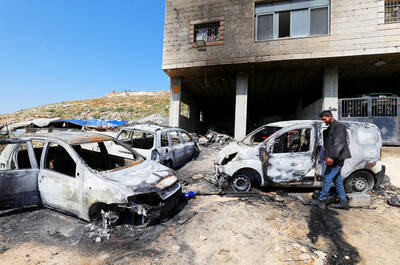
RAMPAGE: A Palestinian man was left dead after dozens of Israeli settlers searching for a missing 14-year-old boy stormed a village in the Israeli-occupied West Bank US President Joe Biden on Friday said he expected Iran to attack Israel “sooner, rather than later” and warned Tehran not to proceed. Asked by reporters about his message to Iran, Biden simply said: “Don’t,” underscoring Washington’s commitment to defend Israel. “We are devoted to the defense of Israel. We will support Israel. We will help defend Israel and Iran will not succeed,” he said. Biden said he would not divulge secure information, but said his expectation was that an attack could come “sooner, rather than later.” Israel braced on Friday for an attack by Iran or its proxies as warnings grew of
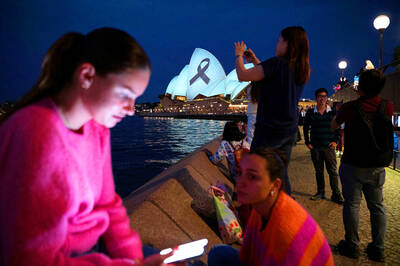
A prominent Christian leader has allegedly been stabbed at the altar during a Mass yesterday in southwest Sydney. Bishop Mar Mari Emmanuel was saying Mass at Christ The Good Shepherd Church in Wakeley just after 7pm when a man approached him at the altar and allegedly stabbed toward his head multiple times. A live stream of the Mass shows the congregation swarm forward toward Emmanuel before it was cut off. The church leader gained prominence during the COVID-19 pandemic, amassing a large online following, Officers attached to Fairfield City police area command attended a location on Welcome Street, Wakeley following reports a number


 RSS
RSS