


Steve Levitt's world is economics, but he has no patience for inflation charts or stock market tables. He'd much prefer to plunge into a scholarly study of ... cheating sumo wrestlers.
Or slippery real estate agents. Or drug-dealing gang members.
Levitt is a maverick economist at the University of Chicago, a school known for esteemed scholars who've paved a path to Stockholm, Sweden: Five Nobel Prize winners in economics are on the faculty. Eighteen others were students, researchers or professors at Chicago.
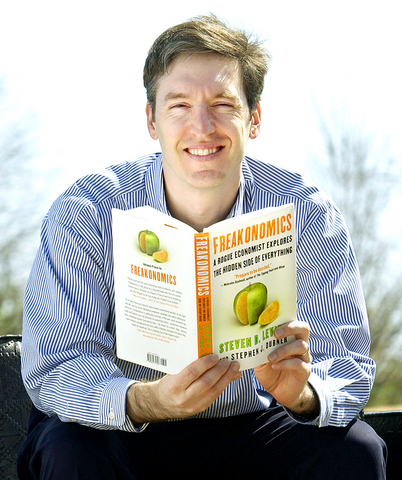
PHOTO: AP
With a boyish curiosity and a powerhouse resume (Harvard, M.I.T., Chicago), Levitt has explored everything from provocative social issues -- linking abortion and lower crime rates -- to patterns of ethnic and age bias among TV game show contestants.
"It's not like I go looking for trouble," Levitt says. "But I try to find unusual ways to ask questions that people care about. And the most interesting answers you can come up with are the ones that are absolutely true and completely unexpected."
Levitt summarizes his unorthodox research in a new book, Freakonomics: A Rogue Economist Explores the Hidden Side of Everything. With co-author Stephen Dubner, he details some eyebrow-raising findings:
Guns kill fewer kids than swimming pools. Gang members may not be mama's boys, but they often share mama's house. The Ku Klux Klan and real estate agents have something in common.
Not typical fodder for an economics book -- one that manages to mention both W.C. Fields and John Kenneth Galbraith -- but that probably helped it climb to No. 2 on Amazon.com's nonfiction list.
Levitt claims his father wasn't all that impressed and teasingly told his son: "This is the Levitt family's biggest accomplishment this week."
At age 37, Levitt already has compiled some impressive accomplishments: In 2003, he won the John Bates Clark medal, an award given to the leading US economist under age 40 that is regarded by some as a junior Nobel. He has a legion of admirers and his share of critics. And a host of businesses are knocking on his door -- everyone from the New York Yankees to General Motors.
Levitt has always been fascinated by corruption and crime. Growing up in Minneapolis, Cops was his favorite TV show.
"Ever since I was a kid, I've been attracted to the dark side," he says.
But young Steve also liked to fiddle around with correlations on a calculator, study stock options in The Wall Street Journal and hole up in his room playing simulation baseball board games.
He started out doing economic research on political campaigns, but when that didn't appeal to him, he says he decided: "I'm just going to study things I like and I'm just going to roll the dice. Maybe it's going to turn out that other people are going to care and maybe it's not."
They cared, all right. Levitt and John Donohue, then of Stanford University Law School, created an uproar in 2001 when they concluded that legalized abortion significantly contributed to a drop in crime in the 1990s. Here's Levitt's explanation: "Legalized abortion lowered unwantedness. Unwantedness is related to crime, so legalized abortion lowered crime."
Angry letters poured in. The right and the left fumed. The authors were branded racists proposing a form of eugenics. Levitt insists he was stunned by the reaction and the study made no moral judgments on abortion.
"It never occurred to us that anybody would be upset," he says. "I've done a lot of research. No one ever cares."
Some critics complained the study used limited data. Others claimed it misinterpreted numbers and made unfair comparisons.
"He's picking up the decline in crack and calling it the abortion effect," says Ted Joyce, an economics professor and expert on reproductive health policy at Baruch College in New York.
Joyce's own study found abortion had no measurable impact on crime.
Levitt took on another social issue when he teamed up with another researcher to develop a statistical method that found a small number of Chicago teachers cheated on standardized tests to help their students. Those findings led to disciplinary action.
Levitt is intrigued by incentives -- financial, moral and social, good and bad. And he found them in the wrestling ring. Levitt co-authored a study that analyzed the won-loss records of sumo wrestlers in tournaments and concluded the matches were rigged. Levitt says he didn't hear a peep from the Japanese press -- even after sending the findings to the Japanese version of the National Enquirer.
Levitt is now working with a foreign bank to analyze banking records to catch terrorists.
"I think following money is the wrong idea," he says. "I'm looking at something more mundane -- how they use banks, what kinds of transactions they do."
He's also studying the impact of crack-cocaine on society. And he knows there will be more repercussions ahead. Maybe even from that comparison of the Klan with real estate agents.
"We have not heard anyone complain," he says, then pauses. "My guess is that's coming."

Republican US lawmakers on Friday criticized US President Joe Biden’s administration after sanctioned Chinese telecoms equipment giant Huawei unveiled a laptop this week powered by an Intel artificial intelligence (AI) chip. The US placed Huawei on a trade restriction list in 2019 for contravening Iran sanctions, part of a broader effort to hobble Beijing’s technological advances. Placement on the list means the company’s suppliers have to seek a special, difficult-to-obtain license before shipping to it. One such license, issued by then-US president Donald Trump’s administration, has allowed Intel to ship central processors to Huawei for use in laptops since 2020. China hardliners

Conjoined twins Lori and George Schappell, who pursued separate careers, interests and relationships during lives that defied medical expectations, died this month in Pennsylvania, funeral home officials said. They were 62. The twins, listed by Guinness World Records as the oldest living conjoined twins, died on April 7 at the Hospital of the University of Pennsylvania, obituaries posted by Leibensperger Funeral Homes of Hamburg said. The cause of death was not detailed. “When we were born, the doctors didn’t think we’d make 30, but we proved them wrong,” Lori said in an interview when they turned 50, the Philadelphia Inquirer reported. The

RAMPAGE: A Palestinian man was left dead after dozens of Israeli settlers searching for a missing 14-year-old boy stormed a village in the Israeli-occupied West Bank US President Joe Biden on Friday said he expected Iran to attack Israel “sooner, rather than later” and warned Tehran not to proceed. Asked by reporters about his message to Iran, Biden simply said: “Don’t,” underscoring Washington’s commitment to defend Israel. “We are devoted to the defense of Israel. We will support Israel. We will help defend Israel and Iran will not succeed,” he said. Biden said he would not divulge secure information, but said his expectation was that an attack could come “sooner, rather than later.” Israel braced on Friday for an attack by Iran or its proxies as warnings grew of

A prominent Christian leader has allegedly been stabbed at the altar during a Mass yesterday in southwest Sydney. Bishop Mar Mari Emmanuel was saying Mass at Christ The Good Shepherd Church in Wakeley just after 7pm when a man approached him at the altar and allegedly stabbed toward his head multiple times. A live stream of the Mass shows the congregation swarm forward toward Emmanuel before it was cut off. The church leader gained prominence during the COVID-19 pandemic, amassing a large online following, Officers attached to Fairfield City police area command attended a location on Welcome Street, Wakeley following reports a number


 RSS
RSS