


The Nasa Indians appear to live well on their lush Rhode Island-size reservation in southern Colombia, a swath of mountains and valleys where sweet fruit grows wild, trout teem in fast-flowing creeks and colorful birds dart about.
They live in tidy well-kept homes, growing coffee, bananas and beans. They produce milk. Placing a great emphasis on economic independence, they run a successful fish farm and are trying to strike up a marble mine.
The one major threat to their existence is Colombia's unrelenting civil conflict, which has ground on for 41 years. But the Nasa, an Indian nation that numbers about 100,000 in this region, has used a pacific civil resistance campaign to stay out of the drug-fueled war, which pits the army and right-wing paramilitaries against Marxist rebels intent on toppling the state.

PHOTO: THE NY TIMES
For four years, the Nasa's stern-faced but unarmed Indigenous Guards -- now a force of 7,000 men and women -- have simply driven away the fighters who venture into their fog-shrouded mountains in Cauca Province. They confront rebel and soldier alike with ceremonial .91m batons decorated with tassels in the colors of the Nasa flag, green and red, and, drawing on their powers of persuasion and numerical superiority, pressure the outsiders to leave.
Their success is legendary, earning the acclaim of the UN and the foreign governments that pay for Nasa development programs.
The Indians have forced traffickers to close down cocaine-producing labs. They have faced down paramilitary death squads. When the mayor of the Nasa town of Toribio was kidnapped by guerrillas last year, 400 guards marched for two weeks over the Andes to the rebel camp where he was being held. They won his release.
"We do not want armed groups on our land," said Julio Mesa, 57, the leader of the Indigenous Guards in Tacueyo. "So what we do is we get people together and get them out."
But in recent weeks, brutal fighting has swept into three of the Nasa's eight towns, testing the Indians' pacifism and autonomy as never before.
Starting on April 14, the rebels began rocket attacks on the Nasa town of Toribio. In nine days of fighting, a 9-year-old boy and several policemen and soldiers were killed. The government took back the town, but rebels pounded another community, Jambalo, with their notoriously inaccurate mortars, propane tanks armed with explosives.
Tacueyo was next.
Last Wednesday, with a Colombian military plane raining down bullets on rebel positions, dozens of young soldiers supported by light tanks and armored vehicles stormed Tacueyo. The rebels responded by firing nearly a dozen of the makeshift mortars. Soldiers answered back with their mounted machine guns from the central square.
"What worries me are the sharpshooters," said one baby-faced soldier, Andres Nova, 24, as he squeezed up against a wall for protection. "They are not that good, but anyone with a rifle is a danger."
Shortly after, snipers killed a soldier with a long-range shot to the head, and wounded two others.
Tacueyo's Indians were caught in the middle. When a rebel rocket landed on a house, severely injuring two children, Mesa and others ran to help. They looked stunned and helpless.
"How can we deal with this?" Mesa said. "They're just shooting off these things. What can we do? It lands wherever it lands."
Mesa, 57, and his wife, Marma, 54, also a member of the guard, had spoken to the rebels early on.
"They said, `We're at war,'" Mesa recounted. "There was nothing more to say, so I left. But first I told them, `What you're doing is very bad.'"
Across Colombia, dozens of Indian tribes are being hammered by the war. Assassins single out leaders of the Wayuu in northeastern Colombia. In northwestern Choco state, Embera children, whipsawed by war and poverty, have committed suicide. Nationwide, tens of thousands of Indians have become refugees. Some of the smaller tribes, the UN recently warned, are on the verge of disappearing.
Mesa and other Nasa leaders are determined to see their nation avoid that fate.
The Nasa, also known here as the Paez, were not always peaceful. In the 1980s, they formed a fighting group, Quintin Lame, but the violence only escalated. The Indians changed tactics, and vowed to stay out of the fighting. They focused on building a self-sustaining community held together by an overarching philosophy of self-determination and the right to be left alone.
"The government wants to involve us, in their army, in the police, in their informants network," explained Nelson Lemus, an Indian leader. "The guerrillas, they want us to get involved in the revolutionary story, the fight for power."
But "getting involved in war," he said, "hurts our culture, our language, our ways."
As Mesa spoke about the Nasa's efforts to keep the peace, a sniper's bullet came close and the Indian leader and other guards hit the ground.
"We want to talk, to see if they will listen," Mesa said, dusting himself off after the shooting ended. "Sometimes they do listen to us, but lots of time, they do not."
For the army, whose commanders met with the Indians throughout the ordeal, there could be no withdrawal, though Colonel Juan Trujillo said he understood the Nasa's position. But he said it was the army's job to fight off the rebels.
"We are the state here," he said.
Still, Mesa was not about to give up. One recent day, he calmly trudged across Tacueyo, generally oblivious to the shooting around him. What he faced, though, was at times heartbreaking. A 2-week-old girl had died; villagers debated whether the missiles and bullets that had raked the fields near her home were to blame.
But not all the news was bad. When townspeople became concerned that light tanks were being positioned too close to where most villagers had escaped, Mesa was able to get a tank commander to hold off.
And when a young man was detained by soldiers, suspected of helping the rebels, Mesa was able to get the army to turn over the young man.
"You see," Mesa said, leading him away. "Talking is the best way to resolve things."
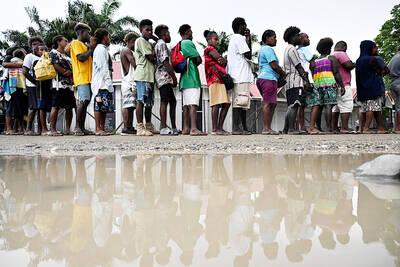
SEEKING CHANGE: A hospital worker said she did not vote in previous elections, but ‘now I can see that maybe my vote can change the system and the country’ Voting closed yesterday across the Solomon Islands in the south Pacific nation’s first general election since the government switched diplomatic allegiance from Taiwan to Beijing and struck a secret security pact that has raised fears of the Chinese navy gaining a foothold in the region. The Solomon Islands’ closer relationship with China and a troubled domestic economy weighed on voters’ minds as they cast their ballots. As many as 420,000 registered voters had their say across 50 national seats. For the first time, the national vote also coincided with elections for eight of the 10 local governments. Esther Maeluma cast her vote in the
Nearly half of China’s major cities are suffering “moderate to severe” levels of subsidence, putting millions of people at risk of flooding, especially as sea levels rise, according to a study of nationwide satellite data released yesterday. The authors of the paper, published by the journal Science, found that 45 percent of China’s urban land was sinking faster than 3mm per year, with 16 percent at more than 10mm per year, driven not only by declining water tables, but also the sheer weight of the built environment. With China’s urban population already in excess of 900 million people, “even a small portion

UNSETTLING IMAGES: The scene took place in front of TV crews covering the Trump trial, with a CNN anchor calling it an ‘emotional and unbelievably disturbing moment’ A man who doused himself in an accelerant and set himself on fire outside the courthouse where former US president Donald Trump is on trial has died, police said yesterday. The New York City Police Department (NYPD) said the man was declared dead by staff at an area hospital. The man was in Collect Pond Park at about 1:30pm on Friday when he took out pamphlets espousing conspiracy theories, tossed them around, then doused himself in an accelerant and set himself on fire, officials and witnesses said. A large number of police officers were nearby when it happened. Some officers and bystanders rushed

HYPOCRISY? The Chinese Ministry of Foreign Affairs yesterday asked whether Biden was talking about China or the US when he used the word ‘xenophobic’ US President Joe Biden on Wednesday called for a hike in steel tariffs on China, accusing Beijing of cheating as he spoke at a campaign event in Pennsylvania. Biden accused China of xenophobia, too, in a speech to union members in Pittsburgh. “They’re not competing, they’re cheating. They’re cheating and we’ve seen the damage here in America,” Biden said. Chinese steel companies “don’t need to worry about making a profit because the Chinese government is subsidizing them so heavily,” he said. Biden said he had called for the US Trade Representative to triple the tariff rates for Chinese steel and aluminum if Beijing was


 RSS
RSS