


Conservative Party leader Michael Howard, fighting against the odds to become Britain's prime minister, branded Tony Blair a liar -- about the quality of intelligence in the run-up to the Iraq war and about the weakness of the legal case for the invasion.
"I'm not criticizing [Blair] for going to war. I'm criticizing him for not telling the truth and for not having a plan" for securing the peace afterwards, Howard said in an interview with reporters on Friday.
"He has a track record of not telling the truth. That's why character and trust are an issue in this election."
Howard, the Tories' third leader since Blair took office in a landslide victory in 1997, has attacked the government on several fronts -- immigration, crime, health and the decision to go to war -- but without yet denting the government's lead in opinion polls.
Howard's focus on Iraq is compromised by his own support for the war, and his stance that he'd have supported the Bush administration even if he'd known Saddam Hussein had no weapons of mass destruction.
Howard clearly sees political capital in questioning whether voters can trust Blair.
But a poll published yesterday suggested that the tactic was backfiring. Some 21 percent of the sample in the Populus tracker poll said they were less likely to vote Labor because of the "liar" allegations, but 44 percent said they were less likely to vote Conservative because of the tactic. Three-fifths of the sample agreed with the suggestion that Conservatives had resorted to name-calling because they lacked a positive campaign.
Populus interviewed 730 adults on Wednesday and Thursday, the days when the Iraq war issue reached a peak. The survey had a margin of error of four percentage points.
The war became a major campaign issue this week as Attorney General Lord Goldsmith's advice on the legality of the conflict was leaked in part, then released in full by the prime minister's office.
The memo, which Blair had steadfastly refused to disclose for two years, revealed Goldsmith's doubts about the legality of going to war without a second UN Security Council resolution. That contrasted with his publicly disclosed summary days later which said a second resolution was not necessary.
Until Blair released the text, Howard told reporters, "we didn't know that the advice was full of caveats and warnings, we didn't know that it changed so much."
Former Labor Party leader Neil Kinnock says he fears the dispute over Iraq this week has badly knocked the party's campaign off course with just days to go before the May 5 vote.
"It is a massive diversion of the campaign for reasons which are understandable -- it's a question of war and peace and the conduct of government so there is a legitimate matter in any general election in a democracy," Kinnock said in an interview to be broadcast this weekend.
Nevertheless, Blair's personal rating has risen: 44 percent of all voters said in The Guardian poll that he would make the best prime minister, up seven points in a week, while Howard's rating dropped from 27 percent to 22 percent.
The survey of 1,547 adults by ICM had a margin of error of three percentage points. Interviews were conducted April 24-26 -- before Goldsmith's memo was published on Thursday.
Blair, 51, and Howard, 63, were both heckled by a television audience Thursday night as they defended their positions on the war, and both sought to change the subject on Friday.
Blair would have lost the crucial vote in the House of Commons on going to war without the help of most of the Conservative members.
Though Howard wasn't the Tory leader then, he hasn't disavowed the war but has hit on issues such as Blair's use of what proved to be flawed intelligence. And that's why he calls Blair a liar.
"We know that the intelligence said on its face that it was limited, sporadic and patchy," Howard said. "[Blair] said the intelligence was extensive, detailed and authoritative. There's no way you can match up those two sets of words."
Howard said he still could have made a strong case for war, even knowing that Saddam didn't possess the weapons of mass destruction he was thought to have.
Nearly half of China’s major cities are suffering “moderate to severe” levels of subsidence, putting millions of people at risk of flooding, especially as sea levels rise, according to a study of nationwide satellite data released yesterday. The authors of the paper, published by the journal Science, found that 45 percent of China’s urban land was sinking faster than 3mm per year, with 16 percent at more than 10mm per year, driven not only by declining water tables, but also the sheer weight of the built environment. With China’s urban population already in excess of 900 million people, “even a small portion

UNSETTLING IMAGES: The scene took place in front of TV crews covering the Trump trial, with a CNN anchor calling it an ‘emotional and unbelievably disturbing moment’ A man who doused himself in an accelerant and set himself on fire outside the courthouse where former US president Donald Trump is on trial has died, police said yesterday. The New York City Police Department (NYPD) said the man was declared dead by staff at an area hospital. The man was in Collect Pond Park at about 1:30pm on Friday when he took out pamphlets espousing conspiracy theories, tossed them around, then doused himself in an accelerant and set himself on fire, officials and witnesses said. A large number of police officers were nearby when it happened. Some officers and bystanders rushed

HYPOCRISY? The Chinese Ministry of Foreign Affairs yesterday asked whether Biden was talking about China or the US when he used the word ‘xenophobic’ US President Joe Biden on Wednesday called for a hike in steel tariffs on China, accusing Beijing of cheating as he spoke at a campaign event in Pennsylvania. Biden accused China of xenophobia, too, in a speech to union members in Pittsburgh. “They’re not competing, they’re cheating. They’re cheating and we’ve seen the damage here in America,” Biden said. Chinese steel companies “don’t need to worry about making a profit because the Chinese government is subsidizing them so heavily,” he said. Biden said he had called for the US Trade Representative to triple the tariff rates for Chinese steel and aluminum if Beijing was
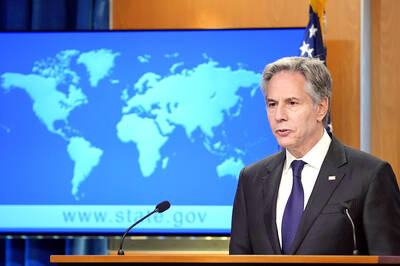
Beijing is continuing to commit genocide and crimes against humanity against Uyghurs and other Muslim minorities in its western Xinjiang province, U.S. Secretary of State Antony Blinken said in a report published on Monday, ahead of his planned visit to China this week. The State Department’s annual human rights report, which documents abuses recorded all over the world during the previous calendar year, repeated language from previous years on the treatment of Muslims in Xinjiang, but the publication raises the issue ahead of delicate talks, including on the war in Ukraine and global trade, between the top U.S. diplomat and Chinese


 RSS
RSS