


The wrecking ball is in full swing in Beijing's historic Qianmen district, the capital's one-time business, entertainment and culinary center, leaving conservationists up in arms.
As part of a controversial scheme to "protect historic and cultural relics," demolition crews have already destroyed some 800 "old and dangerous" homes along legendary Coal Street in the Dazhalan section of Qianmen.
According to a major refurbishment plan, whose details are slowly seeping into the public domain, Coal Street will become an access road to the west of the major artery of Qianmen Street, which is going to be turned into a pedestrian commercial area by the time Beijing hosts the Olympic Games in 2008.
ACCESS
Hundreds more courtyard homes on the east side of Qianmen, whose history stretches back 700 years through the Ming and Qing Dynasties, will also be bulldozed to make way for an eastern access road.
"This is going to be a disaster," says Wang Jun (王軍), author of An Evolutionary Record of Beijing City, a book published last year that recounts 50 years of failed efforts to save Beijing's unique historical character. "They have been slowly destroying Beijing's character for decades and the assault on Dazhalan is just another effort to destroy old Beijing."
Wang laments the role of government-linked investment companies in the "renovation" project, which critics say smacks of a crass attempt to develop lucrative real estate in the heart of the city in the name of "preserving" Beijing's famed courtyard architecture.
When the People's Republic of China was established in 1949, Beijing was one of the oldest capitals in the world and had largely escaped widespread destruction since the beginning of the Ming Dynasty (1368-1644).
Wang's book records how China's communist rulers have destroyed that legacy in the span of some 50 years, first by tearing down the city's walls in the 1950s and 1960s and then destroying thousands of old courtyard homes to build roads or make way for real estate projects over the last decade.
Now the government plans to continue its remake of the capital by moving some 5 million residents from Beijing's center to the suburbs within 15 years in an effort to alleviate pressure on roads and resources.
The plan also appears to be an effort to rectify the Maoist egalitarian policies of the 1950s and 1960s when up to 10 families were crammed into a single courtyard home.
"Reducing the numbers of families living in the courtyard homes is a good idea, but if it means destroying the homes, then this is the same as destroying Beijing's heritage," Wang says.
Another problem with removing all those people is that China's laws on land ownership are not clear, so it will be difficult to say who should be compensated, he said.
In the Dazhalan section of Qianmen, the population density is about 44,000 people per square kilometer, one of the highest in the city, according to the renovation plan.
It says most homes lack plumbing and a modern electrical infrastructure because of their age, so the district needs to be renovated.
The Qianmen area itself sits just south of Tiananmen Square's Zhengyangmen Gate, the front gate to Beijing's old imperial city.
MAZE
The area is a maze of small alleyways and lanes and is where Beijing Opera and Chinese acrobatics were born and where culinary specialities like Peking Duck, Beijing pickled vegetables and dumplings became famous.
The Tongrentang Traditional Medicine Shop, which has manufactured pills, powders and ointments for Chinese emperors since 1669, is also located here along with other former banks and guilds that once made the area Beijing's financial district.
Since 1949, though, the area has largely fallen into disrepair, but has still remained a key tourist attraction for domestic Chinese because of cheap restaurants and hotels.
"The Qianmen project is going to be just like what they did to Nanchizi," Wang says. "They say they want to preserve old Beijing, but there is always a commercial reason that is the real driving force."
Nanchizi was a pilot project next to the Forbidden City, the ancient palace of the Ming and Qing Dynasties, which razed some 900 ancient homes and relocated thousands of people in 2003.
Nearly half of China’s major cities are suffering “moderate to severe” levels of subsidence, putting millions of people at risk of flooding, especially as sea levels rise, according to a study of nationwide satellite data released yesterday. The authors of the paper, published by the journal Science, found that 45 percent of China’s urban land was sinking faster than 3mm per year, with 16 percent at more than 10mm per year, driven not only by declining water tables, but also the sheer weight of the built environment. With China’s urban population already in excess of 900 million people, “even a small portion

UNSETTLING IMAGES: The scene took place in front of TV crews covering the Trump trial, with a CNN anchor calling it an ‘emotional and unbelievably disturbing moment’ A man who doused himself in an accelerant and set himself on fire outside the courthouse where former US president Donald Trump is on trial has died, police said yesterday. The New York City Police Department (NYPD) said the man was declared dead by staff at an area hospital. The man was in Collect Pond Park at about 1:30pm on Friday when he took out pamphlets espousing conspiracy theories, tossed them around, then doused himself in an accelerant and set himself on fire, officials and witnesses said. A large number of police officers were nearby when it happened. Some officers and bystanders rushed
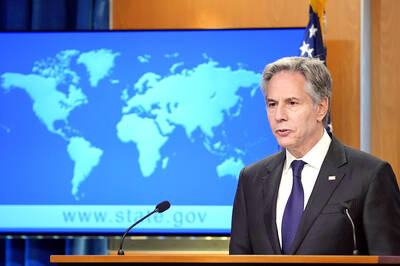
Beijing is continuing to commit genocide and crimes against humanity against Uyghurs and other Muslim minorities in its western Xinjiang province, U.S. Secretary of State Antony Blinken said in a report published on Monday, ahead of his planned visit to China this week. The State Department’s annual human rights report, which documents abuses recorded all over the world during the previous calendar year, repeated language from previous years on the treatment of Muslims in Xinjiang, but the publication raises the issue ahead of delicate talks, including on the war in Ukraine and global trade, between the top U.S. diplomat and Chinese

HYPOCRISY? The Chinese Ministry of Foreign Affairs yesterday asked whether Biden was talking about China or the US when he used the word ‘xenophobic’ US President Joe Biden on Wednesday called for a hike in steel tariffs on China, accusing Beijing of cheating as he spoke at a campaign event in Pennsylvania. Biden accused China of xenophobia, too, in a speech to union members in Pittsburgh. “They’re not competing, they’re cheating. They’re cheating and we’ve seen the damage here in America,” Biden said. Chinese steel companies “don’t need to worry about making a profit because the Chinese government is subsidizing them so heavily,” he said. Biden said he had called for the US Trade Representative to triple the tariff rates for Chinese steel and aluminum if Beijing was


 RSS
RSS