


Marching troops paraded down the same route taken by North Vietnamese tanks when they rolled into the city 30 years ago, as Vietnam yesterday celebrated the communist victory over a US-backed government.
Watched by the country's top leaders and legendary figures such as war hero General Vo Nguyen Giap, soldiers, government workers and performers marched with red flags waving toward the palace gates. Hundreds of aging veterans, their chests decked with medals, watched from the sidelines.
Giant billboards of Ho Chi Minh, Vietnam's revolutionary leader, dominated the parade ground and adjoining streets, which had been blocked off to the public due to security concerns.
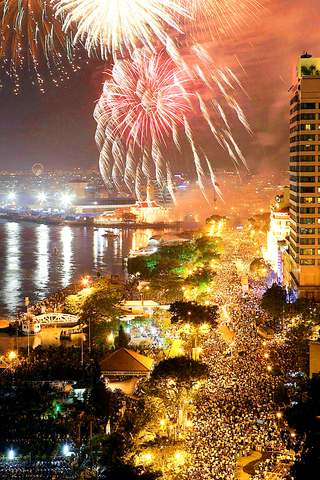
PHOTO: AFP
On April 30, 1975, Communist tanks barreled through the gates of the Presidential Palace, the heart of the US-backed Saigon government. The fall of Saigon marked the official end to the Vietnam War, and the US' more than decade-long attempt to halt the spread of communism in the region. The war claimed an estimated 3 million Vietnamese and some 58,000 American lives.
"I was listening to the radio with my family and heard that Saigon had been liberated. I was very happy because for many years we weren't free. After 30 years we have rebuilt our country. Our land is safe and secure and I think the future will be better for my children," said To Thanh Nghia, 51, a government worker marching in the parade.
The atmosphere in the country three decades later has been mostly festive, focusing on Vietnam's recent economic rejuvenation. Memories of the war and its aftermath are little more than anecdotes in history books for most Vietnamese who were born after it ended.
"My father and grandfather fought in the war but I was too young. I think my future will be good because they created opportunities for my generation," said Nguyen Thanh Tung, an 18-year-old student.
Down the grand boulevard where communist tanks once rolled, capitalism has taken solid root. Some parade floats, sponsored by Vietnamese banks, sported the logo of US credit card companies. One float featured women pushing shopping carts loaded with supermarket goods.
These days, Le Duan Street is home to Diamond Plaza, a glittering, upscale department store where French perfumes and Italian shoes are sold to an emerging urban, middle class. Along the same strip, a French-owned five-star hotel sits across the street from the US consulate.
While Vietnam proudly recalled its victories over both the US and colonial France, the focus was clearly on the future.
"Through our two resistance [wars] against foreign aggressors, the historical clashes in Saigon will always be in the forefront," said President Tran Duc Luong to cheers from the crowd. He called Ho Chi Minh City, the former Saigon, the country's "economic locomotive."
With the president on the giant reviewing platform was a guest of honor, Raul Castro, the brother and successor to Cuba's longtime leader Fidel Castro who stood by Vietnam's communist regime for decades. Also flanking the leader was Giap, the military mastermind behind the defeat of French forces at Dien Bien Phu and later, ousting the US.
Despite Vietnam's remarkable recovery from the devastation of war, most of its largely agrarian population of 82 million remains poor with per capita income hovering around US$550 a year.
But Vietnam is on the crest of an economic wave. Nowhere have the changes been more visible than in the wave of motorbikes and construction that now covers Ho Chi Minh City.
Veteran Luu Quang Dong, 68, from northern Vinh Phuc province, traveled for four days via bus to attend Saturday's ceremony.
Dressed in his olive uniform covered in red and gold medals, he said he made the trip to see the city he had stormed into three decades ago, arriving with his unit just minutes after the tanks crashed through the palace gates.
"I wanted to come and see how much the city has changed," he said.
Though the North and South reunified three decades ago, the task of reconciliation still looms large.
On Friday, Prime Minister Phan Van Khai sent out a message reaching out to Vietnam's former enemies, as well as to those who fought on the side of the former South Vietnam, urging all sides to "close the past, look to the future."
Among them is the US, which has become Vietnam's single-largest trading partner. But relations with overseas Vietnamese, who sent back nearly US$4 billion in remittances last year, remain more sensitive.
Despite the government's message of reconciliation, lingering mistrust continues. Earlier this week, the government banned a book of love songs from the pre-1975 era.
"Thirty years after the war, the country is really reconciled now. Maybe some people still feel bitter about the liberation of Saigon but that number is very small," said Han Van Minh, 65, who was a sergeant in the Saigon army and now runs a small business.

Republican US lawmakers on Friday criticized US President Joe Biden’s administration after sanctioned Chinese telecoms equipment giant Huawei unveiled a laptop this week powered by an Intel artificial intelligence (AI) chip. The US placed Huawei on a trade restriction list in 2019 for contravening Iran sanctions, part of a broader effort to hobble Beijing’s technological advances. Placement on the list means the company’s suppliers have to seek a special, difficult-to-obtain license before shipping to it. One such license, issued by then-US president Donald Trump’s administration, has allowed Intel to ship central processors to Huawei for use in laptops since 2020. China hardliners

Conjoined twins Lori and George Schappell, who pursued separate careers, interests and relationships during lives that defied medical expectations, died this month in Pennsylvania, funeral home officials said. They were 62. The twins, listed by Guinness World Records as the oldest living conjoined twins, died on April 7 at the Hospital of the University of Pennsylvania, obituaries posted by Leibensperger Funeral Homes of Hamburg said. The cause of death was not detailed. “When we were born, the doctors didn’t think we’d make 30, but we proved them wrong,” Lori said in an interview when they turned 50, the Philadelphia Inquirer reported. The
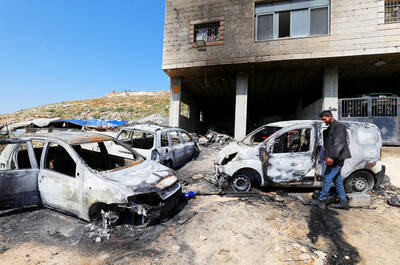
RAMPAGE: A Palestinian man was left dead after dozens of Israeli settlers searching for a missing 14-year-old boy stormed a village in the Israeli-occupied West Bank US President Joe Biden on Friday said he expected Iran to attack Israel “sooner, rather than later” and warned Tehran not to proceed. Asked by reporters about his message to Iran, Biden simply said: “Don’t,” underscoring Washington’s commitment to defend Israel. “We are devoted to the defense of Israel. We will support Israel. We will help defend Israel and Iran will not succeed,” he said. Biden said he would not divulge secure information, but said his expectation was that an attack could come “sooner, rather than later.” Israel braced on Friday for an attack by Iran or its proxies as warnings grew of
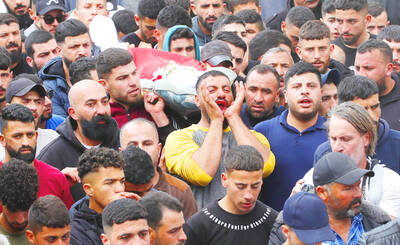
IN PURSUIT: Israel’s defense minister said the revenge attacks by Israeli settlers would make it difficult for security forces to find those responsible for the 14-year-old’s death Israeli Prime Minister Benjamin Netanyahu on Saturday condemned the “heinous murder” of an Israeli teenager in the occupied West Bank as attacks on Palestinian villages intensified following news of his death. After Benjamin Achimeir, 14, was reported missing near Ramallah on Friday, hundreds of Jewish settlers backed by Israeli forces raided nearby Palestinian villages, torching vehicles and homes, leaving at least one villager dead and dozens wounded. The attacks escalated in several villages on Saturday after Achimeir’s body was found near the Malachi Hashalom outpost. Agence France-Presse correspondents saw smoke rising from burned houses and fields. Mayor Amin Abu Alyah, of the


 RSS
RSS