


Wrapping up his investigation into former Iraqi president Saddam Hussein's purported arsenal, the CIA's top weapons hunter in Iraq said his search for weapons of mass destruction (WMD) "has been exhausted" without finding any.
Nor did he find any evidence that such weapons were shipped officially from Iraq to Syria to be hidden before the US invasion, but he couldn't rule out some unofficial transfer of limited WMD-related materials.
He closed his effort with words of caution about potential future threats and careful assessment of this and other unanswered questions.
The Bush administration justified its 2003 invasion of Iraq as necessary to eliminate Saddam's purported stockpile of WMD.
"As matters now stand, the WMD investigation has gone as far as feasible," wrote Charles Duelfer, head of the Iraq Survey Group, in an addendum to the report he issued last fall. "After more than 18 months, the WMD investigation and debriefing of the WMD-related detainees has been exhausted."
In 92 pages posted online Monday evening, Duelfer provided a final look at an investigation that, at its peak, occupied more than 1,000 military and civilian translators, weapons specialists and other experts. His latest addenda conclude a roughly 1,500-page report released last fall.
Among warnings sprinkled throughout the new documents, one concludes that Saddam's programs created a pool of weapons experts, many of whom will be seeking work. While most will probably turn to the "benign civil sector," the danger remains that "hostile foreign governments, terrorists or insurgents may seek Iraqi expertise."
"Because a single individual can advance certain WMD activities, it remains an important concern," one addendum said.
Another addendum noted that military forces in Iraq may continue to find small numbers of degraded chemical weapons -- most likely misplaced or improperly destroyed before 1991. In an insurgent's hands, "the use of a single even ineffectual chemical weapon would likely cause more terror than deadlier conventional explosives," the addendum said.
And still another said the survey group found some potential nuclear-related equipment was "missing from heavily damaged and looted sites." Yet, because of deteriorating security in Iraq, the survey group was unable to determine what happened to the equipment, which also had alternate civilian uses.
"Some of it probably has been sold for its scrap value. Other pieces might have been disassembled" and converted into motors or condensers, an addendum said. "Still others could have been taken intact to preserve their function."
Leaving the door to the investigation open just a crack, a US official, who spoke on condition of anonymity, said a small team still operates under the US-led multinational force in Iraq, although the survey group officially disbanded earlier this month. Those staying on continue to examine documents and follow up any reports of weapons of mass destruction.
In a statement accompanying the final installment, Duelfer said any surprise discovery would be most likely in the biological weapons area because facilities and other clues would be comparatively small.
Nearly half of China’s major cities are suffering “moderate to severe” levels of subsidence, putting millions of people at risk of flooding, especially as sea levels rise, according to a study of nationwide satellite data released yesterday. The authors of the paper, published by the journal Science, found that 45 percent of China’s urban land was sinking faster than 3mm per year, with 16 percent at more than 10mm per year, driven not only by declining water tables, but also the sheer weight of the built environment. With China’s urban population already in excess of 900 million people, “even a small portion

UNSETTLING IMAGES: The scene took place in front of TV crews covering the Trump trial, with a CNN anchor calling it an ‘emotional and unbelievably disturbing moment’ A man who doused himself in an accelerant and set himself on fire outside the courthouse where former US president Donald Trump is on trial has died, police said yesterday. The New York City Police Department (NYPD) said the man was declared dead by staff at an area hospital. The man was in Collect Pond Park at about 1:30pm on Friday when he took out pamphlets espousing conspiracy theories, tossed them around, then doused himself in an accelerant and set himself on fire, officials and witnesses said. A large number of police officers were nearby when it happened. Some officers and bystanders rushed
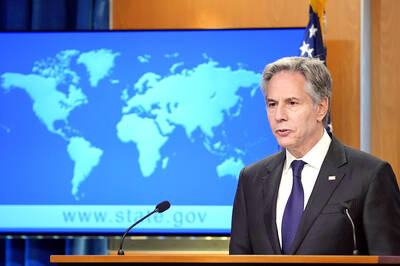
Beijing is continuing to commit genocide and crimes against humanity against Uyghurs and other Muslim minorities in its western Xinjiang province, U.S. Secretary of State Antony Blinken said in a report published on Monday, ahead of his planned visit to China this week. The State Department’s annual human rights report, which documents abuses recorded all over the world during the previous calendar year, repeated language from previous years on the treatment of Muslims in Xinjiang, but the publication raises the issue ahead of delicate talks, including on the war in Ukraine and global trade, between the top U.S. diplomat and Chinese

HYPOCRISY? The Chinese Ministry of Foreign Affairs yesterday asked whether Biden was talking about China or the US when he used the word ‘xenophobic’ US President Joe Biden on Wednesday called for a hike in steel tariffs on China, accusing Beijing of cheating as he spoke at a campaign event in Pennsylvania. Biden accused China of xenophobia, too, in a speech to union members in Pittsburgh. “They’re not competing, they’re cheating. They’re cheating and we’ve seen the damage here in America,” Biden said. Chinese steel companies “don’t need to worry about making a profit because the Chinese government is subsidizing them so heavily,” he said. Biden said he had called for the US Trade Representative to triple the tariff rates for Chinese steel and aluminum if Beijing was


 RSS
RSS