


US President George W. Bush is seeking relief from record-high gas prices and support for Middle East peace as he opens his Texas ranch to Crown Prince Abdullah of Saudi Arabia, the world's largest oil producer.
Bush said he'll make clear that it's not in Saudi Arabia's interests to keep oil prices high.
"If they pinch the world economy too much, it'll affect their ability to sell crude oil in the long run," he said in a television interview last week.
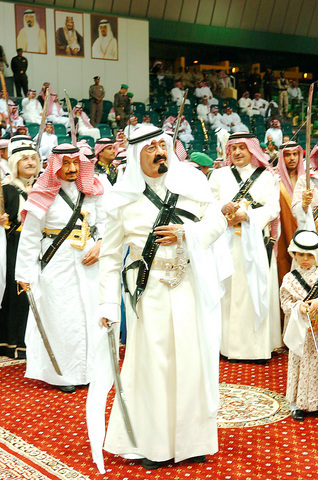
PHOTO: AFP
The president also said he's looking for "a straight answer" on how close the Saudis are to reaching production capacity.
"I don't think they're pumping flat out," Bush said.
Bush's goal of spreading democracy across the Arab world also faces a difficult test with Saudi Arabia, a longtime ally ruled by an absolute monarchy. Traditionally Bush holds news conferences with visiting foreign leaders, but there will be none during this visit because Abdullah rarely talks with reporters.
The meeting marks another step in a quickening pace of US involvement in the Middle East. Two weeks ago Bush met with Israeli Prime Minister Ariel Sharon at the ranch and said Israel should abandon plans for new construction of Jewish settlements in the Palestinian territories. The Saudis believe the administration's strong support for Israel harms prospects for Middle East peace.
Despite the difficult matters, Robert Jordan, a former US ambassador to Saudi Arabia, said the stage was set for a much friendlier meeting yesterday than three years ago when Abdullah first visited the ranch. For one thing, the late Palestinian president Yasser Arafat, a polarizing figure, is now gone -- replaced by an elected president, Mahmoud Abbas. Abbas will have his own meeting with Bush in the next few weeks.
To lay the groundwork for yesterday's meeting, Vice President Dick Cheney talked with Abdullah over lunch on Sunday in a Dallas hotel.
Jordan noted that Saudi officials also have played an instrumental role in persuading Syria to withdraw its troops from Lebanon. They have been supportive of increasing oil production at crucial times.
And Abdullah has taken some initial steps toward introducing democracy to Saudi Arabia by holding elections for municipal councils, even though women's rights remain severely restricted, political parties are banned and press freedoms are limited.
Likely to be on Abdullah's mind is a Saudi proposal that would give Israel normal relations with Arab nations only in exchange for its return to its borders before it captured the West Bank, Gaza Strip, Golan Heights and east Jerusalem in the 1967 Middle East war.
Although Arab leaders last month endorsed that approach, Jordan said Abdullah -- well aware of Bush's position that the "new realties on the ground" of Jewish settlements make a full Israeli withdrawal unrealistic -- is unlikely to come in "with some flat demand."
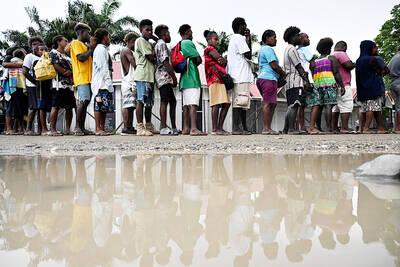
SEEKING CHANGE: A hospital worker said she did not vote in previous elections, but ‘now I can see that maybe my vote can change the system and the country’ Voting closed yesterday across the Solomon Islands in the south Pacific nation’s first general election since the government switched diplomatic allegiance from Taiwan to Beijing and struck a secret security pact that has raised fears of the Chinese navy gaining a foothold in the region. The Solomon Islands’ closer relationship with China and a troubled domestic economy weighed on voters’ minds as they cast their ballots. As many as 420,000 registered voters had their say across 50 national seats. For the first time, the national vote also coincided with elections for eight of the 10 local governments. Esther Maeluma cast her vote in the
Nearly half of China’s major cities are suffering “moderate to severe” levels of subsidence, putting millions of people at risk of flooding, especially as sea levels rise, according to a study of nationwide satellite data released yesterday. The authors of the paper, published by the journal Science, found that 45 percent of China’s urban land was sinking faster than 3mm per year, with 16 percent at more than 10mm per year, driven not only by declining water tables, but also the sheer weight of the built environment. With China’s urban population already in excess of 900 million people, “even a small portion

UNSETTLING IMAGES: The scene took place in front of TV crews covering the Trump trial, with a CNN anchor calling it an ‘emotional and unbelievably disturbing moment’ A man who doused himself in an accelerant and set himself on fire outside the courthouse where former US president Donald Trump is on trial has died, police said yesterday. The New York City Police Department (NYPD) said the man was declared dead by staff at an area hospital. The man was in Collect Pond Park at about 1:30pm on Friday when he took out pamphlets espousing conspiracy theories, tossed them around, then doused himself in an accelerant and set himself on fire, officials and witnesses said. A large number of police officers were nearby when it happened. Some officers and bystanders rushed

HYPOCRISY? The Chinese Ministry of Foreign Affairs yesterday asked whether Biden was talking about China or the US when he used the word ‘xenophobic’ US President Joe Biden on Wednesday called for a hike in steel tariffs on China, accusing Beijing of cheating as he spoke at a campaign event in Pennsylvania. Biden accused China of xenophobia, too, in a speech to union members in Pittsburgh. “They’re not competing, they’re cheating. They’re cheating and we’ve seen the damage here in America,” Biden said. Chinese steel companies “don’t need to worry about making a profit because the Chinese government is subsidizing them so heavily,” he said. Biden said he had called for the US Trade Representative to triple the tariff rates for Chinese steel and aluminum if Beijing was


 RSS
RSS