


A US appeals court on Tuesday refused to block the jailing of two journalists for refusing to testify before a grand jury probing the leak of a CIA operative's identity.
New York Times reporter Judith Miller and Time magazine correspondent Matthew Cooper have each been convicted of contempt of court for refusing to testify before a federal grand jury investigating the leak.
The journalists now face up to 18 months in jail, unless they agree to testify or can convince the US Supreme Court to hear the case.
"We are disappointed with the court's decision and we will seek a stay in order to have sufficient time to seek a US Supreme Court review," Toby Usnik, a spokesman for Miller's employer, the New York Times, said in a statement.
The reporters were convicted after refusing US District Court Judge Thomas Hogan's order to testify, claiming a special privilege for journalists based on their role in providing information to the public.
But judges of the US Court of Appeals for the District of Columbia disagreed, upholding the decision of a three-judge appeals panel from February.
The court said a majority of the seven judges hearing the case had rejected the journalists' petition for a rehearing. One, Judge David Tatel, issued an opinion explaining his vote.
"None of the petitioners' claims meets our high standard for reconsideration by the en banc court," Tatel wrote.
The case involving Miller and Cooper stems from a grand jury investigation into who leaked the name of covert CIA agent Valerie Plame to conservative columnist Bob Novak. Novak revealed her identity in a July 2003 column, citing two unnamed senior administration officials as his sources.
Under public and media pressure sparked by reports that administration officials had disclosed Plame's name to several journalists, President George W. Bush in December 2003 ordered an investigation into the leak and named Patrick Fitzgerald, US attorney in Chicago, as special counsel.
Fitzgerald promptly convened a grand jury and began calling journalists to testify, including those, such as Miller, who had not written about the affair.
The case is one of several in the US that have recently revived the issue of whether reporters should be forced to testify in court about information they learn while doing their jobs.
The First Amendment to the US Constitution protects journalists from government interference in their work. But the Supreme Court ruled in 1972 that protection does not apply to reporters whose testimony is essential in criminal cases, even if a source was promised anonymity.
Nearly half of China’s major cities are suffering “moderate to severe” levels of subsidence, putting millions of people at risk of flooding, especially as sea levels rise, according to a study of nationwide satellite data released yesterday. The authors of the paper, published by the journal Science, found that 45 percent of China’s urban land was sinking faster than 3mm per year, with 16 percent at more than 10mm per year, driven not only by declining water tables, but also the sheer weight of the built environment. With China’s urban population already in excess of 900 million people, “even a small portion
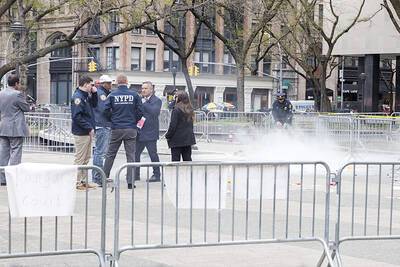
UNSETTLING IMAGES: The scene took place in front of TV crews covering the Trump trial, with a CNN anchor calling it an ‘emotional and unbelievably disturbing moment’ A man who doused himself in an accelerant and set himself on fire outside the courthouse where former US president Donald Trump is on trial has died, police said yesterday. The New York City Police Department (NYPD) said the man was declared dead by staff at an area hospital. The man was in Collect Pond Park at about 1:30pm on Friday when he took out pamphlets espousing conspiracy theories, tossed them around, then doused himself in an accelerant and set himself on fire, officials and witnesses said. A large number of police officers were nearby when it happened. Some officers and bystanders rushed
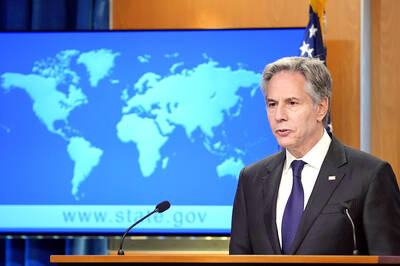
Beijing is continuing to commit genocide and crimes against humanity against Uyghurs and other Muslim minorities in its western Xinjiang province, U.S. Secretary of State Antony Blinken said in a report published on Monday, ahead of his planned visit to China this week. The State Department’s annual human rights report, which documents abuses recorded all over the world during the previous calendar year, repeated language from previous years on the treatment of Muslims in Xinjiang, but the publication raises the issue ahead of delicate talks, including on the war in Ukraine and global trade, between the top U.S. diplomat and Chinese

HYPOCRISY? The Chinese Ministry of Foreign Affairs yesterday asked whether Biden was talking about China or the US when he used the word ‘xenophobic’ US President Joe Biden on Wednesday called for a hike in steel tariffs on China, accusing Beijing of cheating as he spoke at a campaign event in Pennsylvania. Biden accused China of xenophobia, too, in a speech to union members in Pittsburgh. “They’re not competing, they’re cheating. They’re cheating and we’ve seen the damage here in America,” Biden said. Chinese steel companies “don’t need to worry about making a profit because the Chinese government is subsidizing them so heavily,” he said. Biden said he had called for the US Trade Representative to triple the tariff rates for Chinese steel and aluminum if Beijing was


 RSS
RSS