


Prime Minister Ariel Sharon is expected to decide by the weekend whether to put off this summer's Gaza pullout for three weeks, accommodating a religious holiday period but possibly signaling uncertainty and weakness in the face of settler opposition.
A stormy meeting of senior ministers on Tuesday ended with no decision. Both Sharon and his defense minister, Shaul Mofaz, came down on both sides of the issue.
The confusion reflected growing complaints that the government is not ready to carry out the evacuation of 9,000 settlers -- it has yet to figure out where they will go.
The scheduling issue is that the evacuation of all 21 Gaza settlements and four in the West Bank would coincide with the annual period of mourning observant Jews mark for the destruction of the biblical Temples, leading up to the fast day of Tisha B'Av on Aug. 14.
On the one hand, Sharon does not want the Gaza pullout to be added to the list of Jewish catastrophes associated with Tisha B'Av. On the other hand, he is aware that a delay could be seen as weakness and could energize opponents to redouble efforts to scuttle the plan.
According to a statement from his office, Sharon backed the original late July starting date during the Tuesday ministerial meeting. "I really want to help them [the settlers] in any way possible, but delaying the implementation of the plan can create many complications," he said.
But just a day earlier, he told reporters he was "positively inclined" to agree to the three-week delay. An aide said he would decide by the weekend.
Security officials said that during the meeting, Mofaz was cool to the postponement. Later, during a stormy visit to the Gaza settlements, Mofaz was sympathetic. "Residents have made the request, and it could make things easier," he told Army Radio. "I believe that anything that can make it easier should be done."
Some Cabinet ministers suggested the delay would be needed to give the government more time to iron out the hang-ups in withdrawal preparations.
After fighting the plan for months, settlers have only recently started negotiating with the government over compensation, and committees have only been set up in the past few days to decide on the many complex issues involved in the evacuation, such as finding housing for uprooted settlers.
"It is very difficult to carry out the disengagement when there is no cooperation from the settlers. In order for it to be organized there has to be dialogue," Vice Premier Shimon Peres said.
Some officials expressed concern that the proposed delay might scuttle the evacuation altogether. "Any delay would broadcast weakness. Any delay would broadcast vacillation," said Interior Minister Ophir Pines-Paz, whose dovish Labor Party recently joined the government to support the pullout.
Sharon rejected accusations that the government is unprepared. "Everything we are doing now is above and beyond the decisions that were already made," he said.
Israel initially proposed the Gaza withdrawal as a unilateral act, but has said it is willing to coordinate the pullout with the new Palestinian leader, Mahmoud Abbas. Mofaz said he would begin coordination meetings this week.
Abbas met with Israeli reporters on Tuesday, where he announced that the Palestinians have collected weapons from militants in two West Bank towns turned over to Palestinian control. Abbas has come under heavy pressure by Israel and the US to rein in the militants.
Israel has delayed the planned turnover of three more towns, charging the Palestinians have not carried out promises to disarm militants.
Abbas disputed that, "All the fugitives in the cities that were evacuated -- and that is Jericho and Tulkarem -- their weapons were taken from them, and they are all now working in civil and security branches of the government," he said, in a recording broadcast on Israel Radio.
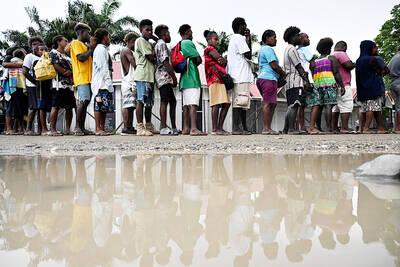
SEEKING CHANGE: A hospital worker said she did not vote in previous elections, but ‘now I can see that maybe my vote can change the system and the country’ Voting closed yesterday across the Solomon Islands in the south Pacific nation’s first general election since the government switched diplomatic allegiance from Taiwan to Beijing and struck a secret security pact that has raised fears of the Chinese navy gaining a foothold in the region. The Solomon Islands’ closer relationship with China and a troubled domestic economy weighed on voters’ minds as they cast their ballots. As many as 420,000 registered voters had their say across 50 national seats. For the first time, the national vote also coincided with elections for eight of the 10 local governments. Esther Maeluma cast her vote in the
Nearly half of China’s major cities are suffering “moderate to severe” levels of subsidence, putting millions of people at risk of flooding, especially as sea levels rise, according to a study of nationwide satellite data released yesterday. The authors of the paper, published by the journal Science, found that 45 percent of China’s urban land was sinking faster than 3mm per year, with 16 percent at more than 10mm per year, driven not only by declining water tables, but also the sheer weight of the built environment. With China’s urban population already in excess of 900 million people, “even a small portion

UNSETTLING IMAGES: The scene took place in front of TV crews covering the Trump trial, with a CNN anchor calling it an ‘emotional and unbelievably disturbing moment’ A man who doused himself in an accelerant and set himself on fire outside the courthouse where former US president Donald Trump is on trial has died, police said yesterday. The New York City Police Department (NYPD) said the man was declared dead by staff at an area hospital. The man was in Collect Pond Park at about 1:30pm on Friday when he took out pamphlets espousing conspiracy theories, tossed them around, then doused himself in an accelerant and set himself on fire, officials and witnesses said. A large number of police officers were nearby when it happened. Some officers and bystanders rushed

HYPOCRISY? The Chinese Ministry of Foreign Affairs yesterday asked whether Biden was talking about China or the US when he used the word ‘xenophobic’ US President Joe Biden on Wednesday called for a hike in steel tariffs on China, accusing Beijing of cheating as he spoke at a campaign event in Pennsylvania. Biden accused China of xenophobia, too, in a speech to union members in Pittsburgh. “They’re not competing, they’re cheating. They’re cheating and we’ve seen the damage here in America,” Biden said. Chinese steel companies “don’t need to worry about making a profit because the Chinese government is subsidizing them so heavily,” he said. Biden said he had called for the US Trade Representative to triple the tariff rates for Chinese steel and aluminum if Beijing was


 RSS
RSS