


Farmers and fishermen are devastating Iraq's marshes, considered by some to be the site of the Garden of Eden, with uncontrolled use of chemicals and fishing using electric shocks, researchers warned on Monday.
The illegal methods are wiping out wildlife, polluting water, endangering human health and undermining the recovery of one of the world's great wetlands, they say.
The marshes are part of what British troops stationed there call Iraq's "wild, wild east," a remote, lawless region where impoverished communities have a tradition of defying authority.
Since the US-led invasion toppled Saddam Hussein two years ago there has been a boom in the use of electroshocking -- nets attached to car batteries -- to catch fish, says Iraq Nature, an environmental group.
Many of the fish not caught are left sterilized or dead, the rotting bodies spawning organic matter which uses up oxygen that in turn allows bacteria to flourish, upsetting the ecological balance.
The damage is made worse by farmers using chemicals intended to treat lice in sheep as pesticides for their crops and by hunters using poison to catch birds.
The deputy health minister, Amer al-Khuza'i, on Monday urged Iraq's most revered cleric, Grand Ayatollah Ali al-Sistani, to issue a fatwa against misuse of the chemicals and poison.
Originally twice the size of the Florida Everglades, the 20,000km2 of marshes were fed by the Tigris and Euphrates rivers and were home to hundreds of species of birds and fish.
The 5,000-year-old marsh Arab culture, based on artificial islands and houses made from tall reeds, is considered a cradle of civilization.
The marsh Arabs were accused of helping and harboring rebels and outlaws during the failed Shiite uprising against Saddam after the 1991 Gulf War, prompting a devastating crackdown.
Thousands were killed and a gargantuan dyke-building programme drained the marshes to just 7 percent of their original extent, a catastrophe compared to the drying up of the Aral sea in central Asia and the deforestation of the Amazon.
When coalition troops overthrew the regime, the surviving marsh Arabs broke many of the dykes and water flooded back, restoring much of the wetland. Earlier this year the journal Science reported the return of giant reeds, water birds and otters, prompting optimism that recovery was under way.
But Iraq Nature researchers who have visited the region each month for the past year said thousands of fishermen were boosting their catch by connecting cheap car batteries with cables to 2m poles with nets. The 12-volt shock electrocuted fish within a 5m radius, yielding 20kg of fish each day per fisherman.
"They know it is wrong but they are poor and say it is the only way to feed their families," said Raied Hameed, one of the researchers. "It is a very serious problem for the marshes."
The Iraqi police and army seldom venture into the countryside and the British forces know better than to inflame protests by intervening, he added.
With few schools, clinics, roads or jobs the region sees little reason to obey authorities which historically have been at best neglectful, at worst murderous.

Republican US lawmakers on Friday criticized US President Joe Biden’s administration after sanctioned Chinese telecoms equipment giant Huawei unveiled a laptop this week powered by an Intel artificial intelligence (AI) chip. The US placed Huawei on a trade restriction list in 2019 for contravening Iran sanctions, part of a broader effort to hobble Beijing’s technological advances. Placement on the list means the company’s suppliers have to seek a special, difficult-to-obtain license before shipping to it. One such license, issued by then-US president Donald Trump’s administration, has allowed Intel to ship central processors to Huawei for use in laptops since 2020. China hardliners

Conjoined twins Lori and George Schappell, who pursued separate careers, interests and relationships during lives that defied medical expectations, died this month in Pennsylvania, funeral home officials said. They were 62. The twins, listed by Guinness World Records as the oldest living conjoined twins, died on April 7 at the Hospital of the University of Pennsylvania, obituaries posted by Leibensperger Funeral Homes of Hamburg said. The cause of death was not detailed. “When we were born, the doctors didn’t think we’d make 30, but we proved them wrong,” Lori said in an interview when they turned 50, the Philadelphia Inquirer reported. The
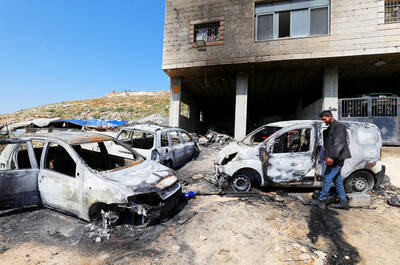
RAMPAGE: A Palestinian man was left dead after dozens of Israeli settlers searching for a missing 14-year-old boy stormed a village in the Israeli-occupied West Bank US President Joe Biden on Friday said he expected Iran to attack Israel “sooner, rather than later” and warned Tehran not to proceed. Asked by reporters about his message to Iran, Biden simply said: “Don’t,” underscoring Washington’s commitment to defend Israel. “We are devoted to the defense of Israel. We will support Israel. We will help defend Israel and Iran will not succeed,” he said. Biden said he would not divulge secure information, but said his expectation was that an attack could come “sooner, rather than later.” Israel braced on Friday for an attack by Iran or its proxies as warnings grew of

A prominent Christian leader has allegedly been stabbed at the altar during a Mass yesterday in southwest Sydney. Bishop Mar Mari Emmanuel was saying Mass at Christ The Good Shepherd Church in Wakeley just after 7pm when a man approached him at the altar and allegedly stabbed toward his head multiple times. A live stream of the Mass shows the congregation swarm forward toward Emmanuel before it was cut off. The church leader gained prominence during the COVID-19 pandemic, amassing a large online following, Officers attached to Fairfield City police area command attended a location on Welcome Street, Wakeley following reports a number


 RSS
RSS