


Sixty years after Vienna was liberated from the Nazis in April 1945, six of Hitler's massive air defense towers still cast a shadow over the city and nobody knows quite what to do with them.
Not that there is a lack of suggestions.
They range from the whimsical, like the artist Christo who wanted to "wrap" the towers like he had done with the Reichstag building in Berlin, to the more utilitarian proposal of transforming them into a high-security data bank.
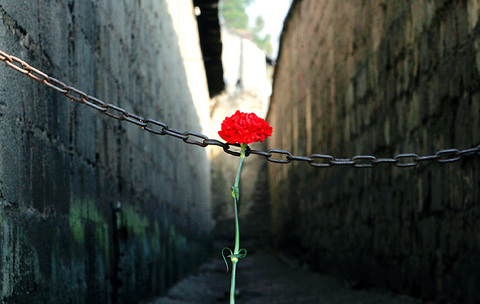
PHOTO: AP
But none of the ideas have found favor with the Austrian government or the Vienna municipality, and the towers are glaringly absent from events Austria is planning this year to mark the 60th anniversary of the end of World War II.
"Nobody wants to take responsibility for these towers because they are part of the past which has been repressed and become taboo" because of Austria's complicity with the Nazis, said Ute Bauer, the author of a book about the towers.
"There is no agreement here as to whether the towers should serve as a commemoration of the liberation of Vienna or of the Allied bombings, or as a memorial to the victims of the Third Reich," she said.
A spokesman for the municipality admitted that the 50m fortresses, were considered a "delicate subject."
The Nazis began building the towers in 1942 to house the air defense units (Flak) of the Third Reich that were trying to ward off the Allied bombers, and intended them to stand as monuments once Hitler had won the war.
But they towers never served either purpose.
By the time they were completed by forced laborers in 1944, Britain's fighter plane were flying at an altitude that put them safely out of reach of the Flak.
In the end the towers served as bunkers for the Austrian population during the heavy bombardments of March and April 1945.
With walls up to 6m thick, the towers are said to be impossible to implode without destroying the surrounding neighborhood.
The only alternative would be to tear them down brick by brick, at an estimated cost of 300 million to 500 million euros (US$387 million to US$645 million) each.
The towers rise like massive iron fists over the city's Art Noveau and neo-Baroque landscape.
Two of them are situated in the flower-filled Augarten public park, and have been invaded by flocks of birds. Only one has found a formal function in housing Vienna's biggest aquarium.
None of the "Flaktuerme" bear any inscription explaining their history and they do not feature on most of the city's tourist routes.
"The time has come to ask ourselves what these fortresses mean for us," said Peter Noever, the director of the Museum of Applied Art in Vienna.
He wants to see one of the towers turned into a studio where artists can produce works putting into perspective the history of Vienna.
Datacenter Vienna, a private company, is ready to spend 80 million euros to transform another one of the towers into a high-security databank and hope the city could one day approve the project.
"Since Sept. 11, more and more big companies are anxious to keep their facts and figures in a secure environment. The very structure of these towers make them ideal because they will be able to withstand almost any form of attack, including a plane crash," Datacenter's director Wolfgang Bleim said.

Republican US lawmakers on Friday criticized US President Joe Biden’s administration after sanctioned Chinese telecoms equipment giant Huawei unveiled a laptop this week powered by an Intel artificial intelligence (AI) chip. The US placed Huawei on a trade restriction list in 2019 for contravening Iran sanctions, part of a broader effort to hobble Beijing’s technological advances. Placement on the list means the company’s suppliers have to seek a special, difficult-to-obtain license before shipping to it. One such license, issued by then-US president Donald Trump’s administration, has allowed Intel to ship central processors to Huawei for use in laptops since 2020. China hardliners
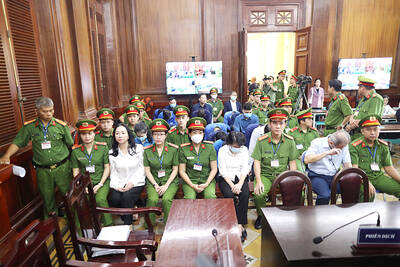
A top Vietnamese property tycoon was on Thursday sentenced to death in one of the biggest corruption cases in history, with an estimated US$27 billion in damages. A panel of three hand-picked jurors and two judges rejected all defense arguments by Truong My Lan, chair of major developer Van Thinh Phat, who was found guilty of swindling cash from Saigon Commercial Bank (SCB) over a decade. “The defendant’s actions ... eroded people’s trust in the leadership of the [Communist] Party and state,” read the verdict at the trial in Ho Chi Minh City. After the five-week trial, 85 others were also sentenced on

Conjoined twins Lori and George Schappell, who pursued separate careers, interests and relationships during lives that defied medical expectations, died this month in Pennsylvania, funeral home officials said. They were 62. The twins, listed by Guinness World Records as the oldest living conjoined twins, died on April 7 at the Hospital of the University of Pennsylvania, obituaries posted by Leibensperger Funeral Homes of Hamburg said. The cause of death was not detailed. “When we were born, the doctors didn’t think we’d make 30, but we proved them wrong,” Lori said in an interview when they turned 50, the Philadelphia Inquirer reported. The
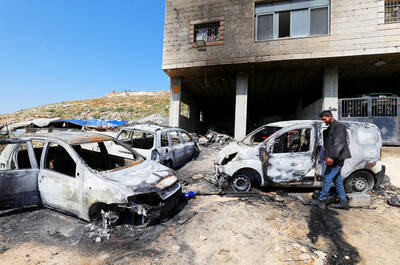
RAMPAGE: A Palestinian man was left dead after dozens of Israeli settlers searching for a missing 14-year-old boy stormed a village in the Israeli-occupied West Bank US President Joe Biden on Friday said he expected Iran to attack Israel “sooner, rather than later” and warned Tehran not to proceed. Asked by reporters about his message to Iran, Biden simply said: “Don’t,” underscoring Washington’s commitment to defend Israel. “We are devoted to the defense of Israel. We will support Israel. We will help defend Israel and Iran will not succeed,” he said. Biden said he would not divulge secure information, but said his expectation was that an attack could come “sooner, rather than later.” Israel braced on Friday for an attack by Iran or its proxies as warnings grew of


 RSS
RSS