


The bodies of 41 Kuwaitis believed killed during the first Gulf War were found in southern Iraq, among 295 mass graves uncovered around the country in the two years since US-led forces invaded and ousted Saddam Hussein, Iraq's Human Rights Minister said Saturday.
In a phone interview with reporters, Bakhtiar Amin said he informed the Kuwaiti government three days ago about the discovery of the bodies in a mass grave in the city of Amarah, 290km southeast of Baghdad.
The discovery was another step in documenting what happened to 605 Kuwaitis who have been missing since the 1991 Gulf War. The bodies of only 190 other Kuwaitis have been identified.
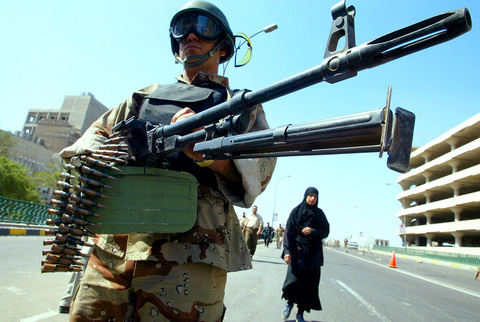
PHOTO: AFP
More and more mass graves are being uncovered across the country, but the fragile security situation is hampering investigators' work, he said.
The graves will be used in war crimes cases being built against Saddam and his top ministers. The Iraqi Special Tribunal is still in the process of gathering evidence.
Some of those already up for trial are Barzan Ibrahim al-Hassan al-Tikriti, one of Saddam's half brothers, former Vice President Taha Yassin Ramadan, and Ali Hassan al-Majid, better known as "Chemical Ali."
"The list of crimes that these people committed is long, and the trials will start as soon as possible," Amin said, adding it was difficult to give a time as to when the trials would begin.
Amin said that since January, two mass graves were discovered in Kirkuk, two were found in Sulaymaniyah, and one in Halabja -- all Kurdish victims who were systematically killed during Saddam's rule.
Investigators also traveled to Nasiriyah, 320km southeast of Baghdad, this week to inspect a site that locals had begun digging up after a farmer plowing in his field discovered about 20 bodies. It was unclear where the bodies came from.
"We're calling on our citizens. No one should open the mass graves. They should inform the authorities and the human rights people. It needs to be done properly, scientifically, respectfully," Amin said.
He said some graves contained the remains of dozens of people, while other had thousands.
"Iraq is a land of mass graves due to the genocide policy of Saddam Hussein," he said. "We have hundreds of thousands of people missing."
It was difficult to estimate how many people were buried in the different sites, since some graves had several layers that have yet to be uncovered, Amin said, recalling one particular location in Hatra in northern Iraq.
"In Hatra, we went looking for one and we found 11. It's difficult to say. It could be more, it could be less. The number of missing is calculated to be about 1 million in Iraq," he said.
Some 2,000 bodies were found recently in the area of Samawah in northern Iraq. The entire site is believed to hold members of Massoud Barzani's clan. Some 8,000 relatives of Barzani, who heads the Kurdish Democratic Party, were taken from a camp in the northern city of Irbil in the summer of 1983 and never heard from again.
Amin said hundreds of thousands of Kurds in the north and Shiites in the south were killed and remained missing after rising up against Saddam's regime during the first Gulf War.

Republican US lawmakers on Friday criticized US President Joe Biden’s administration after sanctioned Chinese telecoms equipment giant Huawei unveiled a laptop this week powered by an Intel artificial intelligence (AI) chip. The US placed Huawei on a trade restriction list in 2019 for contravening Iran sanctions, part of a broader effort to hobble Beijing’s technological advances. Placement on the list means the company’s suppliers have to seek a special, difficult-to-obtain license before shipping to it. One such license, issued by then-US president Donald Trump’s administration, has allowed Intel to ship central processors to Huawei for use in laptops since 2020. China hardliners
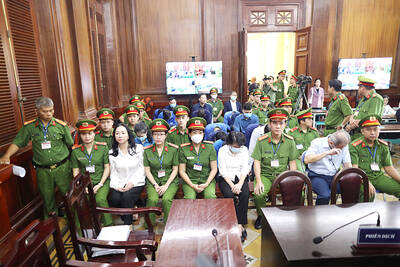
A top Vietnamese property tycoon was on Thursday sentenced to death in one of the biggest corruption cases in history, with an estimated US$27 billion in damages. A panel of three hand-picked jurors and two judges rejected all defense arguments by Truong My Lan, chair of major developer Van Thinh Phat, who was found guilty of swindling cash from Saigon Commercial Bank (SCB) over a decade. “The defendant’s actions ... eroded people’s trust in the leadership of the [Communist] Party and state,” read the verdict at the trial in Ho Chi Minh City. After the five-week trial, 85 others were also sentenced on

Conjoined twins Lori and George Schappell, who pursued separate careers, interests and relationships during lives that defied medical expectations, died this month in Pennsylvania, funeral home officials said. They were 62. The twins, listed by Guinness World Records as the oldest living conjoined twins, died on April 7 at the Hospital of the University of Pennsylvania, obituaries posted by Leibensperger Funeral Homes of Hamburg said. The cause of death was not detailed. “When we were born, the doctors didn’t think we’d make 30, but we proved them wrong,” Lori said in an interview when they turned 50, the Philadelphia Inquirer reported. The
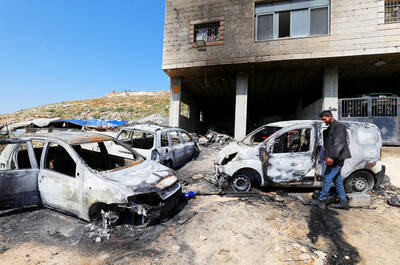
RAMPAGE: A Palestinian man was left dead after dozens of Israeli settlers searching for a missing 14-year-old boy stormed a village in the Israeli-occupied West Bank US President Joe Biden on Friday said he expected Iran to attack Israel “sooner, rather than later” and warned Tehran not to proceed. Asked by reporters about his message to Iran, Biden simply said: “Don’t,” underscoring Washington’s commitment to defend Israel. “We are devoted to the defense of Israel. We will support Israel. We will help defend Israel and Iran will not succeed,” he said. Biden said he would not divulge secure information, but said his expectation was that an attack could come “sooner, rather than later.” Israel braced on Friday for an attack by Iran or its proxies as warnings grew of


 RSS
RSS