


There is a strange new sightseeing attraction in this normally sleepy corner of the Chinese countryside: smashed police cars, rows of trashed buses and dented riot helmets.
They are the trophies of a battle in which peasants scored a rare and bloody victory against the communist authorities, who face one of the most serious popular challenges to their rule in recent years.
In driving off more than 1,000 riot police at the start of the week, Huankantou village in Zhejiang Province is at the crest of a wave of anarchy that has seen millions of impoverished farmers block roads and launch protests against official corruption, environmental destruction and the growing gap between urban wealth and rural poverty.
China's media have been forbidden to report on the government's loss of control, but word is spreading quickly to nearby towns and cities. Tens of thousands of sightseers and wellwishers are flocking every day to see the village that beat the police.
But the consequences for Huankantou are far from clear.
Having put more than 30 police in hospital, five critically injured, the 10,000 residents should be bracing for a backlash.
Instead, the mood is euphoric. There are roadblocks outside the chemical factory that was the origin of the dispute. Late at night the streets are full of gawping tourists, marshalled around the battleground by proud locals who bellow chaotic instructions through loudspeakers.
"Aren't these villagers brave? They are so tough it's unbelievable," said a taxi driver from Yiwu, the nearest city. "Everybody wants to come and see this place. We really admire them."
"We came to take a look because many people have heard of the riot," said a fashionably dressed woman who had come from Yiwu with friends.
Although the aftermath is evident in a school carpark full of smashed police buses, burned out cars and streets full of broken bricks and discarded sticks, the origin of the riot is hazy.
Initial reports suggested that it started after the death of two elderly women, who were run over when police attempted to clear their protest against a chemical factory in a nearby industrial park. Witnesses confirmed that the local old people's association had kept a 24-hour vigil for two weeks outside the plant.
Locals accused officials of seizing the land for the industrial park without their consent. Some blamed toxins from the chemical plant for ruined crops, malformed babies and contamination of a local river.
The village chief reportedly refused to hold a public meeting to hear grievances. Attempts to petition the central government also proved fruitless. Locals said they had lost faith in the authorities.
"The communists are even worse than the Japanese," said one man.
Memories are still fresh of the fighting on Sunday.
"It was about 4am and I was woken up by an unusual noise," said a Ms. Wang, a shopkeeper who lives next to the school where the fiercest fighting took place. "When I looked out of the window, I saw lots of riot police running into the village. Many men rushed out of their houses to defend our village."
Accounts of the conflict differ. Residents say 3,000 police stormed the village, several people -- including police -- were killed, dozens wounded and 30 police buses destroyed. But the Dongyang government says about 1,000 police and local officials were attacked by a mob, with 36 injured and no deaths.
The outcome is also unclear. Locals say the village chief has fled. In his place, they have established an organizing committee, though its members are a secret. This suggests a fear of recriminations, but the public mood is one of bravado.
"We don't feel regret about what we have done," said a middle-aged man. "The police have not come back since they withdrew on Monday. They dare not return."
Some, however, admitted to anxiety.
"I am scared," one old woman said, as she showed two dented riot police helmets, several empty gas canisters, a policeman's jacket and several truncheons and machetes.
But there have been no arrests and no communication from the authorities.
Amid a crowd of locals beside a wrecked bus, one woman won a cheer of approval by calling for the government to make the first move towards reconciliation.
"It's up to them to start talking," she said. "I don't know what we would do if the police came back again, but our demand is to make the factory move out of the village. We will not compromise on that."

Republican US lawmakers on Friday criticized US President Joe Biden’s administration after sanctioned Chinese telecoms equipment giant Huawei unveiled a laptop this week powered by an Intel artificial intelligence (AI) chip. The US placed Huawei on a trade restriction list in 2019 for contravening Iran sanctions, part of a broader effort to hobble Beijing’s technological advances. Placement on the list means the company’s suppliers have to seek a special, difficult-to-obtain license before shipping to it. One such license, issued by then-US president Donald Trump’s administration, has allowed Intel to ship central processors to Huawei for use in laptops since 2020. China hardliners

Conjoined twins Lori and George Schappell, who pursued separate careers, interests and relationships during lives that defied medical expectations, died this month in Pennsylvania, funeral home officials said. They were 62. The twins, listed by Guinness World Records as the oldest living conjoined twins, died on April 7 at the Hospital of the University of Pennsylvania, obituaries posted by Leibensperger Funeral Homes of Hamburg said. The cause of death was not detailed. “When we were born, the doctors didn’t think we’d make 30, but we proved them wrong,” Lori said in an interview when they turned 50, the Philadelphia Inquirer reported. The
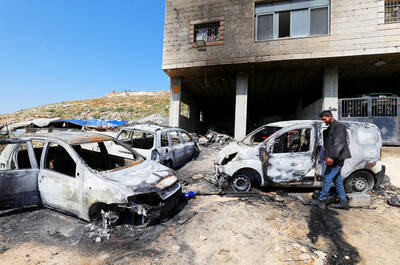
RAMPAGE: A Palestinian man was left dead after dozens of Israeli settlers searching for a missing 14-year-old boy stormed a village in the Israeli-occupied West Bank US President Joe Biden on Friday said he expected Iran to attack Israel “sooner, rather than later” and warned Tehran not to proceed. Asked by reporters about his message to Iran, Biden simply said: “Don’t,” underscoring Washington’s commitment to defend Israel. “We are devoted to the defense of Israel. We will support Israel. We will help defend Israel and Iran will not succeed,” he said. Biden said he would not divulge secure information, but said his expectation was that an attack could come “sooner, rather than later.” Israel braced on Friday for an attack by Iran or its proxies as warnings grew of

IN PURSUIT: Israel’s defense minister said the revenge attacks by Israeli settlers would make it difficult for security forces to find those responsible for the 14-year-old’s death Israeli Prime Minister Benjamin Netanyahu on Saturday condemned the “heinous murder” of an Israeli teenager in the occupied West Bank as attacks on Palestinian villages intensified following news of his death. After Benjamin Achimeir, 14, was reported missing near Ramallah on Friday, hundreds of Jewish settlers backed by Israeli forces raided nearby Palestinian villages, torching vehicles and homes, leaving at least one villager dead and dozens wounded. The attacks escalated in several villages on Saturday after Achimeir’s body was found near the Malachi Hashalom outpost. Agence France-Presse correspondents saw smoke rising from burned houses and fields. Mayor Amin Abu Alyah, of the


 RSS
RSS